Comparing and Ordering Numbers: Parent Guide
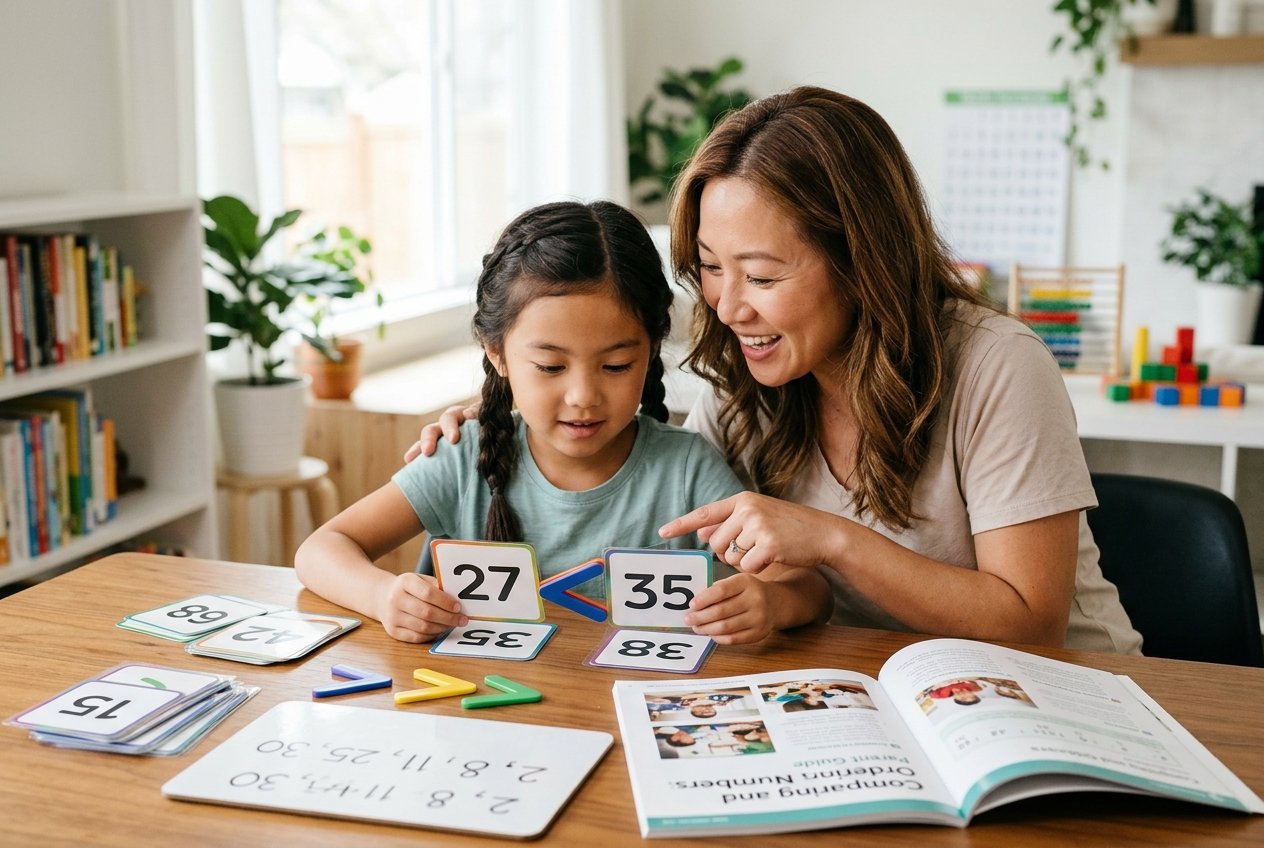
Comparing and ordering numbers is one of those quiet skills that makes almost every later math topic easier. When a child can look at 408, 480, and 84 and confidently explain which number is greatest and why, they are not just memorizing a rule. They are building number sense, place value, estimation, and mathematical language at the same time.
For parents, the good news is that this skill is easy to practice at home without turning the kitchen table into a worksheet battlefield. The best approach is short, visual, and conversational: ask which number is bigger, ask how your child knows, and connect the answer to place value or a number line. The Common Core Grade 2 number and operations standards describe this clearly: children compare three-digit numbers using the meaning of hundreds, tens, and ones.
If your child needs structured practice, a tool like MathSpark can generate grade-appropriate worksheets in seconds, so you can target exactly what is hard today: two-digit numbers, three-digit numbers, symbols, number lines, or mixed review. The aim is not more pressure. It is better practice with less drama.
📺 Video Guide
Why comparing and ordering numbers matters
Children often meet comparing numbers as a small lesson about greater than, less than, and equal signs. But the real skill is deeper. They are learning that numbers have size, that digits carry different values depending on position, and that quantities can be arranged logically from least to greatest or greatest to least. The National Council of Teachers of Mathematics places number magnitude and order inside the core Number and Operations strand for a reason.
When children compare 72 and 27, they must notice that the 7 in 72 means seven tens while the 7 in 27 means seven ones. That single insight prevents a huge number of later mistakes. It supports addition with regrouping, subtraction with borrowing, rounding, estimating, decimals, fractions, and even graph reading. In other words, comparing is not a one-week topic. It is a foundation.
Research summaries on early number sense, including work available through PubMed Central, consistently highlight magnitude, counting, and number relationships as important pieces of early mathematics learning. Parents do not need to read academic papers to act on this. They just need to give children repeated chances to say, see, and explain number relationships.
✓ Key Benefits
- ✓ Stronger place value before harder arithmetic
- ✓ Better estimation and mental math confidence
- ✓ Fewer mix-ups with greater than and less than symbols
- ✓ Easier transition to fractions, decimals, and measurement
The simple place value rule
The most reliable rule for comparing whole numbers is this: compare from left to right, starting with the largest place value. For 3-digit numbers, compare hundreds first. If the hundreds are different, you already know the answer. If the hundreds match, compare tens. If the tens also match, compare ones. This is exactly how standards-based resources such as Illustrative Mathematics frame three-digit comparison.
Try 462 and 426. Both have 4 hundreds, so the hundreds do not decide it. Now compare tens: 6 tens is greater than 2 tens, so 462 is greater than 426. You do not need to compare the ones. This is a powerful moment for children because it shows that math can be efficient and reasoned, not guessed.
With younger children, use base-ten blocks, bundled straws, Lego towers, or drawn boxes for hundreds, sticks for tens, and dots for ones. The What Works Clearinghouse elementary math intervention guide recommends concrete and semi-concrete representations because they make abstract ideas visible before children are expected to work only with symbols.
💡 Pro Tip
Ask, “Which place decided the answer?” That one question turns a quick comparison into real place value thinking.
Use number lines to make order visible
A number line helps children see that numbers have positions, not just names. Numbers farther to the right are greater; numbers farther to the left are smaller. This simple visual model becomes incredibly useful later for negative numbers, fractions, decimals, elapsed time, measurement, and coordinate graphs. The Learning and Teaching with Learning Trajectories project describes comparing and ordering as a developmental path that starts with small quantities and grows toward more complex number relationships.
At home, draw a line from 0 to 100. Mark 0, 50, and 100 first. Then ask your child where 37 belongs. Do not worry if the first placement is not perfect. The conversation matters: Is 37 closer to 0 or 50? Is 82 closer to 50 or 100? This builds estimation, benchmarks, and flexible thinking.
For a child who rushes, number lines slow the thinking down in a helpful way. For a child who freezes, number lines reduce the memory load. The Khan Academy Grade 2 math library uses visual and step-by-step practice for these same place value ideas, which makes it a useful free companion when a child needs another explanation.
How to teach the symbols without confusion
The symbols >, <, and = are useful, but they should not be the first thing a child learns. Start with words: greater than, less than, equal to, more, fewer, same. Then connect the words to the symbols. Many children reverse the signs because they focus on the shape instead of the relationship. That is normal and fixable.
Instead of only saying “the crocodile eats the bigger number,” also say the full math sentence out loud. For example, 48 > 31 is read as “48 is greater than 31.” The reading direction matters. If your child can say the sentence correctly, the symbol usually becomes easier to choose. Resources like Education.com Common Core lesson plans often pair symbols with oral explanations for this reason.
A quick home routine is to write two numbers on sticky notes and place the symbol between them. Then cover the symbol and ask your child to read the sentence with words only. Finally, uncover the symbol and check whether the sentence still makes sense. This keeps attention on meaning, not decoration.
📝 Important Note
If your child keeps reversing symbols, step back to verbal comparisons and number lines for a few days. More symbols are not always the fix; clearer meaning is.
Five home activities that work
First, play “number card lineup.” Write five numbers on cards and ask your child to arrange them from least to greatest. Use cards like 18, 81, 108, 180, and 801 if you want to expose place value traps. After the lineup, ask your child to explain the first decision they made.
Second, use grocery numbers. Compare prices, weights, or quantities: which cereal box has more grams, which price is lower, which receipt total is greater? Everyday numbers help children see that comparing and ordering numbers is not just a school exercise. Sites such as Britannica remind us that numbers are tools for describing quantity, order, and measurement in the real world.
Third, build a clothesline number line. Clip cards onto a string across the room. Start with endpoints, then add missing numbers. Ask: should 64 go closer to 50 or 100? This activity is physical, visual, and surprisingly effective for children who dislike sitting still.
Fourth, try “wrong answer detective.” Write a mistaken comparison such as 305 < 299 and ask your child to find the bug. Many children love correcting the adult, and the explanation reveals whether they understand hundreds, tens, and ones.
Fifth, use short generated practice. A targeted worksheet from MathSpark can give just ten comparisons at the right level, which is often better than a full page that exhausts everyone. Keep practice short: accuracy and explanation beat volume.
A 10-minute practice plan
Here is a simple routine you can repeat two or three times a week. Minute 1: warm up with two quick verbal questions, such as “Which is greater, 46 or 64?” Minutes 2–4: compare three pairs of numbers and ask which place value decided each answer. Minutes 5–7: order four numbers on a number line or card lineup. Minutes 8–9: solve one “wrong answer detective” problem. Minute 10: let your child create one comparison for you to solve.
The routine works because it mixes retrieval, reasoning, visual placement, and explanation. It also stays short enough to avoid the classic homework meltdown. The Institute of Education Sciences emphasizes explicit instruction, representations, and mathematical language in intervention guidance; this small routine includes all three in parent-friendly form.
If your child is in Grades 1–2, stay mostly with two- and three-digit whole numbers. In Grades 3–4, include thousands and rounding benchmarks. In Grades 5 and above, connect the same thinking to decimals and fractions. For example, compare 0.7 and 0.07 by saying seven tenths is greater than seven hundredths. The rule is still place value, just in a new neighborhood.
Common mistakes and how to fix them
One common mistake is comparing only the first digit without checking place value. A child may think 84 is greater than 108 because 8 is bigger than 1. Fix this with expanded form: 84 is 80 + 4, while 108 is 100 + 8. The hundreds place changes everything.
Another mistake is thinking that more digits always means a bigger number, which is true for whole numbers without leading zeroes but becomes tricky when decimals enter the picture. Keep the rule age-appropriate: for whole numbers, more digits usually means larger; for decimals, place value and number lines matter even more.
A third mistake is ordering correctly but not being able to explain why. Explanation matters. The OECD education resources frequently connect strong learning with reasoning and problem solving, not just answer-getting. At home, a simple “How did you know?” is enough to build that habit.
⚠️ Disclaimer
This June 2026 guide offers general educational support for parents. If your child shows persistent difficulty with number sense, speak with the classroom teacher or a qualified learning specialist.
How to know your child is ready to move on
Your child is ready for the next level when they can compare numbers accurately, read the comparison sentence aloud, explain the place value reason, and order a small set without guessing. Speed is not the main signal. Calm, accurate explanation is.
Once whole-number comparison feels steady, connect it to adjacent topics. Rounding becomes easier because children know which benchmark a number is closer to. Estimation becomes easier because they can judge size quickly. Fractions become less scary because they already understand that numbers can be placed and compared. You can also revisit related practice such as building number sense in young children, understanding fractions, rounding numbers, and math homework without stress.
The parent goal is not to turn every evening into math class. The goal is to make number relationships visible in small moments, then give your child enough structured practice to feel successful. Comparing and ordering numbers can become one of the first places a child says, “I get it.” That confidence is worth protecting.
Frequently Asked Questions
What age should children learn comparing and ordering numbers?
Children begin informally in preschool by comparing more, fewer, and same. Formal work with symbols and place value usually grows through Grades 1–3.
Should I teach the greater than symbol with the crocodile trick?
It can help as a memory cue, but do not rely on it alone. Children still need to read the full sentence and explain the number relationship.
What should I do if my child compares 84 and 108 incorrectly?
Use place value blocks or expanded form. Show that 108 has one hundred, while 84 has no hundreds.
Are number lines necessary?
They are strongly recommended because they make size and order visible. They also prepare children for fractions, decimals, and negative numbers later.
How much practice is enough?
Ten focused minutes, two or three times a week, is usually better than long sessions. Ask for explanations, not just answers.