Easter Math Activities for Kids
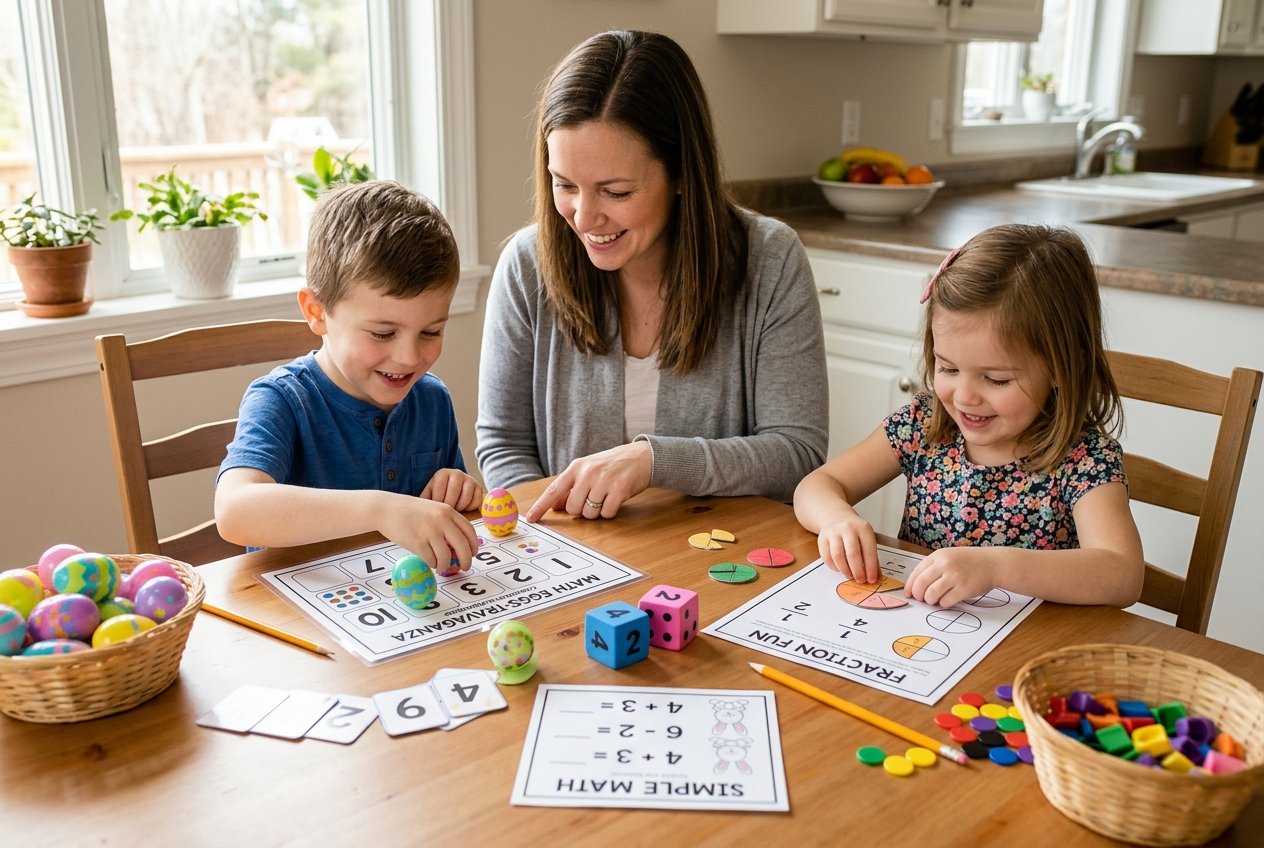
Easter math activities can turn a basket of plastic eggs into relaxed, useful practice without turning the holiday into homework. If your child shuts down when a worksheet appears, this seasonal approach gives you a gentler door into counting, fractions, problem solving and confidence. The goal is not to make every minute educational. The goal is to use the excitement already in the room and add just enough structure that your child says, “one more round.” Research-informed family resources from Stanford DREME and early childhood guidance from NAEYC both point in the same direction: children learn more when math is concrete, playful and discussed out loud with a trusted adult.
This guide gives you ten parent-friendly Easter math activities for ages 5 to 14. Younger children can count, compare, sort and spot patterns. Older children can model fractions, estimate capacity, solve word problems and create scoring systems. You can also pair these games with quick printable practice from MathSpark, which generates AI-powered math worksheets for grades 1 to 9 in about 10 seconds and is useful when you want a focused follow-up after the hands-on game. Keep the tone light, praise strategies, and let the season do the heavy lifting.
📺 Video Guide
Why Easter math activities work
The power of Easter math activities is that they use objects children already want to touch. Plastic eggs can hide number cards, fraction slips, multiplication facts, coins, shapes, riddles or short word problems. A basket becomes a data table. A hunt becomes a search-and-solve challenge. This matters because young learners often need to move from real objects to drawings and only then to symbols. The National Council of Teachers of Mathematics has long emphasized reasoning, representations, communication and problem solving, not just memorizing procedures.
Family involvement also matters. The Erikson Early Math Collaborative focuses on making early math visible in everyday routines, while Waterford highlights counting, sorting, comparing, patterning and measuring as accessible preschool and kindergarten skills. Easter simply gives those ideas a theme. Instead of saying “practice addition,” you can say “open two eggs and find the total.” Instead of saying “do fractions,” you can say “which egg shows one half?” That small shift lowers resistance.
For MathSpark families, this also fits the Pythagoras Exams mindset: build fluency, but keep reasoning central. A child should not only give an answer. He should explain how he knows, show it with objects, and try another strategy. That is the difference between a cute holiday worksheet and a real learning moment.
✓ Quick benefits for parents
- ✓ Uses low-cost materials you probably already have
- ✓ Builds counting, number sense, operations, fractions, data and measurement
- ✓ Keeps practice short enough to avoid holiday meltdowns
- ✓ Works for siblings at different levels by changing the numbers
- ✓ Creates natural “how do you know?” conversations
Ten Easter math activities to try at home
1. Egg count and compare. Fill pairs of eggs with small objects such as buttons, beads or dry pasta. Your child opens two eggs, counts each set and says which has more, fewer or the same. Ask “how many more?” to move from counting to subtraction. For a first grader, use totals under 10. For an older child, use larger numbers or ask for a number sentence.
2. Dice addition baskets. Roll two dice, collect that many eggs, then write the addition sentence. Switch the dice order and notice that 3 + 5 and 5 + 3 make the same total. Classroom activity collections like Teach Starter use similar seasonal manipulatives because they make operations visible instead of abstract.
3. Egg fraction match. Put fraction slips inside eggs: 1/2, 2/4, 3/6, 1/3, 2/3 and 3/4. Children hunt, open and match equivalent fractions. Then they draw bars or circles to prove the matches. If your child is ready, ask which fraction is greater and why.
4. Jellybean graphing. Sort jellybeans or colored egg counters by color. Make a tally chart, then a bar graph. Ask which color appears most, least and how many more one color has than another. This supports data language without needing a formal worksheet.
5. Basket capacity challenge. Estimate how many small eggs will fit in a basket, then test. Repeat with larger eggs or different containers. Third Space Learning’s collection of Easter math activities uses similar measurement ideas because estimation creates a reason to calculate, compare and revise.
6. Number sentence egg hunt. Hide eggs that contain short problems: 8 + 7, 16 – 9, 4 × 6, 36 ÷ 6. Children solve each one and record the answer. For mixed ages, color-code the eggs by difficulty. Younger children get addition and subtraction; older children get multiplication, division and two-step problems.
7. Pattern eggs. Use stickers or markers to make repeating patterns on paper eggs: ABAB, AAB, ABC or growing patterns. Ask your child what comes next and what the rule is. Pre-K resources such as Pre-K Pages often use Easter themes for counting and patterns because they feel like play, not drills.
8. Money eggs. Place coins in eggs. Children count the value, compare two eggs, or “shop” for Easter treats with a pretend budget. This is excellent for grades 2 to 4 because it combines skip counting, addition and real-world reasoning.
9. Coordinates and egg maps. Draw a simple grid map of your living room or garden. Mark egg locations with coordinates. Children read the coordinates to find eggs, then create their own map for a sibling. This quietly builds spatial reasoning, ordered pairs and precision.
10. Create your own Easter board game. Ask your child to design a short path from bunny to basket. Every square needs a math action: add 3, lose 2, double your roll, solve a fraction card, or skip if you land on an even number. Designing rules is powerful because children must think about fairness, probability and operations.
💡 Pro Tip
Keep each game to 10 or 15 minutes. Stop while your child still wants more. A short successful round beats a long “educational” session that ends in eye rolls.
How to adapt by grade level
For ages 5 to 7, focus on counting, one-to-one correspondence, comparing quantities, number recognition and simple addition. Ask children to touch each object as they count and to tell you the last number again as “how many altogether.” This builds cardinality, one of the most important early number ideas. Pathways’ parent guidance on early math skills is a useful reminder that number language can start very naturally in play.
For ages 8 to 10, add fluency and reasoning. Use the same eggs, but put multiplication facts, division facts, fractions, money amounts and measurement tasks inside. Ask your child to explain two different ways to solve one problem. If they use fingers, counters or drawings, do not rush them away from those supports. Representations are bridges, not crutches.
For ages 11 to 14, make the activity less “cute” and more strategic. Have them build probability games, score egg hunts, estimate totals from samples, compare fractions and percentages, or write multi-step word problems for younger siblings. If your child is preparing for competitions or school tests, generate a targeted worksheet in MathSpark after the game: “10 Easter-themed fraction problems for Grade 5” or “15 percentage problems using egg hunt data.” That keeps practice aligned with school goals while preserving the playful hook.
Internal practice also helps. If your child enjoyed the geometry angle, revisit teaching symmetry. If the game involved precedence or scoring rules, connect it to order of operations. Younger learners who struggled with totals may benefit from building number sense, while families who like portable games can try math games for car rides next.
📝 Important Note
Do not turn every mistake into a mini-lesson. Pick one teaching point per activity. If your child miscounts, ask them to check with a different strategy. If they still miss it, model calmly and move on. Confidence is part of the skill.
A simple 30-minute Easter math plan
If you want structure, use this 30-minute plan. Start with five minutes of free exploration: let your child open eggs, sort colors and inspect the materials. Then spend ten minutes on a counting or operations game. After that, use ten minutes for one reasoning task, such as fractions, graphing or estimation. Finish with five minutes of reflection: “What was easy, what was tricky, and what strategy helped?”
This rhythm works because it respects attention span. It also gives you a clean way to differentiate. A younger child can count yellow eggs while an older sibling calculates the percentage of yellow eggs in the set. One child can build a bar graph while another writes a multiplication story from the same data. Nobody needs a separate activity, which is the real parent win.
For printable follow-up, resources like Super Teacher Worksheets and Khan Academy math can provide extra practice, but use them after the playful activity, not before. The hands-on game creates meaning. The worksheet consolidates it. When you reverse the order, many children experience the worksheet as the main event and the game as a reward. That can work, but it often increases resistance.
How to keep the experience stress-free
The best parent move is to sound curious instead of corrective. Try “show me how you got that” rather than “that is wrong.” Try “can we check it another way?” rather than “count again.” Children who already feel anxious about math listen for danger in our tone. A seasonal game gives you a chance to rebuild the emotional pattern around practice.
Use visible materials whenever possible. If your child is solving 7 + 5, let them move seven eggs and five eggs together before writing 12. If they are comparing 2/4 and 1/2, let them fold paper strips. If they are estimating capacity, let them revise their estimate after seeing the first attempt. Good math thinking often looks messy before it becomes efficient.
Finally, celebrate strategy, not speed. “You grouped them by twos,” “you checked with a drawing,” and “you changed your estimate after new information” are better comments than “you are so smart.” Strategy praise teaches children what to repeat. Speed praise can accidentally teach them that slow thinking is bad, which is nonsense. Some of the strongest math thinking is slow, careful and beautifully stubborn.
⚠️ Disclaimer
This article was prepared in June 2026 for parent education. Activity difficulty varies by child, grade level and prior confidence. Use these ideas as flexible practice suggestions, not as a substitute for teacher guidance or individualized learning support.
Frequently Asked Questions
What age are Easter math activities best for?
They work best for ages 5 to 14 because the same materials can be adapted. Younger children count and sort. Older children solve fractions, data, probability and multi-step problems.
Do I need special materials?
No. Plastic eggs, paper, dice, counters, coins and a basket are enough. If you do not have plastic eggs, folded paper cards work fine.
How long should each activity last?
Aim for 10 to 15 minutes. Stop before frustration builds. Consistency and positive emotion matter more than long sessions.
Can these activities replace worksheets?
They should not replace all written practice. They make concepts meaningful, then a short worksheet can help consolidate fluency.
How can I make activities harder for older children?
Add larger numbers, fractions, percentages, probability, coordinates, budget constraints or a requirement to explain the strategy in writing.