Teaching Symmetry to Young Children
Teaching symmetry to young children works best when it feels like a game, not a geometry lecture. A child who folds a paper heart, checks a butterfly wing, or builds a balanced LEGO tower is already doing important spatial reasoning. The goal is not to rush vocabulary. The goal is to help children notice matching parts, explain what they see, and build the confidence to test an idea. Parents can use everyday objects, quick drawings, mirrors, and simple worksheets to make symmetry visible in five minutes at the kitchen table. For extra practice, tools like MathSpark can generate grade-aware worksheet variations in seconds, so practice stays fresh instead of turning into the same tired page again and again.
📺 Video Guide
Teaching symmetry starts with noticing
Children understand symmetry long before they can define it. They notice that faces have two eyes, butterflies have two wings, and some block towers look balanced. That noticing stage matters because geometry begins with visual attention. The NCTM family math guidance emphasizes reasoning, communication, and representation, which means a child should be invited to say what matches, what changes, and what feels uneven. When parents slow down and ask “What do you notice?” the child starts building mathematical language from observation rather than memorization.
A strong first activity is a symmetry hunt. Walk around the house and look for objects that might have a matching half: a spoon, a window, a book cover, a plate, a toy car, or a leaf. Then compare them with objects that do not match perfectly. This contrast helps children avoid the common misconception that anything “pretty” or “balanced” is automatically symmetrical. Resources such as NRICH symmetry activities use open-ended puzzles for exactly this reason: they make children explain, not just label.
Keep the tone light. If a child says a chair is symmetrical, do not correct too fast. Ask where the folding line would go. Ask whether both sides would land on top of each other. The fold test gives the child a way to check independently. That is much more powerful than a parent saying yes or no.
✓ Quick symmetry wins
- ✓ Fold paper shapes and open them to reveal matching halves
- ✓ Use a mirror on drawings to test whether the missing half makes sense
- ✓ Ask children to find one symmetrical and one asymmetrical object in the room
- ✓ Build with blocks on both sides of a pretend center line
Use hands-on activities before worksheets
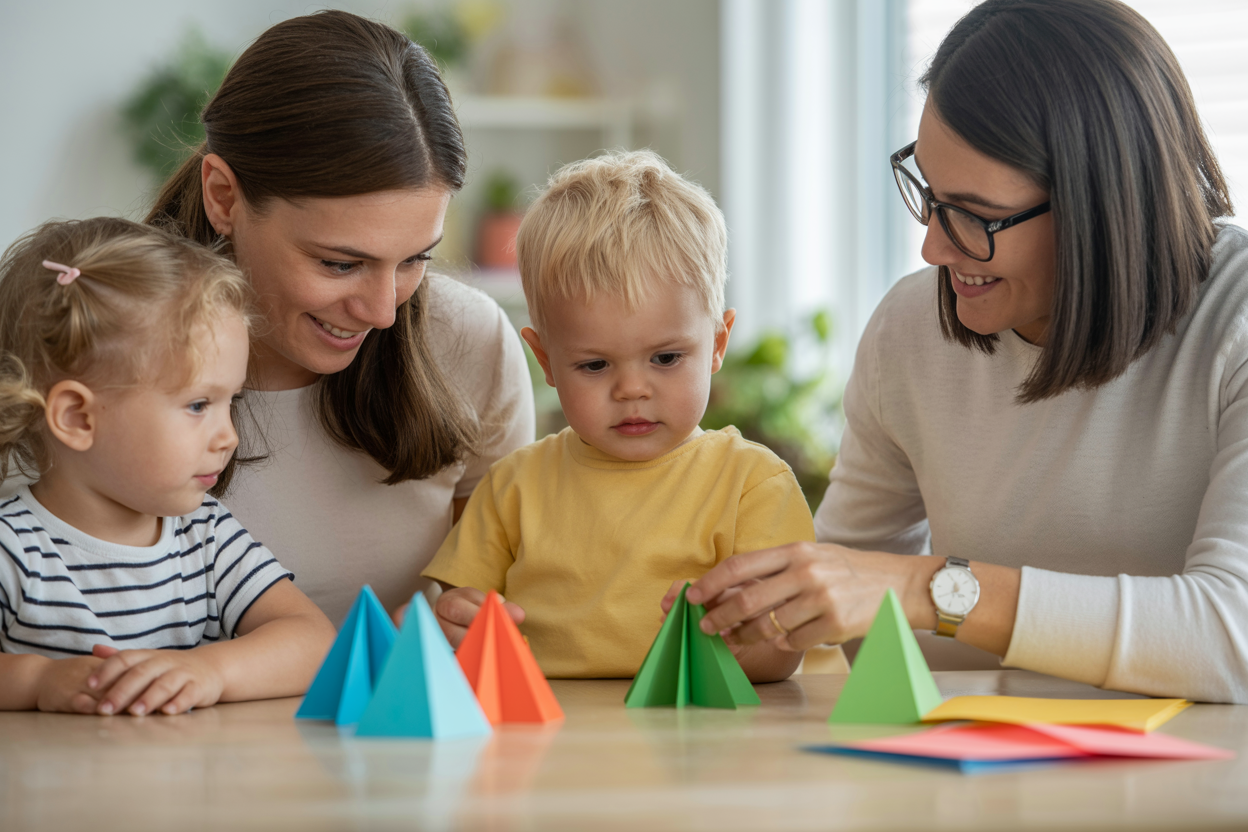
Worksheets are useful, but symmetry is a physical idea first. A child should fold, turn, reflect, draw, and build before being asked to complete a page silently. Try folding a sheet of paper, cutting a simple shape from the fold, and opening it. The reveal creates a small moment of surprise, and that surprise helps the concept stick. Then draw half of a robot, flower, or monster and ask your child to finish the other half. The activity naturally introduces the line of symmetry without needing a formal lecture.
Technology can support this stage when used carefully. Mathigon Polypad lets children move shapes and test transformations on a digital canvas. Desmos classroom tools can also make visual patterns dynamic, especially for older children who are ready to see coordinates or graphs. But for young children, the screen should not replace touch. Use it after paper folding, not before.
Parents often ask when to move from hands-on play to printed practice. My rule: use worksheets after the child has had at least two concrete experiences. That sequence turns the worksheet into a record of something the child already understands. It also makes math worksheets for kids feel calmer because the page is not introducing everything at once.
💡 Make it visible
Draw a bold vertical line down the page and call it the “mirror line.” Children make fewer errors when the center line is obvious.
Teach the language gently
The core words are symmetrical, asymmetrical, and line of symmetry. Introduce one word at a time. Say, “This shape is symmetrical because both sides match.” Then show an object that almost matches but not quite. Children love catching the difference, and that playful correction builds precision. The Khan Academy geometry practice geometry sequence is helpful for parents who want a clean progression from simple shapes to more formal geometric vocabulary.
Be careful with the word “same.” In symmetry, the two sides match like a mirror, but they are not always identical in orientation. If a child draws two shoes facing the same direction, explain that a mirror half flips. This is where a small hand mirror is magic. Place it on the line and let the child see the missing half appear. The mirror gives instant feedback without pressure.
For children who enjoy challenges, ask how many lines of symmetry a shape has. A square has more than one. A rectangle has two. A heart usually has one. Many letters have none, some have one, and a few have more depending on the font. This keeps the lesson from becoming a simple yes-or-no exercise.
Connect symmetry to art, nature, and confidence
Symmetry becomes meaningful when children see it outside math time. Butterflies, leaves, snowflakes, faces, buildings, tiles, flags, and logos all create opportunities for a quick question. “Where would the mirror line go?” is enough. The OECD learning framework reminds educators to connect learning with real-world problem solving, and symmetry is one of the easiest topics for doing that at home.
Art is especially powerful. Ask your child to paint on one side of folded paper, press the page together, and open it. The result is messy, beautiful, and mathematically useful. Children can compare the print with a hand-drawn symmetrical image and notice that the folded print matches more exactly. This turns accuracy into something they can see, not something they are scolded about.
If your child struggles with math confidence, symmetry is a lovely reset topic. It is visual, forgiving, and creative. A child who freezes during arithmetic may happily complete a monster face or design a tile pattern. That success matters. It supports the same confidence-building habits described in building math confidence and helps children feel that mathematics includes more than speed and memorized facts.
📝 Important Note
If your child is in Grades 1 to 3, keep formal terms light and focus on sorting, drawing, folding, and explaining. Older children can extend the same idea into reflection, coordinates, and transformation geometry with support from Illustrative Mathematics tasks.
A simple seven-day symmetry plan
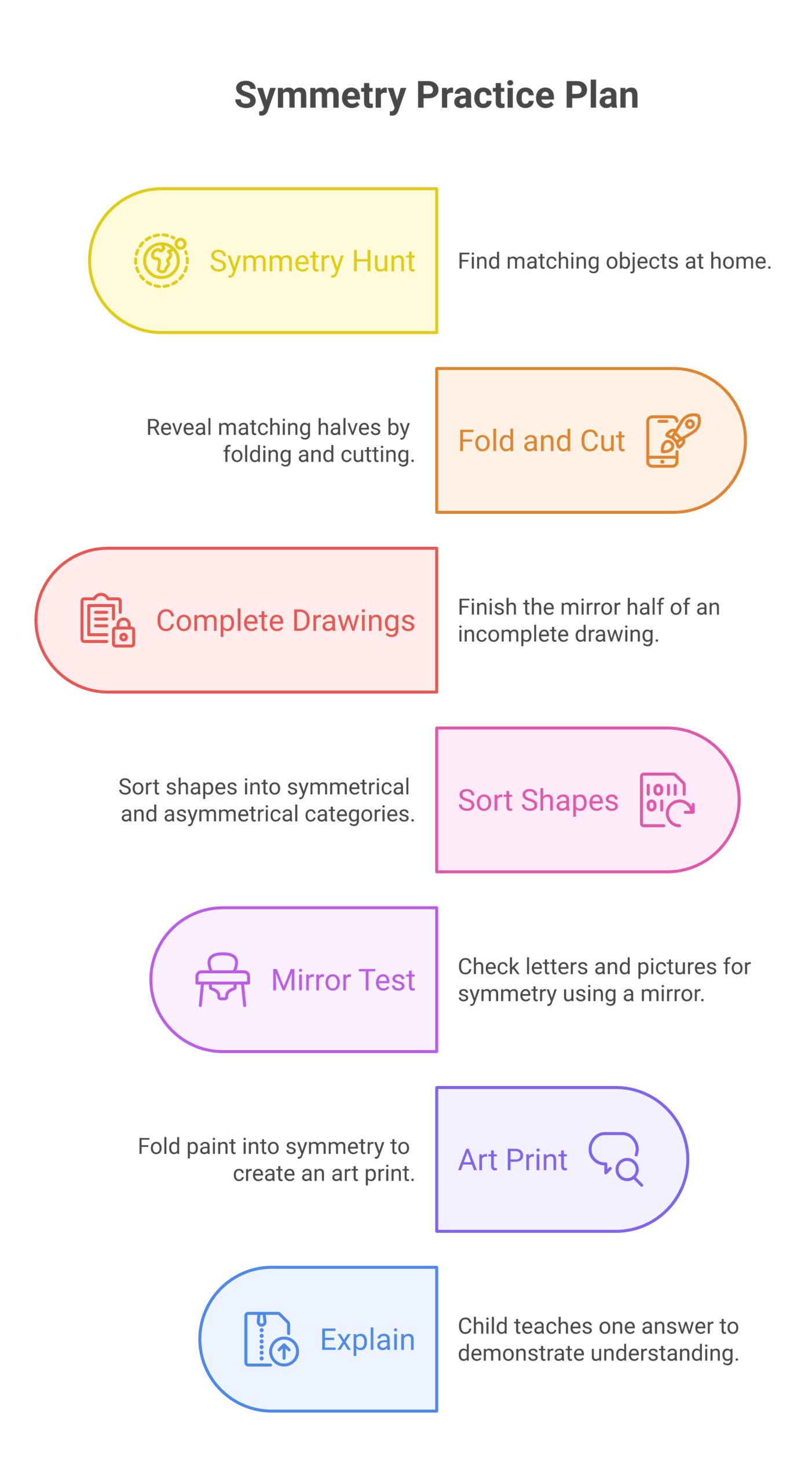
Day one: go on a symmetry hunt around the house. Day two: fold and cut paper shapes. Day three: complete half-drawings. Day four: sort shapes into symmetrical and asymmetrical piles. Day five: use a mirror to test letters and pictures. Day six: create a symmetrical art print. Day seven: do a short worksheet and ask your child to explain one answer. This rhythm gives enough repetition without making the topic feel heavy.
The plan also follows what learning evidence often shows: children benefit from small, spaced practice sessions. The Education Endowment Foundation evidence summarizes the importance of targeted practice and feedback, while National Numeracy parent resources offers parent-friendly numeracy ideas that fit naturally into family routines. You do not need a full lesson plan every day. You need one clear activity, one good question, and a calm stopping point.
When you want printable follow-up, generate a few variations: one page for drawing missing halves, one for identifying lines of symmetry, and one for explaining why a shape is not symmetrical. This variety prevents pattern guessing. It also supports children who need repeated exposure before the idea becomes automatic.
How to correct mistakes without creating stress
The most common mistake is drawing the other half as a copy instead of a reflection. Another is assuming a shape is symmetrical because it looks balanced. A third is ignoring small details, such as the direction of an eye, antenna, or pattern. Correct these gently with tests. Fold the page. Use a mirror. Cover one side. Rotate the page. The goal is to help the child become the checker.
Avoid saying “wrong” too quickly. Say, “Let’s test it.” This tiny phrase changes the emotional temperature. It tells the child that math is something we investigate. It also builds the habit of proof, which matters later in geometry, algebra, data, and problem solving. Even advanced resources like Cambridge Mathematics resources and Scratch creative learning ideas are built around exploration because children learn more when they can test ideas and revise them.
Finally, end with a win. Ask your child to choose the best drawing, explain one matching pair, or teach the idea to a younger sibling. Teaching back is a powerful confidence move. It turns a quiet worksheet skill into spoken mathematical reasoning.
When symmetry is ready for the next step
Once a child can identify and draw simple mirror symmetry, connect it to patterns, grids, and coordinates. Draw half a shape on grid paper and ask your child to count squares across the line. This prepares them for later coordinate graphing and transformations. Keep the task small: one triangle, one house, one robot, one letter. Complexity can grow later.
You can also connect symmetry with coding. A simple set of instructions like “move three squares, turn, move two squares, reflect” helps children see that geometry and algorithms share a structure. This is not about pushing young children into advanced programming. It is about showing that precise instructions create predictable results, a theme that appears in both math and computing.
For broader media and learning choices, Common Sense Media learning advice is useful when parents want to choose age-appropriate digital activities. The best resource is the one your child can use calmly, explain afterward, and leave without a fight.
⚠️ Disclaimer
This guide is educational and current for June 2026. Use it alongside your child’s teacher, curriculum expectations, and your own judgment about readiness.
Frequently Asked Questions
What age is best for teaching symmetry?
Most children can explore symmetry informally from ages four to six, using folding, mirrors, bodies, blocks, and drawing before formal vocabulary.
Should children memorize the definition first?
No. Start with matching halves, folding, and visual checking. Add the words symmetrical, asymmetrical, and line of symmetry after the idea feels familiar.
How long should practice take?
Ten to fifteen focused minutes is enough. Short, successful practice beats a long session that ends in frustration.
Can worksheets help?
Yes, especially when they ask children to draw, complete, sort, and explain instead of only circling answers.
What if my child keeps reversing the sides?
Use a mirror or fold the paper. Physical feedback makes the mistake visible without turning it into a lecture.