Math and Sports: Real Connections Kids Can See
Your kid probably groans at the sight of a worksheet but can rattle off every player’s batting average or know exactly how many goals their favorite striker scored last season. Sound familiar? Here’s the thing: those numbers are math. And once kids realize they’ve been doing math all along while watching, playing, and arguing about sports, something clicks.
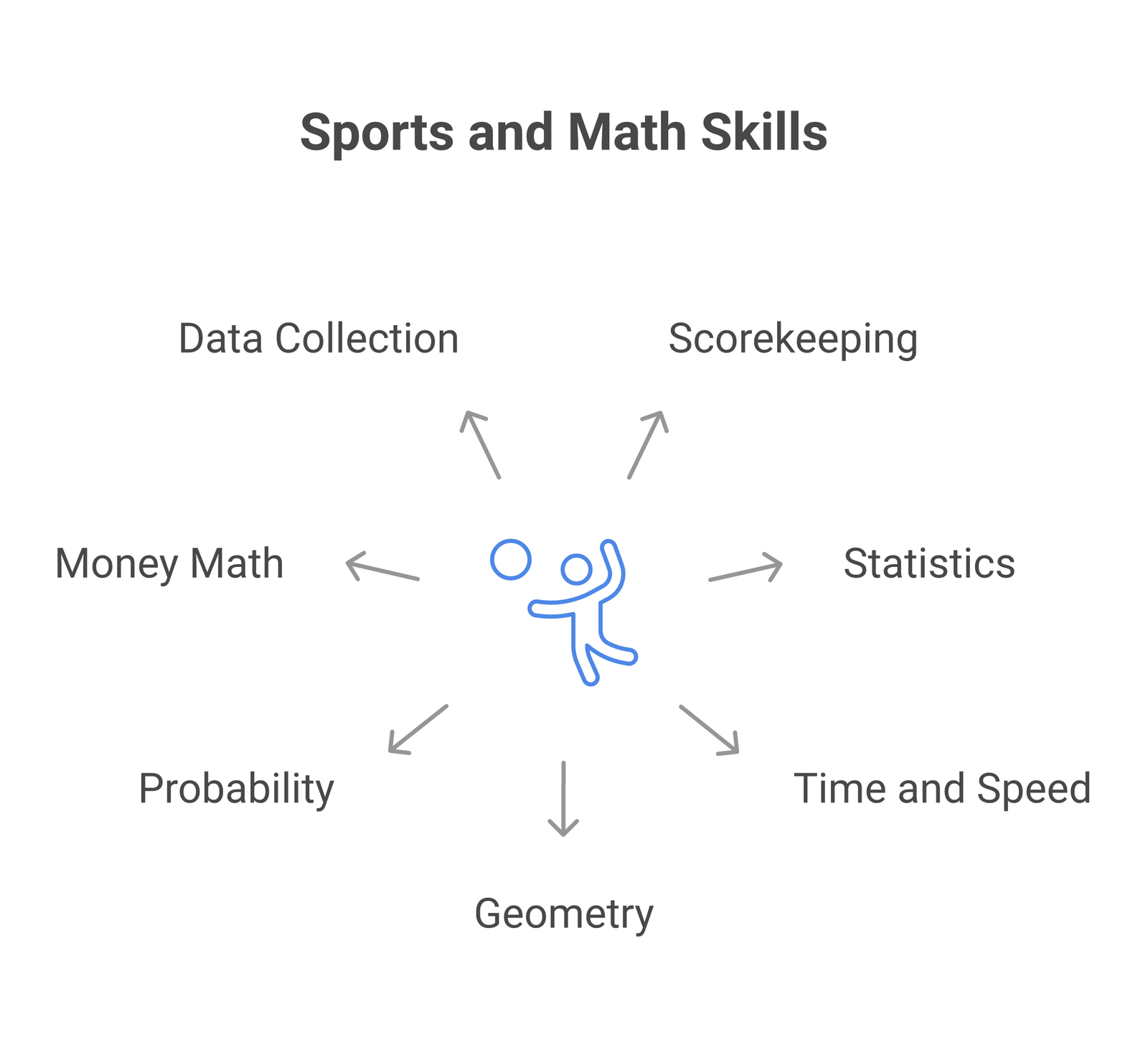
In this guide, we’ll explore over a dozen ways that math and sports intersect in daily life. Whether your child plays soccer in the backyard or just watches basketball on TV, there are real, tangible math connections hiding in plain sight. Let’s pull them out.
📺 Video Guide
Why Sports Are a Secret Math Classroom
Kids learn best when they don’t realize they’re learning. Research from the National Council of Teachers of Mathematics (NCTM) consistently shows that connecting math to real-world contexts improves both comprehension and retention. Sports deliver this connection naturally because kids already care about the outcomes.
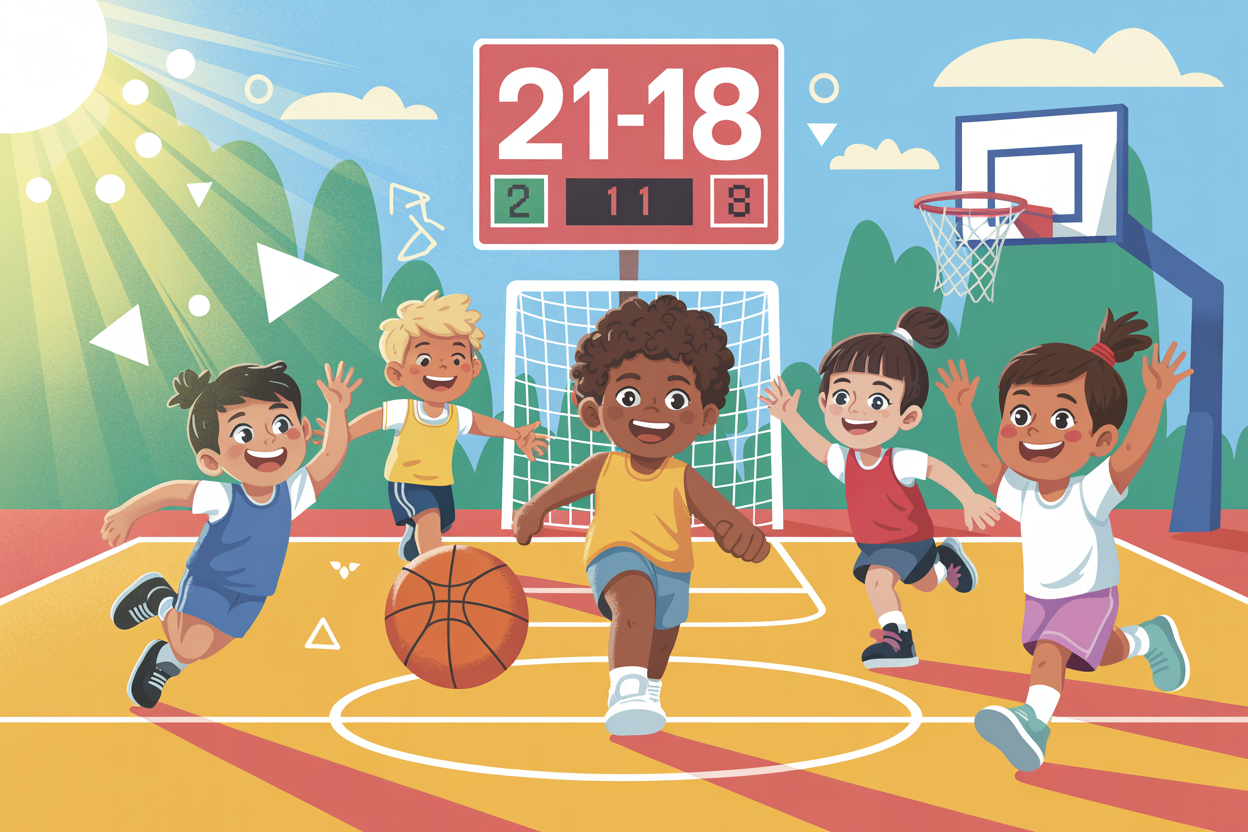
Think about what happens during a basketball game. A child tracks the score (addition), calculates how many points their team needs to catch up (subtraction), watches the game clock count down (elapsed time), and later might check shooting percentages online (fractions and percentages). That’s four math domains covered before halftime.
According to a study published on PubMed, physical activity paired with cognitive tasks can actually improve mathematical performance in school-age children. So the connection isn’t just conceptual. It’s neurological.
Scorekeeping and Basic Operations
The simplest and most obvious math-sports connection: keeping score. Every time your child adds runs in cricket, goals in soccer, or points in tennis, they’re practicing mental addition. But you can push this further.
Ask your child to keep a running total during a game. “If the score is 47-39, how many more points does the red team need to tie?” That question covers subtraction, comparison, and number sense in one shot. The Khan Academy arithmetic section breaks down these foundational skills, but honestly, a live game teaches them faster than any module.
For younger kids (ages 5-7), just counting goals or baskets is enough. For 8-10 year olds, introduce running totals. And for older kids, get them tracking point differentials across multiple games. It scales naturally.
💡 Try This at Home
Next time you watch a game together, hand your child a notebook and say “You’re the official scorekeeper.” They’ll practice addition, subtraction, and recording data without any fuss. You can even have them calculate the final point difference at the end.
Statistics and Averages in Everyday Sports
Sports and statistics are practically inseparable. Batting averages. Free throw percentages. Goals per game. Yards per carry. Kids who follow sports are already swimming in data, even if they’ve never heard the word “statistics” in a classroom.
Here’s a conversation starter: “Messi scored 12 goals in 20 games this season. What’s his goals-per-game average?” Suddenly your child is dividing 12 by 20, and it matters to them because it’s about someone they admire. The Bureau of Labor Statistics K-12 page has tools for helping kids understand data, but sports stats are honestly the best entry point for most children.
You can take this further by comparing players. “Player A averages 22 points per game, Player B averages 19. How many more points does Player A score in a 10-game stretch?” That’s multiplication and comparison stacked together. Sites like ESPN are loaded with these stats, and browsing them together can turn into a surprisingly productive math session.
Time, Speed, and Distance
Track and field is basically a math word problem come to life. If a runner finishes the 100 meters in 10.5 seconds, what’s their speed? If a swimmer does 50 meters in 28 seconds, how long would it take them to swim 200 meters at the same pace? These calculations use division, multiplication, and proportional reasoning.
During the Olympics, these questions write themselves. Kids naturally want to compare athletes’ times, and doing so requires actual computation. You can also bring this home during weekend runs or bike rides. “We biked 6 kilometers in 30 minutes. How far would we go in an hour?”
For older kids (10+), introduce the speed formula: distance divided by time equals speed. Use real race results from events like the World Athletics database. It stops being abstract when you’re calculating Usain Bolt’s actual speed in kilometers per hour.
Geometry on the Field and Court
Every sport plays out on geometric shapes. A soccer field is a rectangle. A basketball court has circles, arcs, and rectangular zones. A baseball diamond is… well, a diamond (or a square rotated 45 degrees, if you want to get technical about it).
Ask your child to calculate the perimeter or area of a tennis court. According to the International Tennis Federation, a singles court measures 23.77 meters by 8.23 meters. That’s a real-world area and perimeter problem with numbers that aren’t conveniently round, which is what actual math looks like.
Angles show up too. The trajectory of a basketball shot, the angle of a soccer kick, the bounce angle of a billiard ball. These connect to geometry concepts kids encounter in school, and seeing them in action helps lock in the understanding. The Math is Fun geometry section has clear visuals that pair well with these sports examples.
✓ Sports Geometry Quick Wins
- ✓ Measure your backyard “field” and calculate its area
- ✓ Draw a basketball court to scale on graph paper
- ✓ Count all the shapes you can find on a soccer field (rectangles, circles, arcs)
- ✓ Measure the angle of a ramp for skateboarding or biking
Probability and Predictions
Every time a kid says “I bet they’re going to win,” they’re making a probability judgment, even if they can’t articulate it. Formalizing this a little goes a long way toward building real math intuition.
Start simple. “A basketball player makes 7 out of 10 free throws. What’s the probability they’ll make the next one?” That’s fractions and percentages in context. From there, you can discuss streaks, hot hands, and sample size, all concepts that connect to probability and statistics curricula.
The U.S. Census Bureau’s educational resources offers data activities for students, and pairing those with sports prediction exercises makes for a powerful combination. Have your kids predict game outcomes before a tournament, track their accuracy, and discuss why some predictions worked and others didn’t. That’s applied statistics.
Money Math Through Sports
Professional sports involve big money, and big money means big math. Player salaries, ticket prices, merchandise costs, team budgets. These are perfect for multiplication, percentages, and even budgeting exercises.
“If a season ticket costs €450 and there are 19 home games, how much does each game cost?” Or: “This player earns $35 million per year and plays about 82 games. How much do they earn per game?” Kids love these calculations because the numbers feel impossibly large, which makes the math feel exciting instead of tedious.
You can also turn a fantasy sports draft into a budgeting exercise. Give your child a fictional budget and a list of players with salaries. They have to build the best team within the budget. That’s addition, subtraction, comparison, and strategic thinking all at once. Resources from Consumer Financial Protection Bureau complement these activities nicely.
Measurement and Data Collection
Sports are loaded with opportunities to measure things. How far can your child throw a ball? How high can they jump? How fast can they run to the end of the block and back? Each of these activities involves measurement, units, and recording data.
Set up a mini “sports day” in the backyard. Time sprints with a stopwatch. Measure long jumps with a tape measure. Count push-ups in 60 seconds. Then put all the data into a simple table or chart. You’ve just covered measurement, data collection, and graphing in one afternoon.
If you want to take it further, tools like MathSpark can generate custom math worksheets tied to measurement and data skills for your child’s specific grade level. It’s free to use and builds worksheets in about 10 seconds, which is handy when you want to reinforce what they practiced outside with some focused follow-up at the table.
Patterns and Strategy
Coaches study game film to find patterns. Batters look for patterns in a pitcher’s throws. Tennis players track where their opponent serves most often. Recognizing and predicting patterns is a core math skill, and sports train it without kids even noticing.
Encourage your child to look for patterns during games. “That team always passes to the left when they’re near the goal.” “This batter strikes out when the pitch is low and outside.” These observations build analytical thinking, which is the same skill set behind algebraic reasoning and data analysis.
The National Center for Education Statistics Kids’ Zone has interactive tools for data exploration, but observing patterns in sports gives kids the raw material to work with before they get formal about it.
Fractions and Percentages on the Field
Sports broadcasting is full of fractions and percentages, and kids absorb them without any formal instruction. “She’s shooting 45% from the field.” “He wins 3 out of every 4 serves.” “The team has won two-thirds of their games this season.”
Use these moments to ask questions. “If they’ve played 18 games and won two-thirds, how many wins is that?” That requires multiplying fractions by whole numbers. “If a player’s free throw percentage drops from 80% to 72%, how many fewer free throws do they make out of 50 attempts?” Now you’re into percentages and comparison.
The U.S. Department of Education parent resources emphasize that conversations about math in everyday contexts significantly boost children’s confidence. Sports provide those conversations on a silver platter.
📝 Keep It Light
The whole point of connecting math to sports is to make it feel less like work. If your child starts groaning when you ask math questions during a game, back off. Let some games just be games. The goal is to sprinkle in math naturally, not turn every match into a pop quiz.
How to Get Started (Without Overthinking It)
You don’t need a lesson plan. Pick one or two ideas from this article and try them this week. Watch a game together and ask one math question. Go outside and time a sprint. Look up your child’s favorite player’s stats and do a quick calculation together.
The National Association for the Education of Young Children recommends integrating math into activities children already enjoy, and sports are usually right at the top of that list. Start where your child’s enthusiasm already lives.
And when you’re ready to reinforce those skills with some structured practice, MathSpark can generate grade-appropriate worksheets that build on exactly the skills your child practiced during the game. It follows the Hellenic Mathematical Society Pythagoras methodology, covering the Greek curriculum while staying accessible for English-speaking families too.
⚠️ Disclaimer
This article is for informational purposes and reflects general educational guidance available as of March 2026. Every child learns differently, and what works for one family might not work for another. Consult your child’s teacher for personalized recommendations that align with their specific curriculum and learning needs.
Frequently Asked Questions
What age should I start connecting math and sports?
You can start as early as 4 or 5. At that age, just counting goals or points is plenty. As kids get older, you can layer in more complex concepts like averages, percentages, and speed calculations.
My child doesn’t play sports. Can this still work?
Absolutely. Watching sports on TV or online works just as well. You can also use sports stats from websites and apps. The math is in the numbers, not in the physical activity itself.
Which sports are best for math learning?
Any sport works, but basketball, baseball, soccer, and track and field are especially rich in math opportunities. Basketball and baseball have particularly detailed statistics that kids can explore.
How do I make sure this doesn’t ruin their enjoyment of sports?
Keep it casual. Ask one or two questions per game, not ten. Follow your child’s lead. If they’re into the action and don’t want to do calculations, just enjoy the game together. The math conversations will happen naturally over time.
Can I use sports math to help with homework?
Yes. If your child is working on fractions, pull up a player’s shooting percentage. If they’re learning about area, calculate the dimensions of a playing field together. Connecting homework to something they care about makes it stick.