Outdoor Math Activities: Learn from Nature
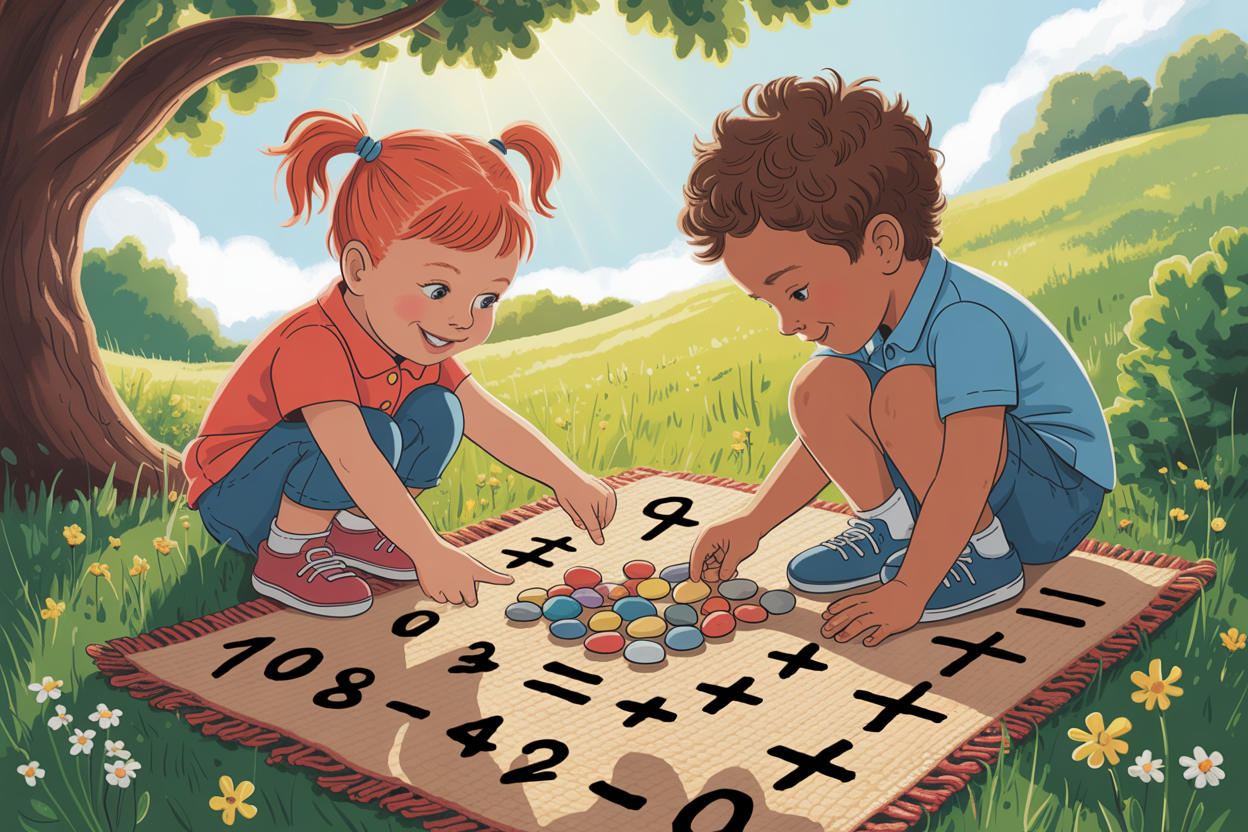
Outdoor math activities are the easiest way I know to get a child doing real math without the usual resistance. If your kid focuses better when they are moving, touching, and looking at real stuff, you are not imagining it. A short walk outside can turn “Ugh, math” into “Wait, can we count those?”
The trick is to stop treating math like a worksheet-only subject and start treating it like a way to notice the world. A stick becomes a unit. A shadow becomes a measurement problem. A pile of pinecones becomes a data set.
And when you want to bring that “outside” learning back indoors, you can create quick practice in about 10 seconds with MathSpark. Pick the skill your child is working on, generate a worksheet, and keep the vibe calm. It follows the Pythagoras Exams methodology and supports grades 1 to 9.
Why outdoor math works (even for kids who “hate” math)
When kids struggle with math, the problem is often not intelligence. It is attention, confidence, and the feeling that math is a pile of symbols with no meaning. Outside, math has meaning fast. You can point to the “why” right away.
There is also a real body of research that connects time in nature with mental well-being and attention. You do not need to turn your walk into a lecture, but it helps to know you are not wasting time. The American Psychological Association has covered evidence on nature exposure and well-being, and research on attention restoration is published in journals like PNAS.
For math teaching specifically, hands-on experiences are not a “nice extra.” Many curricula lean on concrete examples before abstract symbols. If you want a professional reference point, the National Council of Teachers of Mathematics (NCTM) regularly discusses reasoning, problem solving, and learning in context.
📺 Video Guide
✓ Key Benefits
- ✓ Math feels useful, not abstract
- ✓ Movement can support attention for many kids
- ✓ You get natural chances to talk through thinking out loud
A 60-second setup (what to bring)
You can do almost everything in this list with nothing. If you want to be slightly prepared, bring:
- A small zip bag (to collect a few leaves, pebbles, or pinecones)
- A short piece of string (for measuring and making shapes)
- Chalk (sidewalk math is underrated)
- Your phone camera (for pattern hunts and “math photo” challenges)
If you are heading to a national park or a local nature center, you may also find ready-made kid activities. The U.S. National Park Service learning pages are a good example of how outdoor exploration can be structured without feeling like school.
💡 Pro Tip
Use the same “unit” for a whole activity. Measure everything with the same stick, or the same set of steps. Consistency makes comparisons click.
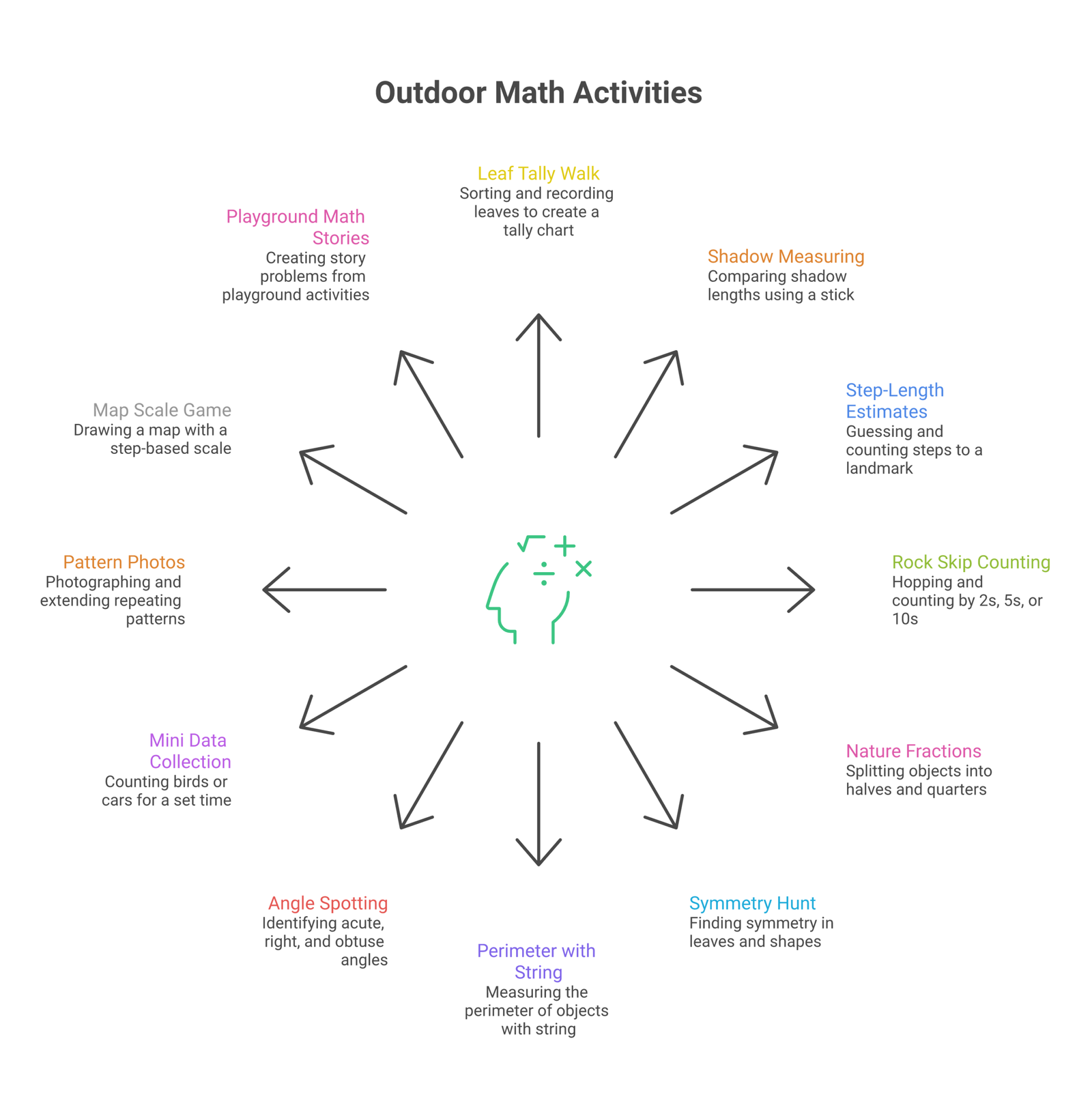
12 outdoor math activities you can do almost anywhere
Pick two or three. Stop while it is still fun. The goal is repetition over weeks, not one epic afternoon.
- Leaf tally walk: Find 10 leaves, sort by type, and make a tally chart. Later you can turn it into a bar graph.
- Shadow measuring: Measure your child's shadow with a stick, then measure yours. Which is longer? By how much? If your child gets curious about the sun and seasons, NOAA education resources have kid-friendly explanations.
- Step-length estimates: Guess how many steps to the next tree, then count. Talk about why the estimate was off.
- Rock skip counting: Place rocks in a line and skip count by 2s, 5s, or 10s as you hop.
- Nature fractions: Collect 8 small objects. Make “half” under a leaf, “quarter” under a rock. Rearrange and check.
- Symmetry hunt: Look for symmetry in leaves, flowers, and playground shapes. For a quick reference, see Britannica's overview of symmetry.
- Perimeter with string: Use string to outline a small area (a bench seat, a sandbox edge). Measure the string length. If measurement units confuse your child, the U.S. National Institute of Standards and Technology (NIST) has clear explanations of measurement and standards.
- Angle spotting: Find acute, right, and obtuse angles on slides, ladders, and rails. Khan Academy geometry is a solid refresher for parents too.
- Mini data collection: Count birds, cars, or dogs for 5 minutes. Make a quick table. If your child loves birds, the Cornell Lab of Ornithology is a goldmine, and you can even explore real observation projects through eBird.
- Pattern photos: Take photos of repeating patterns: fence posts, tiles, pinecones. Later, ask “What comes next?” Museums often run pattern activities for kids. The Smithsonian education hub is worth bookmarking.
- Map scale game: Draw a simple map of the park. Decide that 1 big step = 1 square. Estimate distances on your map.
- Playground math stories: “If 6 kids are on the swings and 3 leave, how many now?” Keep it tied to what they can see.
Outdoor math when you do not have “nature” nearby
If you live in a city, your outdoor classroom might be a sidewalk, a small square, or the space between parked cars. That still works. Math does not need a forest. It needs objects that can be counted, compared, measured, and arranged.
A few quick ideas that fit almost anywhere: count steps between streetlights, measure bench lengths with hand spans, hunt for shapes in signs and buildings, and take photos of repeating patterns in tiles and fences. If your child is older, add small challenges like “Estimate the area of this rectangle using your feet as a unit” and then check.
For a more “nature” feel without leaving town, try a local botanical garden or museum courtyard. Many have free educational materials, and you can turn a normal visit into a data day by counting plant types, comparing leaf sizes, or building a quick graph on your phone when you get home.
How to keep it fun (and not turn it into a lesson)
Outdoor math goes off the rails when parents start correcting every step. Your job is not to be a walking answer key. Your job is to ask one question that makes thinking visible.
A simple script that works in real life:
- “What do you notice?”
- “What do you think will happen?”
- “How could we check?”
If you want more ideas for learning through play, Edutopia has practical classroom-to-home strategies that translate well to family routines.
📝 Important Note
Do not correct every mistake in the moment. Ask one question and let your child think. Outdoor math works because it feels low pressure.
Make it grade-appropriate (quick adjustments)
Grades 1 to 2: Count, compare, and describe. “Which pile has more?” “How many altogether?” Use simple number bonds. If your child likes songs and rhythm, even resources like PBS KIDS can support counting and early number sense.
Grades 3 to 5: Add measurement, fractions, and basic graphs. Start using vocabulary like perimeter, estimate, and unit. Ask “How do you know?” more often than “What is the answer?”
Grades 6 to 9: Add ratios, scale, and more careful data. For example, record shadow length every hour and talk about proportional change. If you want kid-friendly science context for weather and seasons, NASA Climate Kids keeps it clear without talking down to children.
Turn outdoor observations into calm practice at home
This is where many parents get stuck: the walk was fun, but school still expects worksheets. You can bridge that gap without turning your child into a table-bound robot.
Try this simple loop:
- Take one photo outside (a pattern, a pile of leaves, a path)
- Ask one question at home (“How many?”, “How long?”, “What fraction?”)
- Do 6 to 10 quick problems that match the skill
If your child needs extra confidence, keep the worksheet short and predictable. If you want a fast way to generate aligned practice, use MathSpark. You can create a worksheet aligned to grade level in about 10 seconds and keep practice short enough that nobody melts down.
One more practical note: movement matters for health too. For general guidance on kids and physical activity, the CDC explains why regular activity supports children's well-being. Outdoor math is not a workout plan, but it is a nice “two birds” situation.
⚠️ Disclaimer
Outdoor activities come with real-world variables. Use age-appropriate supervision, follow local safety rules, and choose tasks that fit your child's needs. This article is for educational ideas, not medical or professional advice (March 2026).
Frequently Asked Questions
What are the best outdoor math activities for kids?
Start with counting and sorting (leaves, rocks), then add measurement (steps, string perimeter) and simple data collection (tallies and graphs). Pick two activities and repeat them weekly.
How long should an outdoor math session be?
Ten to twenty minutes is plenty. End while it still feels fun. Short sessions, repeated often, beat a long afternoon that everyone dreads next time.
What if my child refuses and just wants to play?
Let them play first. Then slip in one question that fits what they are already doing. One good question is better than five forced tasks.
Can outdoor math replace worksheets?
It does not have to be either-or. Outdoor math builds understanding. Short worksheets build fluency. Combine them with a simple routine: play outside, take a photo, then do a small set of aligned problems at home.
Where can I find quick practice problems after an outdoor activity?
You can write a few yourself, or use tools that generate practice by skill and grade. For example, MathSpark creates worksheet sets in about 10 seconds for grades 1 to 9.
If you try one thing this week, make it the step-length estimate. It is simple, it builds number sense, and it creates an easy habit: guess, check, talk. That is math. Outside just makes it feel normal.