Online Math Resources: Best Free Websites for Kids in 2026

Your child is stuck on a math problem, you are Googling “free math help for kids,” and the first five results are either paywalled or look like they were designed in 2003. Sound familiar? The good news is that there are genuinely excellent free math websites out there. The tricky part is sorting the useful ones from the flashy distractions.
I spent time testing dozens of platforms so you would not have to. This guide covers the best free math websites for kids in 2026, organized by age group, learning style, and what they actually do well. Some are fully free, some offer generous free tiers, and I will be upfront about which is which.
📺 Video Guide
Best fully free math websites
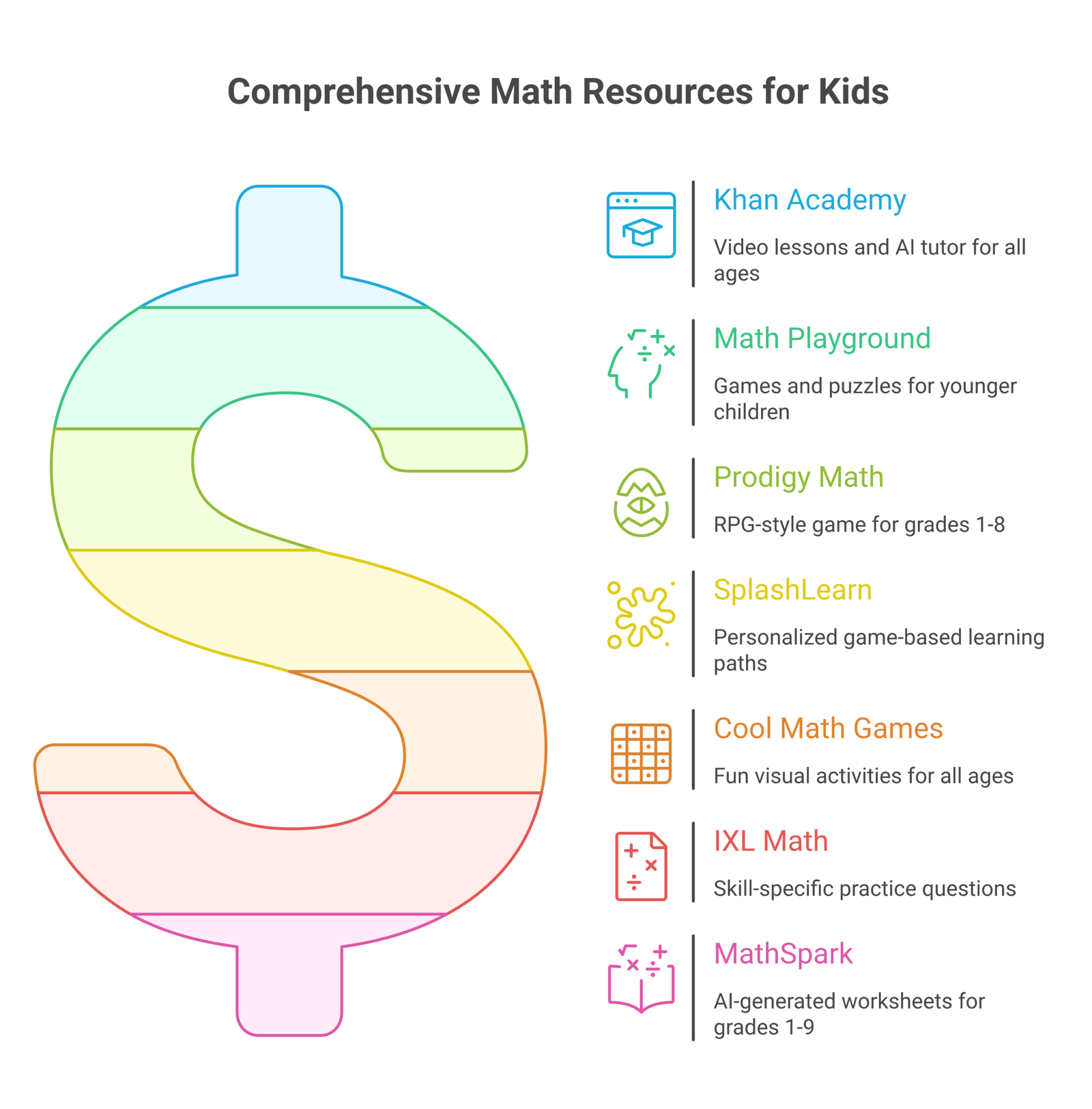
Khan Academy
If you have not used Khan Academy yet, start here. It covers Pre-K through early college math, with video lessons, practice exercises, and progress tracking. The platform recently added Khanmigo, an AI-powered tutor that walks kids through problems step by step instead of just giving answers.
Everything is completely free. No premium tier, no trial period. Khan Academy operates as a nonprofit, funded by donations from organizations like the Bill & Melinda Gates Foundation. The content is structured by grade and topic, making it easy to find exactly what your child needs help with.
Best for: Kids who learn well from video explanations and need structured, self-paced practice. Works especially well for filling specific knowledge gaps.
Math Playground
Math Playground is one of those sites that looks simple but keeps kids engaged for surprisingly long stretches. It offers hundreds of math games, logic puzzles, and word problem activities for grades K through 6. The games are designed by a former teacher, and you can tell. They actually teach something instead of just wrapping random addition problems in a cartoon shell.
The “Thinking Blocks” series stands out, as it teaches kids to model word problems visually before solving them. That is a skill many children struggle with through middle school. According to the National Center for Education Statistics, word problem comprehension is one of the biggest gaps in elementary math achievement.
Best for: Kids ages 5 to 12 who learn better through games than worksheets.
Funbrain
Funbrain has been around since 1997, which in internet years makes it ancient. But it has kept evolving. The math section includes games for Pre-K through 8th grade, with content that mixes math into story-based adventures and puzzles. It is completely ad-free, which is rare for a free math site.
Best for: Younger kids (Pre-K to grade 3) who need a gentle, playful introduction to math concepts.
✓ What makes a math website actually good?
- ✓ Adapts difficulty based on your child’s answers, not just their age
- ✓ Teaches concepts, not just drills (understanding over memorization)
- ✓ Provides feedback on wrong answers instead of just marking them red
- ✓ Free tier is actually usable, not a crippled demo
- ✓ Works on tablets and phones, since that is where kids actually use them
Best freemium math websites (generous free tiers)
Prodigy Math
Prodigy is the one your kids are probably already asking about. It is an RPG-style math game for grades 1 through 8 where players solve math problems to battle monsters, earn rewards, and explore a fantasy world. The core math content is free, and the paid membership only adds cosmetic items and extra game features, not additional learning content.
What sets Prodigy apart is its adaptive algorithm. It adjusts problem difficulty in real time based on how your child performs. Research from the U.S. Department of Education supports this kind of personalized practice as one of the most effective approaches to improving math outcomes. Over 100 million students worldwide use Prodigy, according to the company.
The parent dashboard is free too, letting you see which topics your child practices most and where they are getting stuck. That data alone is worth signing up for.
Best for: Kids ages 6 to 14 who need motivation to practice. The game format turns “do your math practice” from a battle into a request they might actually say yes to.
SplashLearn
SplashLearn covers Pre-K through grade 5 with personalized learning paths. Teachers get full free access, and parents can try it for 7 days before deciding on a subscription. The platform aligns with Common Core State Standards, which is helpful if you want practice that matches what your child learns in school.
The visual approach works well for younger kids. Problems use drag-and-drop interactions, number lines, and animated demonstrations that make abstract concepts concrete. A 2023 study published in the Journal of Educational Technology & Society found that game-based math platforms improved student engagement by 40% compared to traditional worksheet practice.
Best for: Younger kids (ages 3 to 10) who respond to colorful, interactive learning environments.
IXL Math
IXL takes a different approach than the game-based platforms. It is skill-focused practice, organized by grade and topic, with immediate feedback and detailed explanations when you get something wrong. The free version limits daily practice questions, but it is enough to supplement homework or target specific weak spots.
IXL covers K through 12th grade, which makes it one of the few platforms that grows with your child. The diagnostic tool identifies gaps automatically and recommends where to focus next. If your child consistently struggles with fractions, for instance, IXL will pinpoint whether the issue is understanding equivalence, operations, or converting between forms.
Best for: Kids who need targeted practice on specific skills. Parents who want clear progress data.
Free math websites for specific age groups
For Pre-K and kindergarten (ages 3 to 6)
At this age, math is about counting, number recognition, sorting, and basic patterns. ABCya and Starfall both offer free math games designed for this level. Starfall focuses on visual learning with animations that show counting and grouping, while ABCya has a wider variety of mini-games.
The National Association for the Education of Young Children recommends limiting screen time for this age group, so think of these as supplements to hands-on activities rather than replacements. Ten to fifteen minutes a day is plenty.
For elementary school (ages 6 to 11)
This is where most free math websites for kids concentrate their content, and for good reason. Elementary math lays the foundation for everything that comes later. Cool Math Games is a perennial favorite that mixes strategy games with math practice. It is lighter on structured curriculum alignment but stronger on making math feel like play.
For more structured practice, XtraMath is completely free and focuses on building fact fluency, which means addition, subtraction, multiplication, and division speed. It is simple, no-frills, and effective. Sessions last about 10 minutes, which fits neatly into a homework routine.
If your child is in grades 1 through 9 and you want worksheets that match the school curriculum, MathSpark generates AI-powered practice sheets in about 10 seconds. You pick the grade, topic, and difficulty, and it creates a custom worksheet with an answer key. It follows the Pythagoras Exams methodology and is free in its basic form. I have found it especially useful for quick extra practice before tests.
For middle school (ages 11 to 14)
Middle school math takes a sharp turn toward abstract thinking, with pre-algebra, geometry, and proportional reasoning. Math is Fun breaks down these topics with clear explanations, interactive tools, and practice questions. The geometry section is particularly good, with visual demonstrations of angles, area, and transformations.
Desmos is another standout for this age group. It started as a graphing calculator but has expanded into a full math learning platform. The activities are inquiry-based, meaning kids explore concepts by manipulating graphs and variables rather than just watching explanations. Research published by the National Council of Teachers of Mathematics consistently shows that this kind of interactive exploration builds deeper understanding than passive instruction.
💡 Quick tip for parents
Let your child try two or three different sites before committing to one. What clicks for one kid might bore another. A child who hates worksheets might love Prodigy’s game format, while a kid who finds games distracting might prefer IXL’s straightforward practice. There is no single “best” choice.
YouTube channels for free math learning
Sometimes a 5-minute video explains a concept better than 30 minutes of reading. These YouTube channels offer free math instruction that is actually good.
Math Antics covers everything from basic numeracy to algebra with clean animations and clear explanations. The creator has a knack for breaking complex ideas into digestible steps. Numberblocks, produced by the BBC, is perfect for Pre-K through grade 1, teaching number concepts through animated characters. Jack Hartmann uses catchy songs to teach counting, skip counting, and basic operations, and his videos are widely used in early childhood classrooms.
For older kids, 3Blue1Brown produces some of the best math content on the internet. The videos are visually stunning and explain concepts like linear algebra, calculus, and probability in ways that make you genuinely curious. They are aimed more at high school and above, but a motivated middle schooler could get a lot from them.
How to get the most from free math websites
Having access to great tools means nothing if they sit unused. Here is what works based on what parents and teachers consistently report.
Set a consistent schedule. Even 10 to 15 minutes daily produces better results than hour-long weekend cramming sessions. The What Works Clearinghouse, a research initiative from the U.S. Department of Education, found that distributed practice (short, regular sessions) is more effective for math retention than massed practice (long, infrequent sessions).
Mix platforms. Use a game-based site like Prodigy for motivation, then switch to something structured like Khan Academy or MathSpark worksheets for focused skill building. Variety keeps things fresh and addresses different aspects of learning.
Check the parent dashboard. Most free math websites for kids offer some form of progress tracking. Use it. Knowing that your child has attempted 50 fraction problems but only gets 40% right tells you something actionable. That is a topic worth extra attention, and you can generate a targeted worksheet on it.
Sit with them sometimes. Not every session, but occasionally. Ask them to explain what they are doing. Research from Harvard University’s Graduate School of Education shows that when children explain their mathematical thinking out loud, they build stronger conceptual understanding. You do not need to know the math yourself. Just asking “how did you figure that out?” is enough.
📝 A note about “free”
Some websites advertise as free but show ads to kids, which can be distracting and occasionally inappropriate. Funbrain and Khan Academy are both ad-free. Others like Cool Math Games have ads but keep them separated from the learning content. If ads bother you, check before handing the device to your child.
Comparing the top free math websites
Here is a quick breakdown to help you pick the right one.
Khan Academy covers Pre-K to 12, is 100% free, and works best for self-paced video learning with practice. No ads.
Math Playground covers K to 6, is 100% free, and works best for game-based learning with logic puzzles.
Prodigy covers grades 1 to 8, offers free core math with paid cosmetics, and works best for motivating reluctant learners.
SplashLearn covers Pre-K to 5, is free for teachers with a parent trial, and works best for personalized learning paths.
IXL covers K to 12, offers limited free daily questions, and works best for targeted skill practice.
XtraMath covers K to 6, is 100% free, and works best for building fact fluency quickly.
MathSpark covers grades 1 to 9, is free in its basic form, and works best for AI-generated worksheets matching the school curriculum.
Desmos covers grades 6 to 12, is 100% free, and works best for interactive math exploration and graphing.
What about math apps versus websites?
Most of the websites listed here also have mobile apps. Khan Academy, Prodigy, and SplashLearn all work well on tablets. For younger kids, the app versions are often easier to navigate. For older kids, the website versions typically have more features.
One advantage of websites over apps is that they are easier for parents to monitor. You can see the browser history, and there is no concern about in-app purchases sneaking through. The Common Sense Media website reviews both apps and websites for educational value and age appropriateness, which is worth checking before introducing anything new.
⚠️ Disclaimer
This article was last reviewed in March 2026. Website features, pricing, and availability may change. Always verify current offerings directly on each platform’s website. Free tiers may have limitations not fully covered here.
Frequently asked questions
What is the best completely free math website for kids?
Khan Academy is the most comprehensive fully free option. It covers Pre-K through 12th grade with video lessons, practice problems, and progress tracking. There is no premium tier or paywall for any content.
How much time should my child spend on math websites each day?
Research supports 10 to 15 minutes of daily practice over longer infrequent sessions. For Pre-K and kindergarten, keep it under 10 minutes. Elementary students can do 15 to 20 minutes. The goal is consistency, not marathon sessions.
Are free math websites as effective as paid tutoring?
For regular practice and concept reinforcement, free math websites can be very effective. They cannot replace a tutor for diagnosing specific learning difficulties or providing personalized explanations in real time. Think of them as daily practice tools that supplement rather than replace human instruction.
Can free math websites help with math anxiety?
Yes. Game-based platforms like Prodigy and Math Playground reduce the pressure associated with math practice. Kids focus on playing the game rather than worrying about getting answers wrong. The key is choosing platforms that give encouraging feedback and adjust difficulty automatically so children are challenged but not overwhelmed.
Do these websites work for kids following a non-US curriculum?
Most of these websites organize content by math topic rather than specific national curricula, so they work across different educational systems. MathSpark specifically follows the Greek school curriculum and Pythagoras Exams methodology, which may be more relevant for families in Greece or following similar programs.