Understanding Percentages: A Parent’s Guide to Teaching Kids
What Are Percentages, Really?
Percentages trip up more kids than most parents realize. Your child might breeze through addition and multiplication, then hit a wall when “%” shows up. The reason is simple: percentages are a different way of thinking about numbers, not just a new operation. They connect fractions, decimals, and division all at once, and that’s a lot to hold in your head at age 8 or 9.
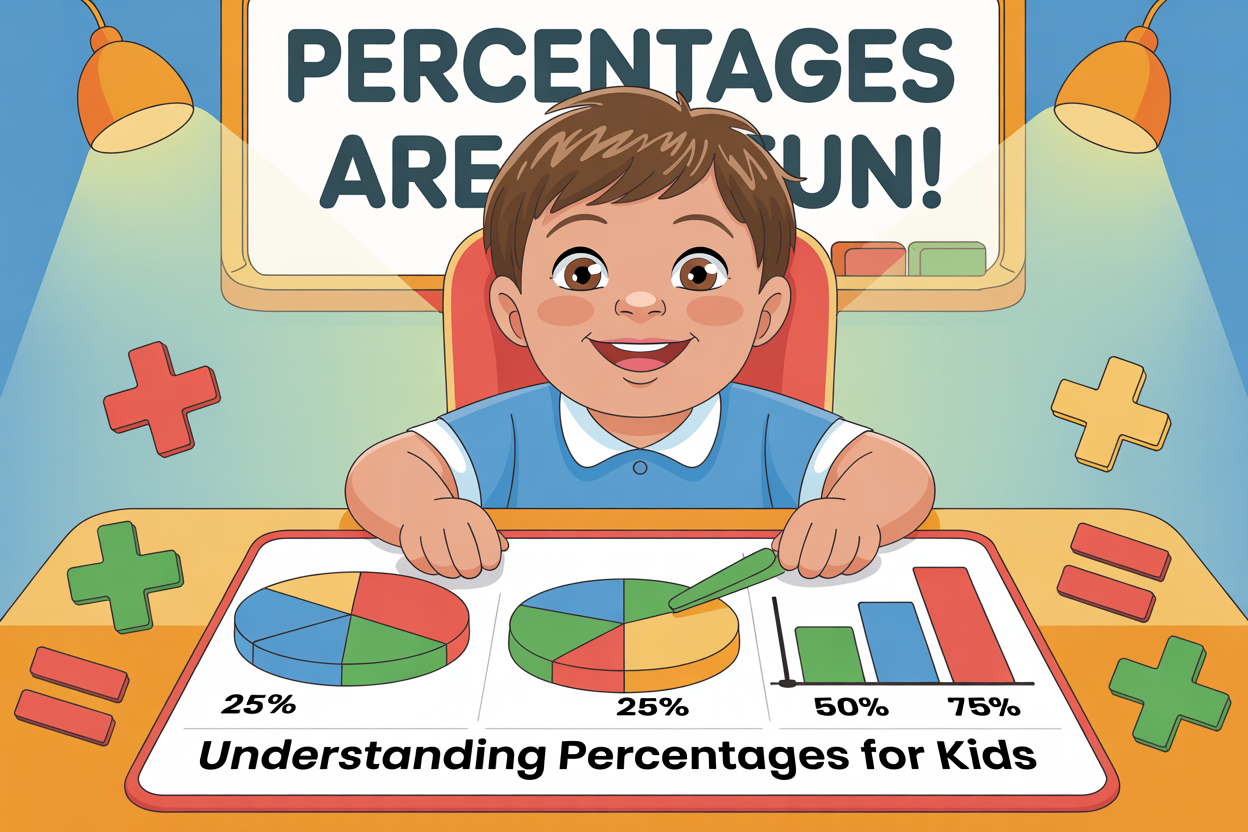
The word “percent” literally means “per hundred.” So 25% means 25 out of every 100. Once your child gets that one idea locked in, everything else about percentages starts clicking into place. The National Council of Teachers of Mathematics (NCTM) includes percentage understanding as a core benchmark for upper elementary students, and for good reason: percentages show up in shopping, cooking, sports, science, and just about every adult task you can think of.
📺 Video Guide
Why kids struggle with percentages
Most children learn fractions first, and they get used to the idea that 1/2 of a pizza is half the pizza. When percentages arrive, they have to translate between systems: 1/2 is the same as 50%, which is the same as 0.5. That three-way connection is where confusion creeps in.
Research from the Institute of Education Sciences (IES) shows that students who work with visual models before jumping into abstract calculations build stronger number sense. So instead of asking your child to calculate 30% of 60 right away, start with pictures, grids, and real objects.
Another common stumbling block: kids think percentages can only go up to 100%. When they see “150% increase” in a news headline, it breaks their mental model. Getting ahead of this by explaining that 100% means “the whole thing” and anything above 100% means “more than the whole” saves a lot of head-scratching later.
Start with the 100-square grid
The best introductory tool is a 10×10 grid, which gives your child exactly 100 squares to work with. Print one out (or draw it together) and grab some colored pencils. Ask your child to color in 50 squares. “You just colored 50 out of 100, which is 50 percent.” That’s it. The concept lands immediately when they can see and touch it.
From there, try these progressions:
- Color 25 squares = 25%. Ask: “Is this more or less than half?”
- Color 75 squares = 75%. Ask: “How many are NOT colored?”
- Color 10 squares = 10%. Ask: “How many groups of 10% fit in the whole grid?”
- Color 1 square = 1%. Now they see how small 1% actually is.
The Math is Fun website has free printable percentage grids you can use at home. Once your child is comfortable with the grid, they’ve built an internal picture of what percentages look like, and that mental image carries over into harder problems.
💡 Quick tip
Hang a blank 100-square grid on your fridge. Each day, color in squares to show something real: “We’ve eaten 30% of the cereal box” or “Your birthday is 80% of the way through the month.” Daily exposure beats a single long lesson every time.
Connecting percentages to fractions and decimals
Here’s a straightforward way to show the connection. Write these three columns on a piece of paper:
- 50% = 50/100 = 1/2 = 0.50
- 25% = 25/100 = 1/4 = 0.25
- 10% = 10/100 = 1/10 = 0.10
- 75% = 75/100 = 3/4 = 0.75
Let your child spot the pattern. The percentage number goes over 100 to make the fraction, and you move the decimal point two places left to get the decimal form. Kids who already understand decimals and fractions will pick this up faster, so review those topics first if needed.
A study published in the Journal of Experimental Child Psychology found that children who practice converting between fractions, decimals, and percentages score higher on problem-solving tasks. The act of translating between forms builds flexible number thinking.
Real-world percentage activities that actually work
Worksheets have their place, but percentages click fastest when kids use them for real things. Here are activities that parents have told us work well:
Shopping discounts. Next time you see a “20% off” sign, hand your child a calculator and ask them to figure out the sale price. A shirt costs €25, and it’s 20% off. What’s the discount? What do you actually pay? The Federal Trade Commission notes that understanding discounts is a basic financial literacy skill, and your child can start learning it now.
Sports statistics. If your kid follows basketball or soccer, percentages are everywhere. A player who makes 8 out of 10 free throws has an 80% success rate. Look up stats on ESPN together and talk about what the numbers mean.
Cooking and recipes. “We need to make 50% more of this recipe because we have guests.” If the recipe calls for 200g of flour, what’s 50% more? This connects percentages to multiplication in a way that results in actual cookies, which is about the best motivation a kid can get.
Battery and download bars. Phones and tablets show percentages constantly. “Your tablet is at 35%. If it loses 5% every 10 minutes, how long until it dies?” Suddenly percentages feel urgent.
Grade tracking. If your child scored 18 out of 20 on a spelling test, that’s 90%. Having them calculate their own test scores in percentage form builds ownership over their learning and reinforces the math at the same time.
✓ Key benchmark percentages every kid should know
- ✓ 100% = the whole thing (all of it)
- ✓ 50% = half (1/2)
- ✓ 25% = a quarter (1/4)
- ✓ 10% = one-tenth (move the decimal point one place left)
- ✓ 1% = one-hundredth (tiny, but useful for calculating anything)
- ✓ 0% = nothing at all
The 10% shortcut method
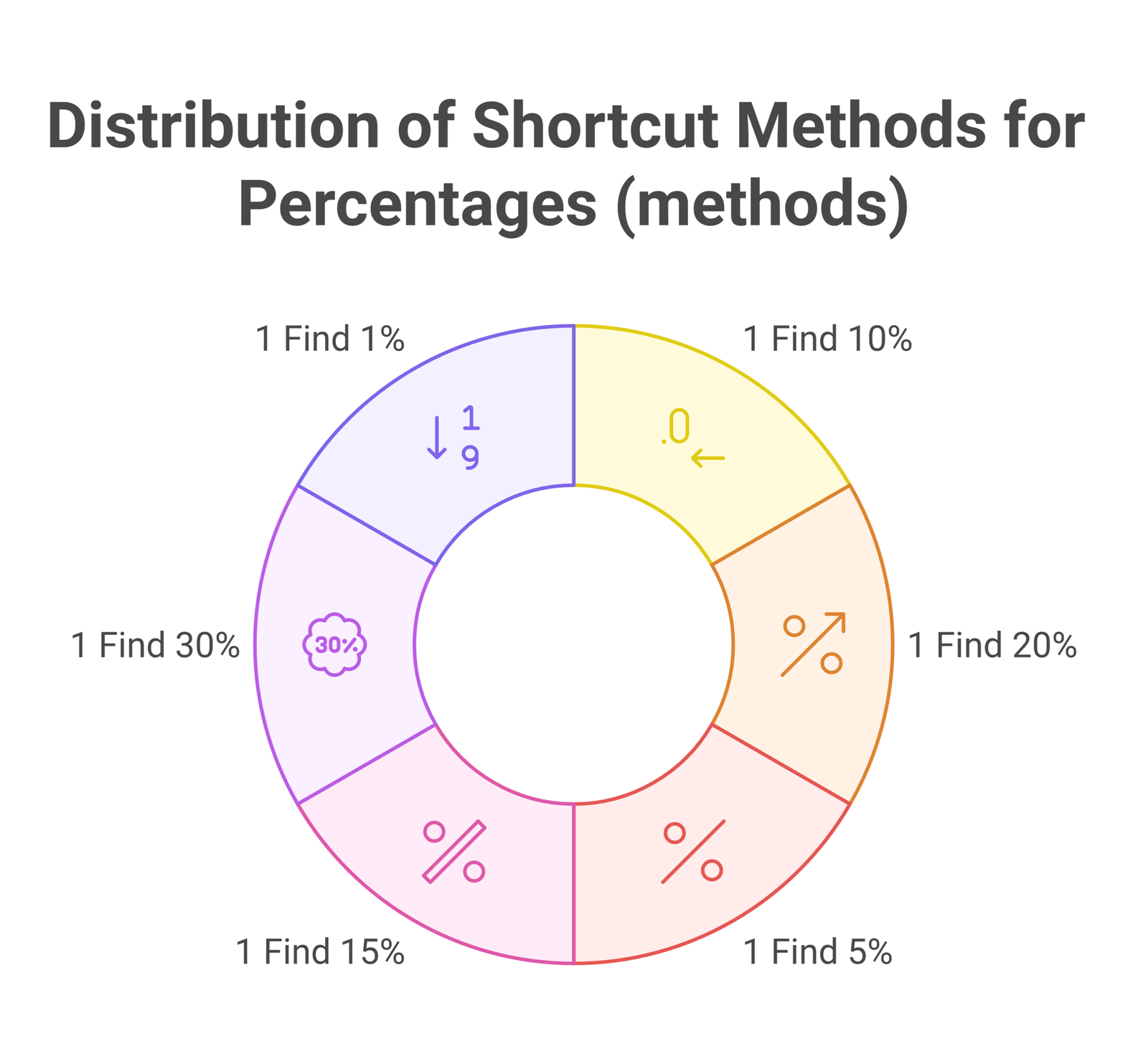
This is the single most useful trick for mental percentage calculations, and it works for adults too. To find 10% of any number, just move the decimal point one place to the left. 10% of 80 = 8. 10% of 350 = 35. 10% of 7 = 0.7.
Once your child knows 10%, they can build almost any other percentage from it:
- 20% = 10% doubled
- 5% = half of 10%
- 15% = 10% + 5%
- 30% = 10% tripled
- 1% = 10% divided by 10 (move the decimal again)
Want 35% of 200? Find 10% (= 20), triple it for 30% (= 60), find 5% (= 10), and add them (60 + 10 = 70). It sounds like a lot of steps written out, but kids get fast at this with practice. The Khan Academy percentage module uses this exact approach and is free for anyone to use.
Common mistakes to watch for
After helping hundreds of parents through our MathSpark worksheets, we see the same percentage mistakes pop up again and again. Catching them early saves your child a lot of frustration down the road.
Thinking 50% of everything is 50. Kids sometimes treat the percentage as the answer itself. Remind them: 50% means half of whatever number you’re working with. 50% of 20 is 10, not 50.
Forgetting what the “whole” is. “30% of what?” is the question kids skip over. If your class has 30 students and 30% are absent, that’s 9 students, not 30. Always identify the total first.
Decimal point errors when converting. To go from a percentage to a decimal, divide by 100 (or move the decimal two places left). So 45% becomes 0.45, not 4.5. According to BBC Bitesize, this is one of the most common errors in national math assessments.
Adding percentages of different wholes. 10% of your savings plus 10% of your allowance does not equal 20% of your total money (unless savings and allowance are equal). This trips up older kids especially when they start working with percentage problems in word form.
📝 When to worry
If your child still struggles with percentages after consistent practice over several weeks, it might signal gaps in fraction or decimal understanding. Go back and strengthen those foundations first. The Understood.org guide on math difficulties can help you spot if something deeper is going on.
Practice worksheets and online tools
Consistent, short practice sessions beat long cramming sessions. Aim for 10-15 minutes a day rather than an hour on weekends. Here are solid resources:
MathSpark generates AI-powered math worksheets tailored to your child’s grade level in about 10 seconds. It follows the Greek school curriculum and the Pythagoras Exams methodology, but also works well for international curricula since percentage concepts are universal. The basic version is free.
Khan Academy has a complete percentage module with video lessons and practice exercises, all free. The adaptive system adjusts difficulty as your child improves.
IXL Math offers targeted percentage drills sorted by grade. The free version gives you a few problems per day; the paid plan unlocks unlimited practice.
NRICH (University of Cambridge) focuses on percentage puzzles and investigations rather than drill. Great for kids who find worksheets boring and want something that makes them think sideways.
Grade-by-grade percentage expectations
Knowing what’s expected at each stage helps you match your practice to your child’s level. The Common Core State Standards and the Greek national curriculum both follow a similar progression:
Grades 3-4 (ages 8-10): Introduction to the concept. Recognize that “percent” means “out of 100.” Shade grids to represent simple percentages like 50%, 25%, and 10%. No calculations yet.
Grade 5 (ages 10-11): Convert between fractions, decimals, and percentages. Find simple percentages of whole numbers (50% of 80, 10% of 200). Understand 100% as the whole.
Grade 6 (ages 11-12): Calculate any percentage of a number. Solve word problems involving discounts, tax, and tips. Compare quantities using percentages. The Massachusetts Department of Education framework sets this as the year where percentage fluency should be solid.
Grades 7-9 (ages 12-14): Percentage increase and decrease. Profit, loss, and interest calculations. Compound percentages. Working backwards from a percentage to find the original number.
A 5-day percentage learning plan
If your child needs a structured approach, try this plan. Each day takes about 15 minutes.
Day 1: The grid. Print a 100-square grid. Color in 50%, 25%, 75%, and 10%. Talk about what each one looks like.
Day 2: Fractions connection. Write out the conversion table (50% = 1/2, 25% = 1/4, etc.). Quiz each other back and forth.
Day 3: The 10% trick. Practice finding 10% of different numbers. Then build 20%, 5%, and 15% from there. Use MathSpark to generate a quick worksheet for extra practice.
Day 4: Shopping math. Look through a flyer or online store together. Calculate the sale price for items with 10%, 20%, or 50% discounts.
Day 5: Quiz and review. Mix everything together. Give 10 quick problems covering grids, conversions, and real-world calculations. Celebrate what they got right and note what needs more work.
💡 Pro tip for parents
If your child gets frustrated, switch from worksheets to something physical. Sort a bag of M&Ms by color, then figure out what percentage each color makes up. Learning feels different when there’s chocolate involved. The National Association for the Education of Young Children recommends play-based approaches for younger kids especially.
Beyond the basics: percentage increase and decrease
Once your child has the fundamentals down, they’ll encounter “percentage increase” and “percentage decrease” in school. These sound complicated but follow a simple pattern:
- Percentage increase: A shirt costs €40 and the price goes up by 25%. Find 25% of 40 (= 10), then add it to the original (40 + 10 = €50).
- Percentage decrease: That same shirt goes on sale for 20% off the new price. Find 20% of 50 (= 10), then subtract (50 – 10 = €40).
Notice something interesting? A 25% increase followed by a 20% decrease brought us right back to the starting price. That kind of observation is exactly the type of mental math thinking that separates kids who understand percentages from kids who just memorize formulas.
For older students heading into secondary school, the Purplemath lessons on percentage applications cover profit and loss, simple interest, and tax calculations in clear language without assuming too much background knowledge.
⚠️ Disclaimer
This article provides general educational guidance for parents as of March 2026. Curriculum standards vary by country and school district. Check with your child’s teacher for specific grade-level expectations in your area.
Frequently Asked Questions
What age should kids learn percentages?
Most curricula introduce percentages around age 9-10 (grades 4-5), starting with visual representations. By age 11-12, children should be calculating percentages of numbers and solving word problems. Earlier informal exposure through shopping and cooking helps build readiness.
How do I explain the difference between fractions and percentages?
Tell your child that percentages are just fractions with a denominator of 100. So 25% is 25/100, which simplifies to 1/4. The percentage form is handy because it’s easy to compare. Is 3/7 bigger than 5/12? Hard to tell. But 43% vs. 42%? Immediately clear.
What’s the fastest way to calculate percentages mentally?
The 10% method. Find 10% by moving the decimal point one place left, then combine to get whatever percentage you need. For example, 35% = three times 10% plus half of 10%. With practice, this becomes almost instant.
Can percentages be more than 100%?
Yes. 100% means the complete amount. 200% means double. If your savings grow from €50 to €150, that’s a 200% increase. It confuses kids at first, but using examples like “I ate 150% of my usual lunch” makes it click.
How can I make percentage practice less boring?
Use real money (play money or real coins), food, sports stats, or video game scores. Any context where your child already cares about the numbers makes percentage practice feel like a game rather than homework. Tools like MathSpark can generate varied worksheets so your child doesn’t see the same problems twice.