Multi-Digit Multiplication Strategies for Kids

Multi-digit multiplication strategies can turn a page of intimidating numbers into a set of small, logical moves. If your child freezes when they see 47 × 23, the problem is usually not laziness. It is cognitive overload: too many digits, too many places to track, and not enough structure. The goal is to help them see multiplication as organized thinking, not a race to remember steps.
Parents often learned one standard algorithm and were told to repeat it until it stuck. Today, strong math teaching starts with meaning. The National Council of Teachers of Mathematics emphasizes reasoning, representation, and communication, while the Common Core multiplication expectations ask students to use place value and strategies before fluency becomes automatic. That is good news at home, because you do not need to become a tutor. You need a calm sequence that makes each step visible.
📺 Video Guide
✓ What your child should understand first
- ✓ Multiplication is groups, arrays, and area, not only memorized facts.
- ✓ Every digit has a place value, so 40 × 20 is not the same as 4 × 2.
- ✓ Partial products keep thinking visible before the compact algorithm.
- ✓ Estimation helps children catch answers that are obviously too small or too large.
Why Multi-Digit Multiplication Strategies Work
Multi-digit multiplication strategies work because they reduce the invisible load on working memory. A child solving 36 × 18 has to remember facts, place values, regrouping, alignment, and the final addition. Guidance from Understood working memory guidance explains why working memory can become a bottleneck when children are asked to hold too much at once. Strategies like area models and partial products move some of that thinking onto paper.
The best starting point is place value foundation. If a child sees 36 as 30 + 6 and 18 as 10 + 8, the problem becomes four smaller products: 30 × 10, 30 × 8, 6 × 10, and 6 × 8. That is not a trick. It is the distributive property in a child-friendly form, and it matches how multiplication is described in resources like Britannica explanation of multiplication.
This approach also protects confidence. When children jump straight into the compact algorithm, one slipped digit can ruin the whole answer. When they use a strategy, each piece can be checked. They can estimate first, solve in parts, and ask, “Does this answer make sense?” That habit matters later in fractions, algebra, science, and money decisions.
💡 Quick Parent Move
Before correcting an answer, ask your child to estimate. For 48 × 19, “about 50 × 20” gives 1,000, so an answer like 112 should immediately feel wrong without blame.
Strategy 1: Area Model for Visual Thinkers
The area model is often the gentlest entry point. Draw a rectangle, split each side by place value, and fill the smaller boxes. For 42 × 36, split 42 into 40 and 2, then split 36 into 30 and 6. The boxes become 40 × 30, 40 × 6, 2 × 30, and 2 × 6. Add the products to get 1,512. Students can literally see where every part came from.
This is especially useful for visual learners and children who have already practiced arrays. Khan Academy multiplication lessons uses similar visual progressions, and Edutopia math strategy ideas regularly highlights concrete representations for math ideas. If your child struggles with “carrying,” do not start by drilling carrying. Start by making the tens and ones visible.
At home, use grid paper or a whiteboard. Keep the numbers friendly at first: 23 × 14, 31 × 12, 42 × 15. Ask your child to label the sides, solve each box, and then add. If they dislike drawing, use a simple table with rows and columns. The point is not artistic neatness. The point is structure.
Strategy 2: Partial Products for Clear Thinking
Partial products are the bridge between the area model and the standard algorithm. Instead of compressing everything into a few crowded lines, children write each product separately. For 47 × 23, they might solve 47 × 20 = 940 and 47 × 3 = 141, then add 1,081. Another child may split both numbers: 40 × 20, 40 × 3, 7 × 20, and 7 × 3. Both are valid.
This is where math facts fluency becomes helpful. If basic facts are shaky, multi-digit work feels painfully slow. But fluency does not mean speed at any cost. It means facts are familiar enough that attention can go to place value and reasoning. Practice should be short, regular, and varied.
Parents can make partial products less scary by narrating the place value: “We are multiplying by 20, not by 2.” That single sentence prevents many errors. The NAEP math framework places strong emphasis on mathematical reasoning, and this is reasoning in action. Children are not just following steps. They are explaining why each line belongs.
📝 Important Note
If your child writes 47 × 2 instead of 47 × 20, do not say, “You forgot the zero.” Say, “What is the value of the 2 in 23?” This shifts the conversation from rule-following to understanding.
Strategy 3: The Standard Algorithm Without Mystery
The standard algorithm is efficient, but it should not be mysterious. Once a child has used area models and partial products, the compact algorithm becomes a shorthand. The first row usually represents multiplying by the ones digit. The second row represents multiplying by the tens digit. The placeholder zero is not a decoration. It shows that the child is multiplying by a ten.
If your child has learned the algorithm but keeps making alignment mistakes, return to partial products for a week. Connect each compact row to a longer line. For example, in 36 × 24, the row for 4 is 144. The row for 20 is 720. If the compact work shows 72 instead of 720, the issue is not carelessness. The child has lost the place value meaning.
This is also a good time to use common math mistakes as a checklist. Common mistakes include multiplying only one digit, forgetting the tens place, adding before finishing all products, and accepting an answer that fails estimation. A calm checklist beats a long lecture every time.
A Simple 15-Minute Practice Routine
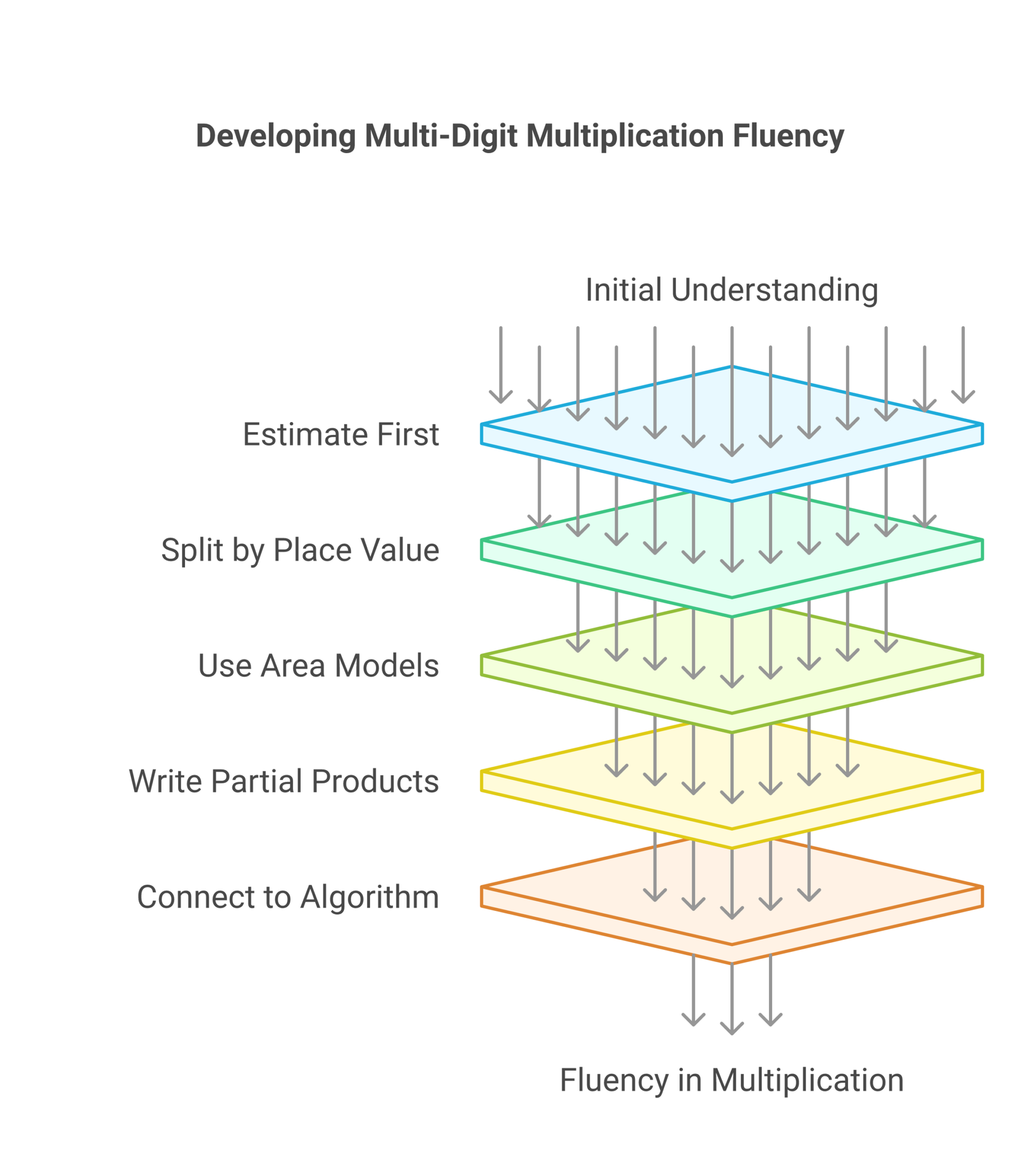
Parents do not need hour-long worksheets. A focused 15-minute routine is enough. Start with one estimation problem, then one visual problem, then one partial products problem, and finish with one standard algorithm problem. Keep the numbers similar so the child notices the connection between methods. This aligns with mastery learning ideas described by the Education Endowment Foundation: students need clear steps, feedback, and time to consolidate.
Here is a sample routine for 34 × 16. First estimate: 30 × 20 = 600, so the exact answer should be near 600. Next draw an area model: 30 × 10, 30 × 6, 4 × 10, 4 × 6. Then write partial products: 340 + 204. Finally use the compact algorithm and compare. One problem, four views, no panic.
For ready-made practice, math worksheets for kids can help, but the worksheet should match the child’s current strategy. A page full of compact algorithm problems is not helpful if the child still needs area models. Tools like MathSpark are useful here because parents can generate grade-appropriate math worksheets in seconds and choose practice that supports the method being taught, not just random drills.
✓ 15-minute practice plan
- ✓ 2 minutes: estimate the product before solving.
- ✓ 5 minutes: solve one problem with an area model.
- ✓ 4 minutes: solve the same problem with partial products.
- ✓ 3 minutes: try the compact algorithm.
- ✓ 1 minute: explain which method felt clearest and why.
How to Help Without Taking Over
The hardest part for many parents is staying quiet long enough to let the child think. If you jump in too quickly, your child may learn that math is something adults rescue them from. Instead, use prompts. Ask, “What do you know already?” “Which part could you split?” “Where is the tens digit?” “How could we check this?” The YouCubed growth mindset resources work on growth mindset is a useful reminder that mistakes can be treated as information, not verdicts.
For students with math learning difficulties, the Learning Disabilities Association math overview notes that explicit instruction, visuals, and repeated practice can make a real difference. That does not mean endless repetition. It means clear modeling, guided practice, and independent practice in that order. If your child is overwhelmed, reduce the digits. Solve 23 × 4 before 23 × 14. Then build back up.
Confidence grows when children experience success that feels earned. Celebrate explanations more than speed. “I like how you split 48 into 40 and 8” is more helpful than “Good job.” It tells the child exactly which thinking move worked. Over time, this builds math confidence, which is often the missing ingredient in math homework.
💡 Low-Stress Script
Try saying: “Let’s make the problem smaller.” That one sentence gives your child permission to use strategy instead of brute force.
When to Move From Strategies to Fluency
Strategies are not meant to replace fluency forever. They are meant to build it honestly. A child is ready to use the standard algorithm more often when they can estimate, explain the role of the tens place, and spot unreasonable answers. If they cannot explain why the second row is shifted, keep using partial products.
International assessments like OECD PISA mathematics framework value applying mathematics in real situations, not only completing procedures. That is why strategy work is worth the time. Children who understand multiplication can use it for recipes, shopping, area, scaling drawings, and later algebra. Children who only memorize steps may pass a quiz and still feel lost when the problem looks different.
Use short review cycles. On Monday, area model. On Tuesday, partial products. On Wednesday, compact algorithm. On Thursday, mixed practice. On Friday, one real-world problem. The variety prevents boredom and shows your child that multiplication is a flexible tool.
⚠️ Disclaimer
Educational guidance current as of May 2026. If your child has persistent math anxiety, very slow progress despite support, or major gaps in number sense, consider speaking with the teacher or a qualified learning specialist.
Frequently Asked Questions
What is the best strategy for multi-digit multiplication?
Start with the area model if your child needs visual support, then move to partial products, and finally connect both to the standard algorithm.
Why does my child forget the zero in long multiplication?
Usually because the child is thinking “multiply by 2” instead of “multiply by 20.” Return to place value language and partial products.
Should kids memorize the standard algorithm?
Yes, eventually, but memorization should come after understanding. The algorithm is faster when children know what each line means.
How much practice is enough?
Ten to fifteen minutes of focused practice several times a week is better than one long, stressful session.
Can worksheets help?
Yes, if they match the strategy your child is learning. Use visual and partial-product worksheets before moving to compact algorithm drills.