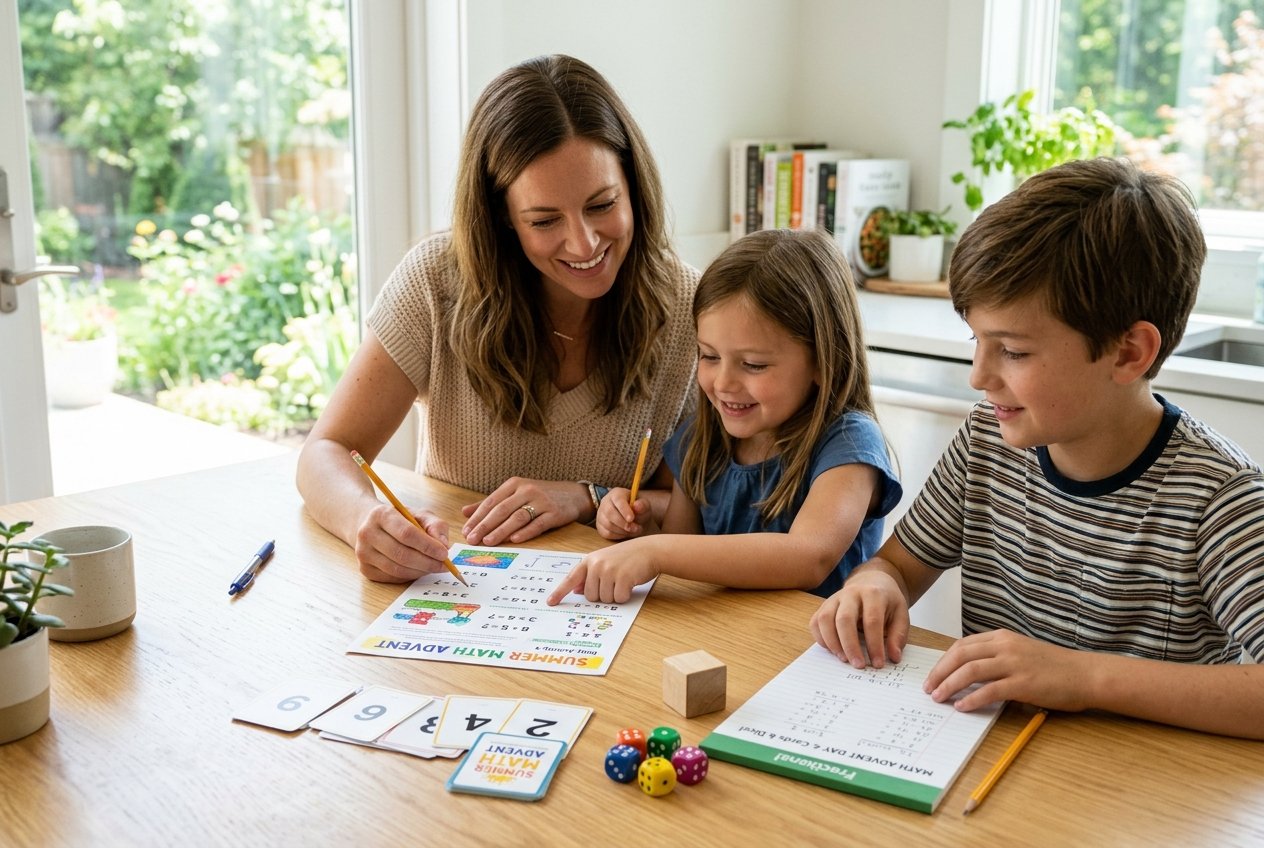
5th-8th Grade Math Prep: Late June Parent Guide

5th-8th grade math prep in late June should not feel like launching a second school year at the kitchen table. The goal is simpler: notice what your child has forgotten, rebuild confidence before August, and preview the next grade without turning summer into a punishment. International results such as OECD PISA 2022 remind parents that mathematics confidence matters, but your home plan can stay calm, short, and very practical.
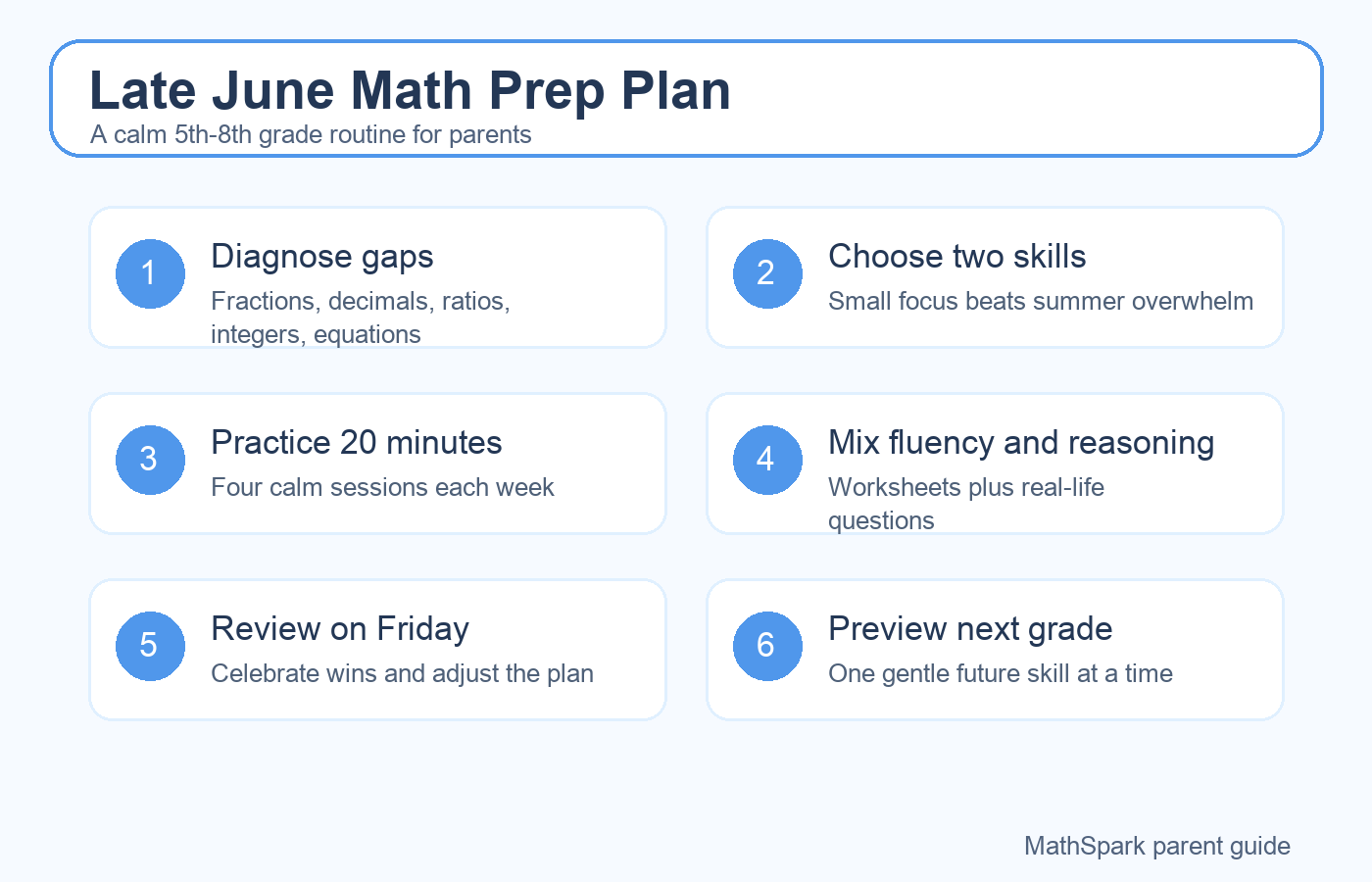
If your child is moving from grade 5 to grade 8, late June is the perfect moment because school is still fresh enough to remember the weak spots, yet there is enough time to fix them gently. Think of this as a bridge, not a boot camp. Four focused sessions per week, each around twenty minutes, can protect fluency and reduce the September shock.
For parents who want instant practice without hunting through random PDFs, MathSpark can generate AI-powered math worksheets for grades 1-9 in about ten seconds, with practice aligned to the Greek curriculum and inspired by Pythagoras Exams methodology. Use it as one tool in a balanced plan: quick worksheet, short discussion, then stop before frustration rises.
📺 Video Guide
Why late June works for 5th-8th grade math prep
Late June gives you unusually clean information. Your child still remembers which units felt hard, report cards or teacher comments are recent, and the family calendar has not yet filled with August panic. Research summaries from the What Works Clearinghouse fractions guide stress that fractions and rational numbers are not isolated school topics. They support later ratios, rates, proportions, equations, and algebraic reasoning.
The middle grades are where small gaps start to compound. Grade 5 strengthens fraction operations and decimals. Grade 6 formalizes ratios and rates. Grade 7 extends proportional relationships and percent. Grade 8 introduces functions and linear equations more explicitly, as shown in the Common Core mathematics progression. A child who is shaky with equivalent fractions in June may feel lost when unit rates appear in September.
That does not mean you need a tutor for every child or a heavy workbook schedule. The National Council of Teachers of Mathematics frames algebra readiness as a gradual development of thinking, not a single dramatic leap. Parents can support that development with questions, short practice, and visible progress.
✓ Key Benefits
- ✓ Prevents summer slide without daily battles
- ✓ Reveals the two or three skills that need attention most
- ✓ Makes September topics feel familiar instead of frightening
- ✓ Builds confidence through visible weekly wins
Start with a tiny diagnosis, not a giant test
Begin with ten mixed questions, not a full exam. Include one question each on multiplication, division, fractions, decimals, measurement, a word problem, and a simple pattern or equation. If your child is entering grade 6 or above, include a ratio question too, because ratios and proportional relationships become central in the middle grades.
Watch how your child thinks, not only whether the answer is right. Does he know what the problem is asking? Does she choose a sensible operation? Does your child freeze when a fraction appears? These observations tell you more than a score. Write down three labels: fluent, shaky, and avoid. The avoid category is usually where the real plan begins.
Keep the tone neutral. Say, “This is just our map for the summer,” not, “You forgot everything.” Children hear judgment quickly, especially around math. The diagnostic should feel like checking the weather before a trip. It tells you what to pack.
The grade-by-grade focus areas parents should know
For rising fifth graders, prioritize multi-digit multiplication, division, place value, fraction equivalence, and decimals. Public family guides such as the Seattle Public Schools summer math guide show how useful short routines, games, and video support can be for elementary transition years.
For rising sixth graders, the biggest bridge is from arithmetic to flexible reasoning. Fractions, decimals, and percents need to connect. If your child can calculate one-half of 24 but cannot explain why one-half equals 0.5 or 50 percent, spend time on models and number lines before more procedures.
For rising seventh graders, ratios, rates, percent change, negative numbers, and expressions deserve attention. For rising eighth graders, linear relationships, slope language, functions, scientific notation, and multi-step equations become more visible. Free courses like Khan Academy Get Ready courses can help you preview the next grade in a structured way, while IXL skill plans can provide a checklist if you prefer daily skill targets.
A four-week plan that does not ruin the summer
Week one is for diagnosis and repair. Choose two weak skills only. If the list is longer, resist the urge to fix everything at once. A child who feels successful with two skills will cooperate more than a child who feels buried under twelve.
Week two is for fluency. Use short worksheet sets, flashcards, oral questions, and quick games. The target is ease, not speed for its own sake. A child should be able to move through basic facts, fraction comparisons, and decimal place value without using all working memory before the real problem begins.
Week three is for word problems and explanations. Ask your child to underline the question, circle the numbers that matter, and say the plan aloud before calculating. This is where many capable children struggle. They know procedures but cannot choose when to use them.
Week four is for preview. Pick one next-grade topic and make it friendly. For grade 6, preview ratios with recipes. For grade 7, preview percent change with sale prices. For grade 8, preview slope with walking speed or phone battery drain. The aim is recognition, not mastery.
💡 Pro Tip
Use a timer that ends the session while your child still has energy. Stopping at twenty good minutes is better than stretching to forty resentful minutes.
How to practice without creating math anxiety
Math anxiety often grows when children feel exposed, rushed, or compared. Parent-friendly resources from Understood emphasize support, clarity, and reducing shame. At home, this means fewer lectures and more calm prompts: “Show me how you started,” “What do you notice,” and “Which part feels confusing?”
Use real contexts. Fractions can come from snacks, recipes, and sports statistics. Ratios can come from lemonade, map distances, and exchange rates. Measurement can come from furniture, garden space, or a family walk. Sites like Edutopia regularly highlight active, meaningful learning because children remember ideas better when they connect to experience.
Separate practice from performance. During practice, mistakes are information. During performance, the child is being judged. Summer should mostly be practice. If you correct every error immediately, your child may stop taking risks. Instead, collect errors and look for patterns together at the end.
Internal resources to pair with this plan
If your main concern is summer learning loss, start with our guide on how to prevent summer math slide and then build a weekly rhythm from this article. Families who prefer printable practice can also use printable math worksheets for kids 5-14 as quick practice blocks.
For hands-on days, mix in fun fraction activities with summer snacks or real-life math activities for kids. These are useful when your child is tired of formal worksheet practice but still needs number talk.
The best parent plan alternates formats: one worksheet day, one game day, one explanation day, and one real-life math day. That rotation protects consistency without making every session feel identical.
What to measure each Friday
Each Friday, track three things: accuracy, independence, and mood. Accuracy tells you whether the skill is improving. Independence tells you whether your child can start without heavy help. Mood tells you whether the routine is sustainable. Large-scale assessments such as the Nation’s Report Card measure achievement at a system level, but at home you need a smaller dashboard that helps one child move forward.
Use a simple scorecard: green means easy, yellow means needs more practice, red means we need a different explanation. Do not make red a failure. Red simply means the current method is not landing yet. Maybe the child needs a drawing, a number line, smaller numbers, or a real object.
By the end of July, you want fewer red skills, more independent starts, and less emotional resistance. That is meaningful progress even if the child has not mastered every next-grade topic.
📝 Important Note
Do not introduce every next-grade topic in June. Previewing is useful. Replacing the school curriculum at home is not. Keep the plan light enough that your child still gets a real summer.
When to ask for more help
If your child cannot recall basic multiplication facts, avoids all word problems, or becomes distressed at the sight of fractions, extra support may be worth it. That support does not have to mean a full tutoring program immediately. It could be a teacher recommendation, a short diagnostic from a tutor, or a focused set of worksheets for one missing skill.
The warning sign is not one bad worksheet. The warning sign is a repeated pattern across several days: the same misconception, the same emotional shutdown, or the same inability to explain reasoning. When that happens, change the approach before adding more volume.
Parents sometimes think the answer is more practice. Often, the answer is better practice. Ten problems that reveal thinking can beat fifty problems that rehearse confusion.
⚠️ Disclaimer
This July 2026 guide is educational information for parents, not a replacement for your child’s teacher, school curriculum, or professional learning evaluation.
Frequently Asked Questions
How much 5th-8th grade math prep should we do in summer?
Aim for three to four sessions per week, about twenty minutes each. Consistency matters more than long sessions.
Should my child practice old skills or preview the next grade?
Do both, but repair old gaps first. Use about seventy percent review and thirty percent gentle preview.
What if my child hates worksheets?
Use shorter worksheets, games, real-life problems, and oral explanations. The format can change while the skill goal stays the same.
Are math apps enough for summer prep?
Apps can help, but children also need written work, explanation, and parent conversation so they can transfer skills to school tasks.
When should I consider a tutor?
Consider help if the same gap appears repeatedly, your child shuts down emotionally, or school feedback already flagged a serious concern.