Skip Counting Games for Summer Multiplication
Skip counting games turn multiplication practice into movement, laughter, and quick wins. If your child freezes when a worksheet says 6 × 4, the problem is often not effort. The child may not yet feel that multiplication means equal groups, repeated addition, and predictable jumps. A pool, park, or backyard gives you the perfect low-pressure space to make those jumps visible. The goal is not to drill until everyone is grumpy. The goal is to help children hear, see, and move through patterns like 2, 4, 6, 8 or 5, 10, 15, 20 until multiplication starts to feel familiar.
Math educators have pushed for years toward understanding before memorization. The National Council of Teachers of Mathematics emphasizes reasoning, representations, and connections, which is exactly what outdoor skip counting can provide. A chalk path becomes a number line. Pool rings become equal groups. Pine cones become arrays. When your child says “three groups of four is twelve,” he is not just chanting. He is building the mental bridge between counting and multiplication.
Summer is an especially good time for this because children need practice without feeling like school has invaded the holiday. Research summaries from NWEA continue to highlight that math skills are vulnerable during long breaks, but the answer is not a two-hour workbook battle. Short, repeated practice works better for most families. Ten playful minutes several times a week can keep facts alive and build confidence for September.
📺 Video Guide
Why skip counting games build multiplication sense
Skip counting is not a cute warm-up. It is one of the simplest ways children meet multiples. Counting by 2s shows even numbers. Counting by 5s connects naturally to fingers, coins, and clocks. Counting by 10s supports place value. When the sequence is connected to groups, it becomes multiplication: four jumps of 5 lands on 20, so 4 × 5 = 20. Resources such as Khan Academy use this same connection between visual models, repeated addition, and multiplication facts.
The outdoor advantage is attention. Many children who resist sitting still will happily jump, toss, splash, race, and sort. Movement gives them a second way to encode the pattern. Saying the numbers aloud adds rhythm. Seeing the chalk circles adds a visual track. This is especially useful for children who have memorized a few facts but do not yet understand why the answers make sense.
✓ Key Benefits
- ✓ Turns multiplication facts into equal jumps and groups
- ✓ Supports children who learn through movement and rhythm
- ✓ Keeps summer practice short, light, and repeatable
- ✓ Gives parents quick insight into which facts need review
Start with 2s, 5s, and 10s before harder facts
The best first sequences are 2s, 5s, and 10s because they have obvious patterns. Twos connect to pairs of shoes, eyes, socks, and hands. Fives connect to fingers, half tens, and clocks. Tens connect to place value and money. The Common Core math standards also treat place value, equal groups, and operations as connected ideas across the elementary years, so these games are not random entertainment. They are playful practice of core number relationships.
Once those are easy, add 3s and 4s. Leave 6s, 7s, 8s, and 9s until your child has a strategy, such as doubling, using a known fact, or building from 5s and 10s. A child who knows 5 × 8 = 40 can reason that 6 × 8 is one more group of 8, so 48. That is far better than guessing under pressure.
💡 Pro Tip
If your child makes mistakes, do not restart the whole sequence. Step back two numbers, say them together, then continue. Confidence matters more than a perfect performance.
Pool game: splash the multiples
Use floating rings, diving toys, or plastic cups. Choose a sequence, such as counting by 5s. Place five objects on the edge of the pool or in a shallow area. Your child splashes, taps, or collects one object while calling out each multiple: 5, 10, 15, 20, 25. After the round, ask one multiplication question: “You made five jumps of 5. What is 5 × 5?”
This works because it keeps cognitive load small. The body handles the rhythm, the eyes track the objects, and the parent asks only one reflective question at the end. The Institute of Education Sciences practice guide recommends regular attention to arithmetic fact fluency in interventions, and this is the home version: brief, repeated, purposeful practice without turning the day into a lesson plan.
For younger children, stop at 20 or 30. For older children, add a challenge card: “Start at 15 and keep counting by 5s,” or “Count backward by 2s from 24.” Backward skip counting is harder, so use it only when forward counting is comfortable.
Park game: multiplication relay
At the park, mark a start line and choose a tree, bench, or cone as the turning point. The child runs or walks to the marker while saying the sequence aloud. On the return, you ask a fact connected to the last number. If the sequence was 3, 6, 9, 12, the question is “How many 3s made 12?” The answer is four, which leads naturally to 4 × 3 = 12.
For siblings, make it cooperative instead of competitive. One child says the first multiple, the next child says the second, and so on. Cooperative math games reduce the “I am bad at math” feeling because the sequence belongs to the group. Sites like YouCubed often stress that children benefit from seeing math as reasoning and pattern finding, not speed alone.
If your child loves sports, use throws instead of running. Every successful catch counts as one group. Five catches by 4s makes 4, 8, 12, 16, 20. Misses do not erase the score. They just add another try. This keeps the tone light.
Backyard game: chalk path multiplication
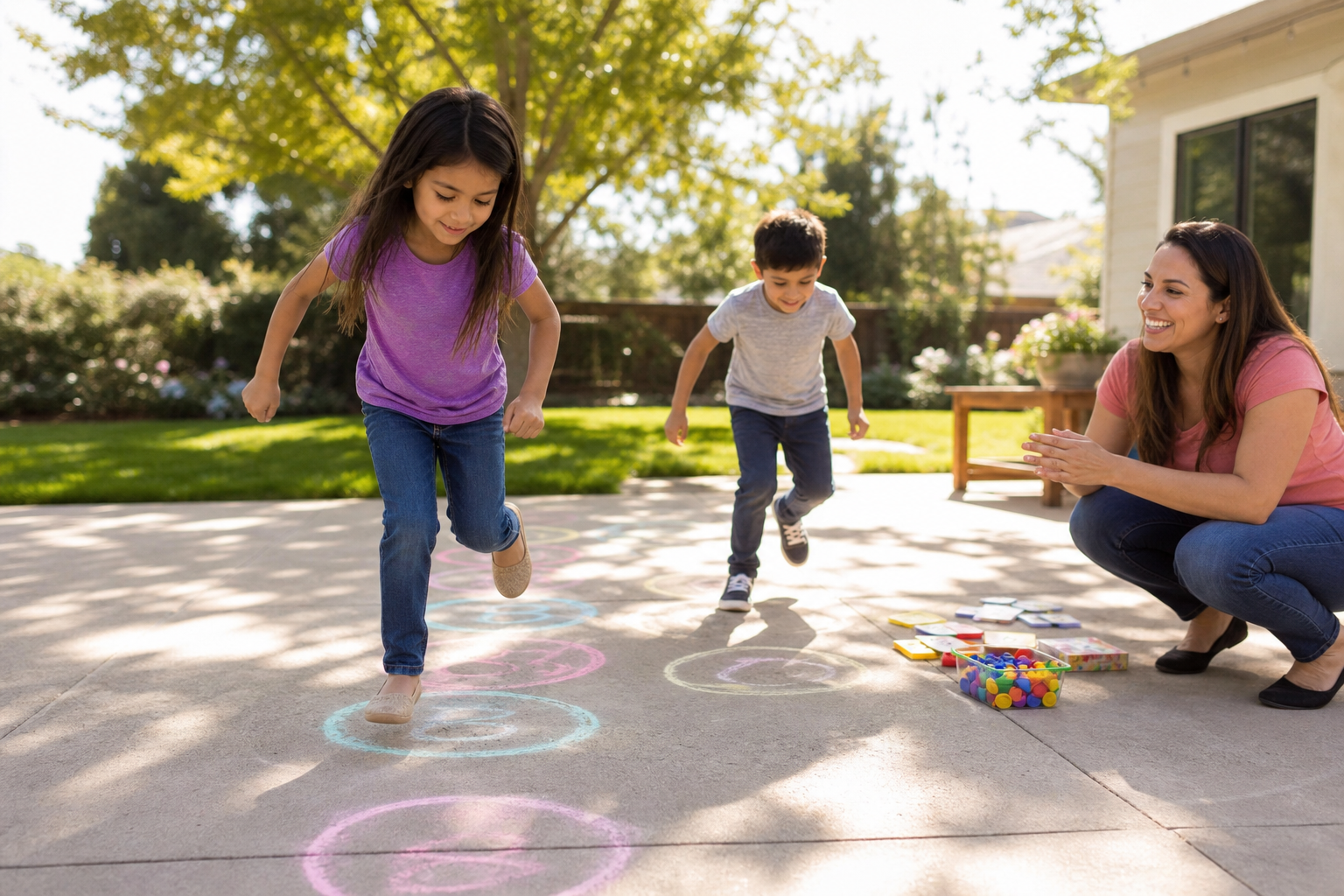
Draw ten circles in a path. Fill them with multiples: 2, 4, 6, 8, 10, and so on. Your child jumps from circle to circle and says each number. Then erase two numbers and ask the child to fill the missing multiples. Finally, translate the path into multiplication facts: the seventh circle in the 2s path is 14, so 7 × 2 = 14.
To add depth, draw arrays beside the path. For 4 × 3, draw four rows of three dots or three rows of four dots. The visual array makes the commutative property easier to notice: 4 × 3 and 3 × 4 both make 12. Rich problem collections from NRICH use similar visual reasoning because children need to see structure, not just answers.
A simple 15-minute routine for summer days
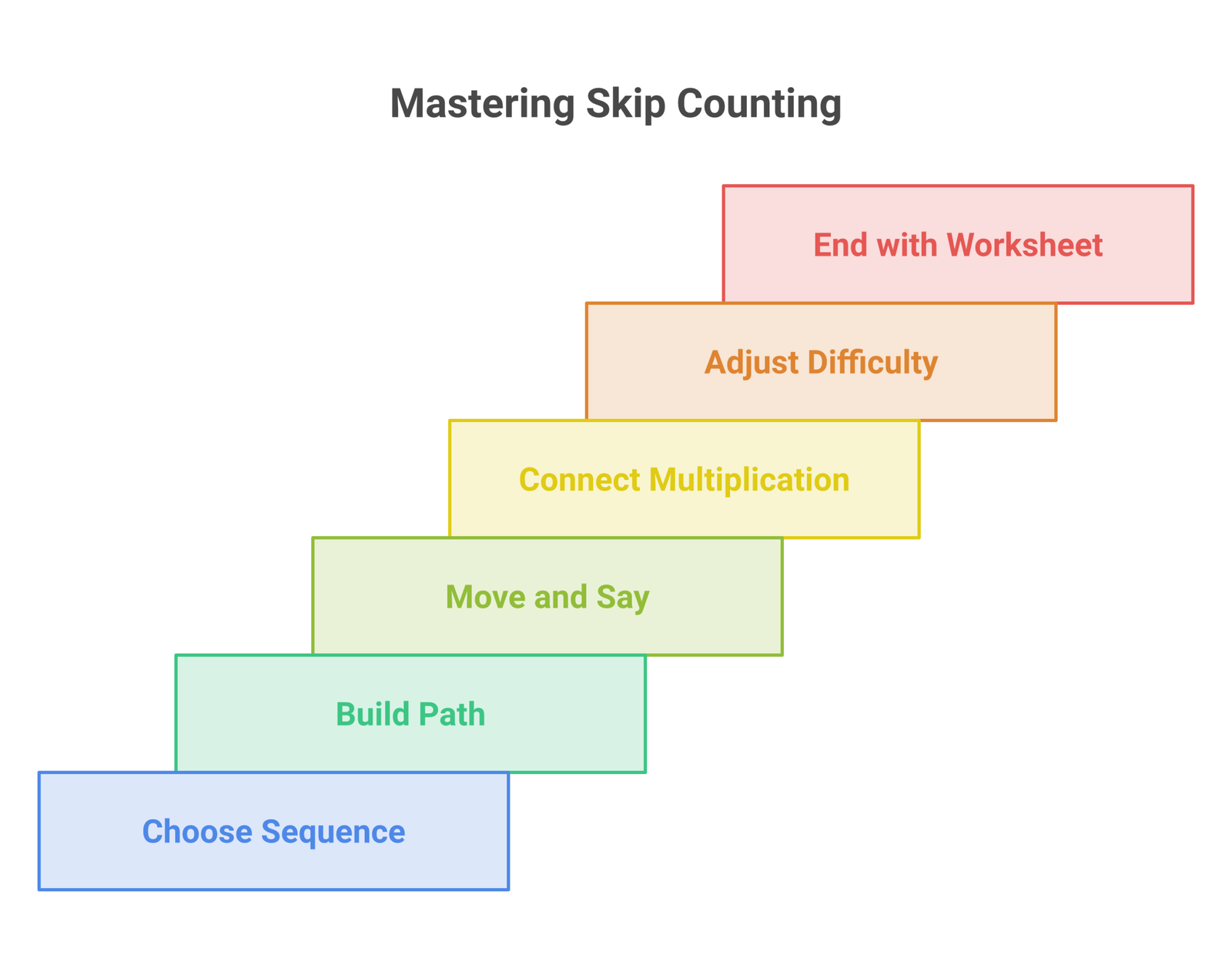
Here is the routine I recommend: two minutes to choose the sequence, eight minutes to play, three minutes to connect the game to facts, and two minutes to write or solve five examples. That final written step matters. It transfers the outdoor confidence back to the page. If you want this step ready in seconds, MathSpark can generate grade-appropriate worksheets for ages 5-14 in about 10 seconds, following a structured Pythagoras Exams-style approach and the Greek school curriculum.
For example, after a backyard game counting by 5s, generate or write five quick facts: 3 × 5, 6 × 5, 9 × 5, 5 × 10, and 5 × 12. The worksheet should feel like a victory lap, not a punishment. If the child misses more than two, the game was probably too difficult. Drop back to an easier sequence tomorrow.
How to adapt skip counting games by age
Ages 5-7 need counting, objects, and very short rounds. Use pairs, fives, and tens with toys, steps, shells, or snack pieces. Ages 8-10 can connect the sequence to multiplication facts, arrays, and missing-number challenges. Ages 11-14 can use skip counting as a warm-up for factors, multiples, least common multiples, ratios, and mental math.
The Education Endowment Foundation recommends using representations and discussion to strengthen mathematical understanding. That principle applies beautifully at home. Ask your child to explain the pattern: “How did you know the next number?” or “Which fact helped you?” Explanation turns a game into learning.
For middle schoolers, avoid babyish language. Call it a warm-up, a challenge, or a strategy game. Ask them to design the path for a younger sibling. Teaching someone else is a powerful way to reveal gaps and strengthen fluency.
📝 Important Note
Do not use movement games to hide a child’s real confusion. If the sequence never sticks after several short sessions, slow down and rebuild with objects, drawings, and smaller numbers.
When to move from skip counting to multiplication facts
Move on when your child can do three things: say the sequence, explain the groups, and answer a related fact without panic. For instance, a child who can count 4, 8, 12, 16 and say “that is four groups of 4” is ready for 4 × 4. If the child can only chant the sequence, keep connecting it to objects and groups.
The What Works Clearinghouse math intervention guide supports regular fluency activities, but fluency should mean accurate, flexible recall built from understanding. Timed practice can help some children, but it should not be the first tool for a child who is anxious. First build meaning. Then build speed.
You can also use high-quality digital practice in moderation. PBS Kids math games are useful for younger learners, while Mathigon offers rich visual math for older students. Digital tools work best when they support the same patterns you are practicing offline.
Make it easy enough to repeat
The best skip counting games are the ones you will actually repeat. Keep materials simple: chalk, a ball, cups, stones, shells, cards, or pool toys. Keep the session short. Stop while the child still feels successful. A parent who tries to cover every multiplication table in one afternoon will usually create resistance. A parent who plays one focused game four times this week will get better results.
If you are building a broader summer plan, connect this activity with your summer math routine, your plan to prevent summer math slide, and other hands-on ideas like fun fraction activities or outdoor measurement games. The point is continuity. Small experiences stack.
For children who need extra reassurance, resources from Understood can help parents think about attention, confidence, and learning differences. A child who avoids multiplication may be overwhelmed, not lazy. Outdoor games help because they lower the emotional temperature.
⚠️ Disclaimer
This June 2026 guide is educational information for parents and is not a diagnosis or individualized learning plan. If your child has persistent difficulty with number patterns, fact recall, or math anxiety, consider speaking with a teacher or qualified learning specialist.
Frequently Asked Questions
What are the best numbers for skip counting games?
Start with 2s, 5s, and 10s because children can see the patterns quickly. Then add 3s and 4s before moving to harder facts.
How long should a game last?
Ten to fifteen minutes is enough. Short, repeated practice is usually better than one long session that ends in frustration.
Should I correct every mistake immediately?
Correct gently, but do not interrupt constantly. Step back to the last correct number, say the next two together, and continue.
Can skip counting replace multiplication worksheets?
No. It prepares children for worksheets by building meaning. A few written facts after the game help transfer learning back to paper.
What if my child thinks this is too easy?
Add missing numbers, backward counting, larger multiples, or ask the child to design a game for someone else.