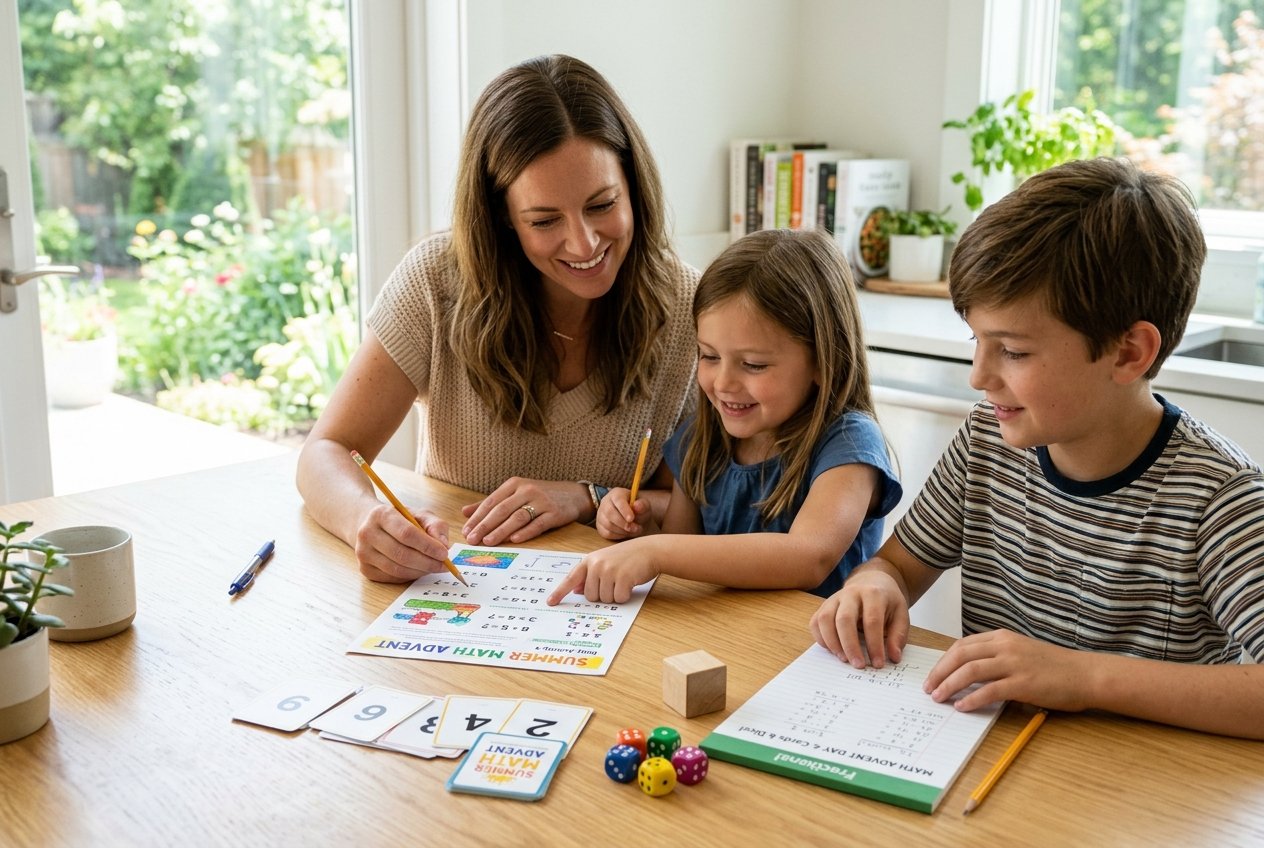
Beat the Summer Slide: Printable Math Worksheets

Summer math worksheets can be the difference between a child who returns to school rusty and a child who walks in feeling steady, prepared, and proud. The trick is not to turn July into a second school year. The trick is to give kids aged 5 to 14 a small, predictable rhythm of practice that protects number sense, facts, fractions, problem solving, and confidence without creating daily arguments.
Research summaries from NWEA summer learning research and family guidance from Harvard Graduate School of Education point in the same direction: math skills can fade when children stop using them, and short, regular practice helps. That is why a printable worksheet plan works best when it feels light, varied, and connected to real life.
Why Summer Math Worksheets Work Best in Small Doses
Worksheets are useful because they make practice visible. A parent can see whether a child is fluent with addition, whether multiplication facts are shaky, whether fractions are confusing, or whether word problems cause a freeze. But printable practice only helps when it is matched to the child. A five-year-old needs counting, comparison, shapes, and playful addition. A nine-year-old may need multiplication, division, fractions, and measurement. A fourteen-year-old may need decimals, ratios, percentages, pre-algebra, and geometry review.
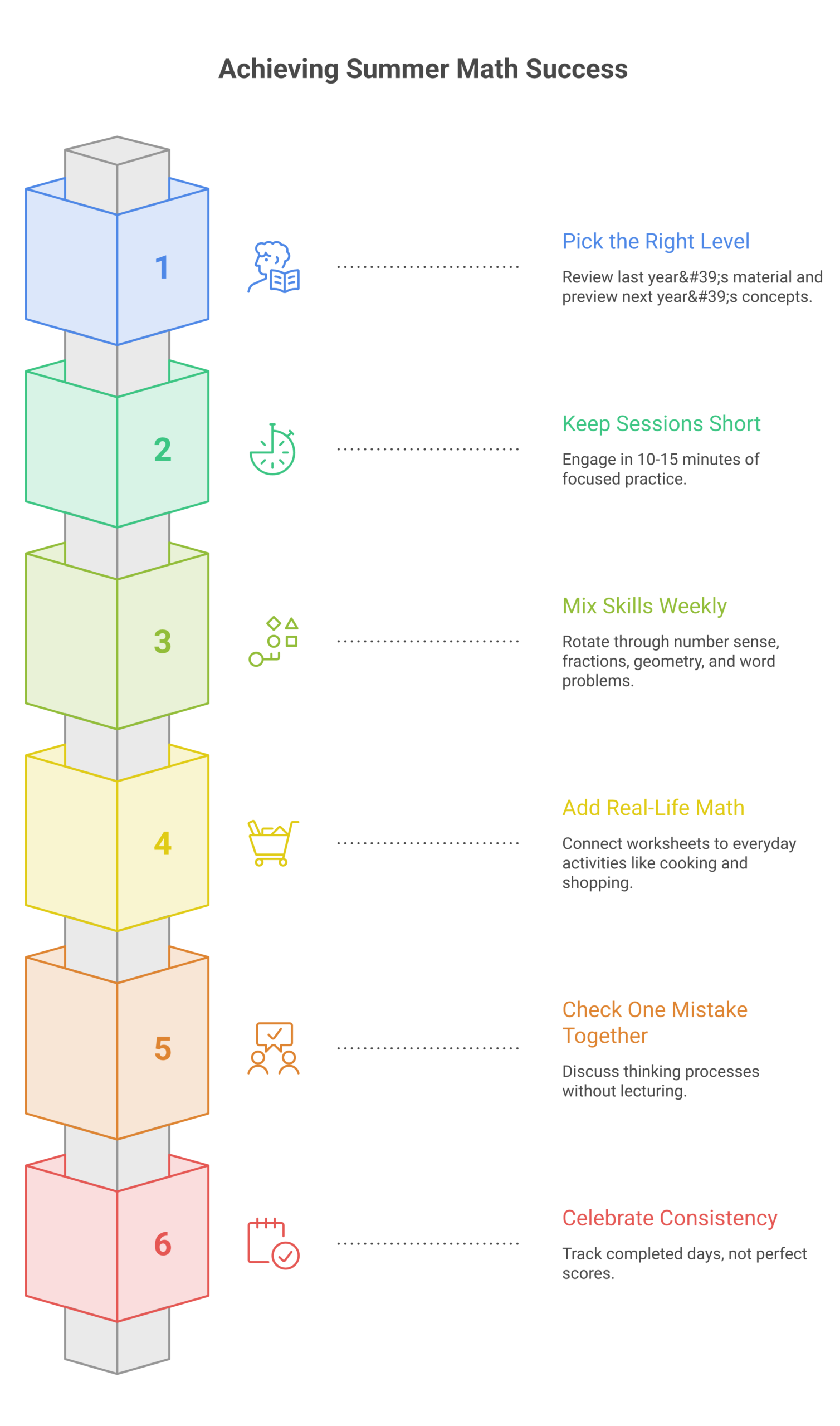
The Education Endowment Foundation recommends practical parent support that builds routines and discussion, not long lectures. The Institute of Education Sciences practice guide also emphasizes clear examples, practice, and review. For families, that translates into 10 to 15 minutes, three to five times per week, with one skill focus at a time. If your child already has a summer math routine, use worksheets to support that rhythm rather than replace summer fun.
✓ Why It Helps
- ✓ Short practice protects skills without draining motivation
- ✓ Printable pages make progress easy to see
- ✓ Mixed review helps kids connect old and new topics
- ✓ Parents can spot gaps before September
- ✓ A calm routine lowers math anxiety
Choose Worksheets by Age, Not Just Grade
Ages 5 to 7 need concrete, visual pages. Look for counting objects, ten frames, number lines, simple addition, simple subtraction, shapes, patterns, and measurement with familiar objects. If a worksheet looks crowded, split it in half. Young learners often need success first and challenge second. A page with six thoughtful problems can be better than a page with thirty tiny sums.
Ages 8 to 10 usually benefit from mixed operations, place value, multiplication arrays, beginning division, fractions as parts of a whole, money, time, and simple word problems. This is also the age where parents should listen for strategy. If your child says, “I just know it,” ask them to show another way. Resources such as Khan Academy math and Illuminations by NCTM can give extra models when a printed page is not enough.
Ages 11 to 14 need review that feels mature. Use percentages, ratios, decimals, integers, coordinate grids, area, perimeter, volume, and multi-step word problems. Public school examples like a Montgomery County summer packet example show how review packets can revisit several strands across the summer. Keep the tone respectful. Older kids resist babyish pages, even when the skill gap is real.
💡 Pro Tip
If a child misses more than one-third of a worksheet, the page is probably too hard for independent summer practice. Step back one level, rebuild fluency, then return to the harder page later.
A 4-Week Printable Worksheet Plan for Kids Aged 5–14
Week one should be diagnostic and gentle. Give two short pages from last year’s material, not next year’s. Notice where your child works smoothly and where they pause. Do not grade everything in red. Circle one strong strategy and one topic to revisit. This week is about finding the starting line.
Week two should rebuild fluency. Younger children can practice number bonds, skip counting, and simple addition or subtraction. Upper elementary children can review multiplication facts, division, fractions, and word problems. Middle school students can review decimals, integers, equations, and percentages. Use printable pages because they keep the work focused, but add one real-life example after each session.
Week three should mix skills. This is where many children become stronger because they stop treating math as isolated boxes. A worksheet might include four computation problems, two word problems, one measurement problem, and one challenge puzzle. Sites like NRICH mathematics are useful for adding reasoning tasks when your child needs something richer than drills.
Week four should preview lightly. Choose one topic from the next school year and introduce it with very easy examples. For a rising third grader, that may be multiplication as equal groups. For a rising sixth grader, it may be ratios. For a rising eighth grader, it may be linear relationships. The goal is recognition, not mastery.
📝 Important Note
For July 2026, keep practice flexible around travel, heat, family visits, and camps. Missing a day is not failure. Restarting calmly is the skill you want your child to learn.
Make Worksheets Feel Like Real Math, Not Busywork
Children are more willing to complete a page when they can see why the skill matters. After a fraction worksheet, cut fruit, pour juice, or halve a recipe. After a money worksheet, compare two supermarket offers. After a geometry page, measure a room, a suitcase, or a garden pot. This is where printable work becomes practical thinking.
The National Council of Teachers of Mathematics consistently promotes reasoning, communication, and problem solving, not just answer getting. So after a worksheet, ask one question: “How did you know?” That single sentence turns a page of answers into a conversation. If your child struggles to explain, let them draw, use objects, or point to the step that helped.
Tools can help when they remove preparation friction. MathSpark worksheet generator creates AI-powered math worksheets for grades 1 to 9 in seconds, follows the Pythagoras Exams methodology, and supports the Greek school curriculum. Use it the way a smart parent would use any worksheet source: choose the level, keep the session short, and discuss one idea afterward. You can also combine it with printable addition worksheets for younger learners or prevent summer math slide if summer slide is the main concern.
What to Put in a Weekly Worksheet Basket
Create a small folder or basket with pencils, a ruler, blank paper, printed pages, dice, playing cards, and a simple progress tracker. Add one “easy win” page, one grade-level page, and one puzzle page each week. If everything in the basket is difficult, children learn to avoid it. If everything is easy, they do not grow. The balance matters.
For online support, use carefully chosen resources. Math Learning Center free apps gives visual models like number frames and fraction pieces. Common Sense Media learning resources can help parents choose apps and websites with more confidence. Bedtime Math is a friendly option for families that prefer story-based math prompts. The worksheet remains the anchor, but these tools add variety.
A strong weekly mix for ages 5 to 14 includes one fluency page, one word problem page, one visual math page, and one real-world challenge. For example, a child might practice multiplication facts on Monday, read a shopping word problem on Wednesday, complete a geometry drawing on Friday, and estimate the cost of a family snack on Sunday. That is enough to keep math alive without making summer feel like punishment.
How Parents Should Respond to Mistakes
The fastest way to ruin summer math is to treat every error as a crisis. A mistake tells you what to teach next. If the child misunderstands the operation, model one example. If the child rushes, ask them to underline key numbers. If the child guesses, ask them to estimate first. If the child shuts down, reduce the number of problems and restore confidence.
Try a three-step correction routine. First, praise a useful behavior: “You kept going.” Second, ask a thinking question: “Where did the problem change?” Third, solve one similar problem together. Do not re-teach the entire topic unless the gap is large. Most summer practice should end with the child feeling capable enough to come back tomorrow.
For children who dislike worksheets, offer choice. Let them choose the order, the pencil color, the timer, or whether to do the first half before breakfast or after swimming. Choice does not remove the expectation. It makes the expectation easier to accept.
⚠️ Disclaimer
This article is educational guidance for July 2026 and is not a substitute for advice from your child’s teacher, school, or specialist. If your child has persistent difficulty, high anxiety, or diagnosed learning needs, ask for individualized support.
The Simple Rule: Consistency Beats Intensity
A perfect two-hour worksheet marathon in July is less useful than ten calm minutes repeated across the month. Children build confidence through repetition, feedback, and small wins. Parents build confidence when the plan is simple enough to maintain. That is why printable summer math worksheets work best as a routine, not an emergency rescue plan.
Start with review, keep the pages short, connect one problem to real life, and celebrate effort. When September arrives, your child does not need to be ahead of everyone. They need to feel ready to participate, remember core skills, and believe that math is something they can handle.
Frequently Asked Questions
How often should my child do summer math worksheets?
Most children do well with 10 to 15 minutes, three to five times per week. Short, consistent practice is better than occasional long sessions.
Should worksheets review old skills or teach new ones?
Start with last year’s skills, then add a light preview near the end of summer. Review builds confidence and makes new material easier.
What if my child hates worksheets?
Use fewer problems, add choice, connect the page to a real activity, and discuss only one mistake. The goal is calm consistency, not a battle.
Are printable worksheets enough to prevent summer slide?
They help most when combined with games, reading, cooking, shopping, measuring, and math conversations.
What is the best worksheet level for ages 5 to 14?
Choose pages your child can complete with about 70 to 85 percent accuracy. If they miss too much, step back and rebuild.