Summer Math Advent: 10 Daily Activities for Kids
Summer math activities that feel like play
Summer math activities do not need to look like school. The best plan for kids ages 5–14 is short, playful, visible, and easy for a tired parent to start after breakfast or before the beach. Research on summer learning consistently shows that math skills are more vulnerable to long breaks than many reading skills, with the National Summer Learning Association highlighting the importance of regular, high-quality practice during vacation months. That does not mean worksheets all day. It means ten calm minutes, a clear target, and a little novelty.
The idea behind a Summer Math Advent is simple: choose one tiny math mission each day for ten days, then repeat the cycle with harder numbers or a new theme. A five-year-old might count shells, sort coins, or jump along a chalk number line. A fourteen-year-old might estimate discounts, compare ratios, or model the cost of a family outing. If you want a ready-made companion, MathSpark can generate AI-powered worksheets for grades 1–9 in about ten seconds, following the Pythagoras Exams methodology and the Greek school curriculum, so you can pair playful practice with a quick written check without turning summer into tutoring.
This approach also matches what parents already know: children practice longer when the task feels purposeful. A game with dice, cards, recipes, shopping lists, or sports scores gives math a reason to exist. It keeps the emotional temperature low, which matters because OECD PISA 2022 data connect higher mathematics anxiety with lower performance across education systems. The goal is not to race. The goal is to help your child say, “I can try this,” one small win at a time.
✓ Why the 10-day format works
- ✓ Short sessions reduce resistance and protect the holiday mood.
- ✓ Repeated practice supports memory without cramming.
- ✓ Games make children explain strategies, not just chase answers.
- ✓ Parents can adapt the same activity for siblings at different ages.
The parent rule: ten minutes, one skill, no drama
Ten minutes is enough when the focus is sharp. The What Works Clearinghouse elementary math intervention guide emphasizes explicit instruction, guided practice, visual representations, cumulative review, and fluent retrieval of arithmetic facts. At home, that translates into a tiny routine: explain the game, play one round together, let the child try, then ask one reflection question. You are not recreating a classroom. You are creating a low-pressure repetition loop.
For younger children, pick one concrete idea: counting forward and backward, making ten, comparing lengths, naming shapes, or recognizing halves and quarters. For upper elementary children, rotate multiplication facts, place value, fractions, elapsed time, and word problems. For middle school students, use ratios, percentages, averages, negative numbers, and simple algebraic thinking. If the activity is too easy, change the numbers. If it is too hard, reduce the numbers and keep the same game.
A helpful pattern is “show, play, explain.” First, show one example out loud. Then play. Finally, ask your child how they knew. That last question is where learning deepens. The National Council of Teachers of Mathematics argues that well-designed math games build fluency through reasoning, strategy, and discussion rather than isolated drill. A child who explains why 8 + 7 can become 8 + 2 + 5 is building number sense, not just memorizing an answer.
💡 Pro Tip
Keep a small summer math basket with dice, cards, coins, graph paper, chalk, a tape measure, and two pencils. When everything is visible, starting becomes easy. Add one printed practice page from MathSpark when your child needs a quiet written follow-up.
The 10 Summer Math Advent activities
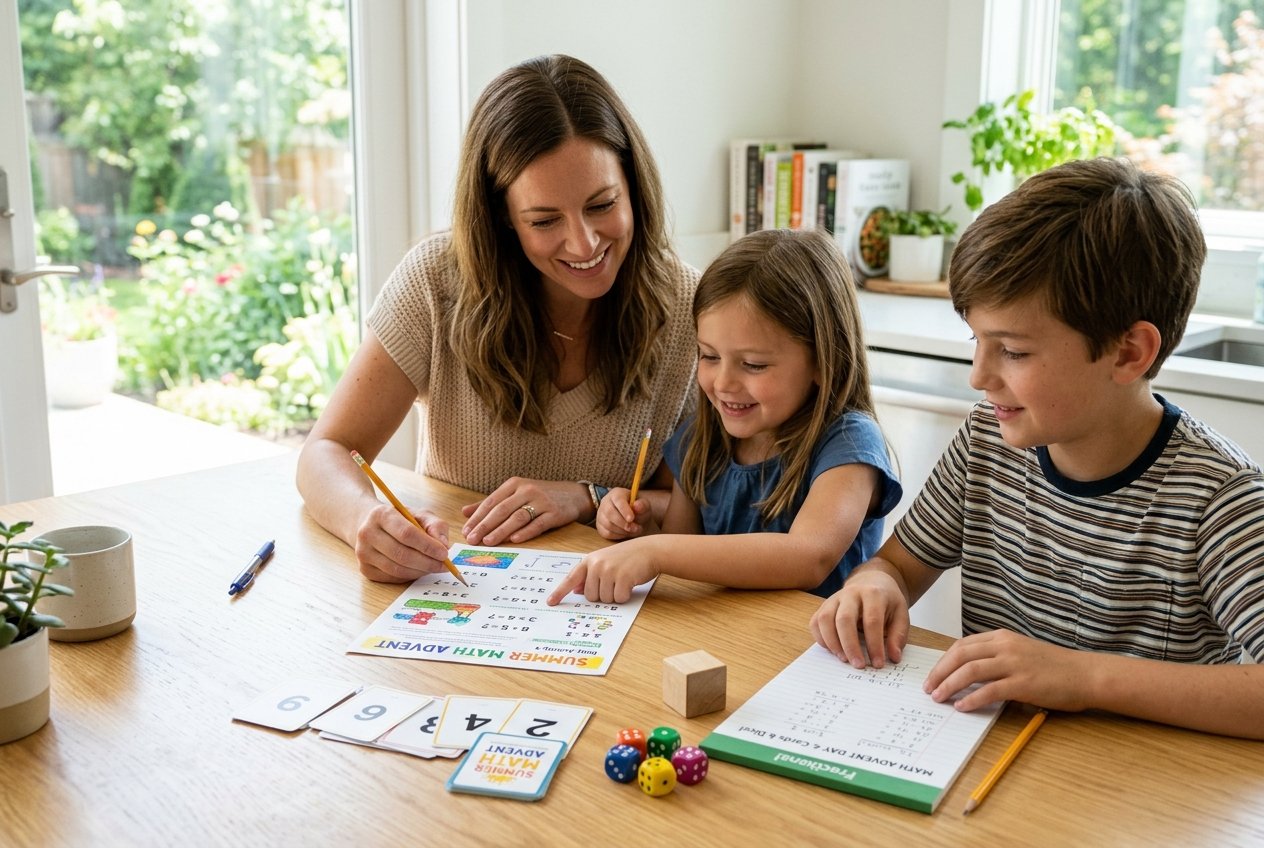
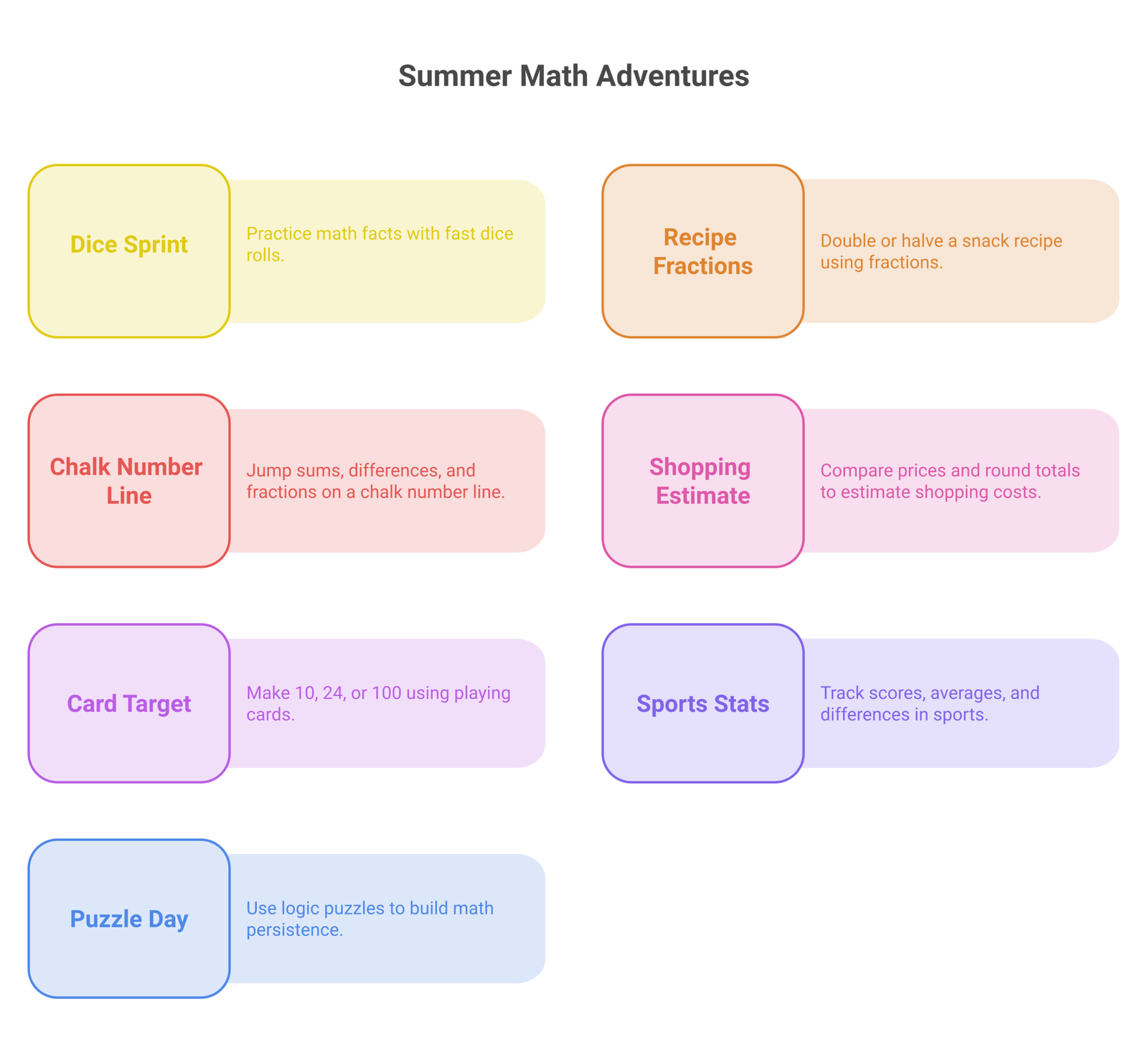
Day 1 is Dice Sprint. Roll two dice and ask younger children to add, subtract, or compare. Older children can multiply, create fractions, or build expressions. For example, with 4 and 6 they might make 10, 24, 2, two-thirds, or 4x + 6. Keep score for five rounds and ask which strategy was fastest.
Day 2 is Recipe Fractions. Choose a snack recipe and halve or double it. Younger children can count cups and spoons. Older children can convert one-half cup into two quarter-cups or compare ratios. This supports the same conceptual foundation described in the IES fractions practice guide, which stresses that fractions should be understood as numbers and quantities, not just rules to memorize.
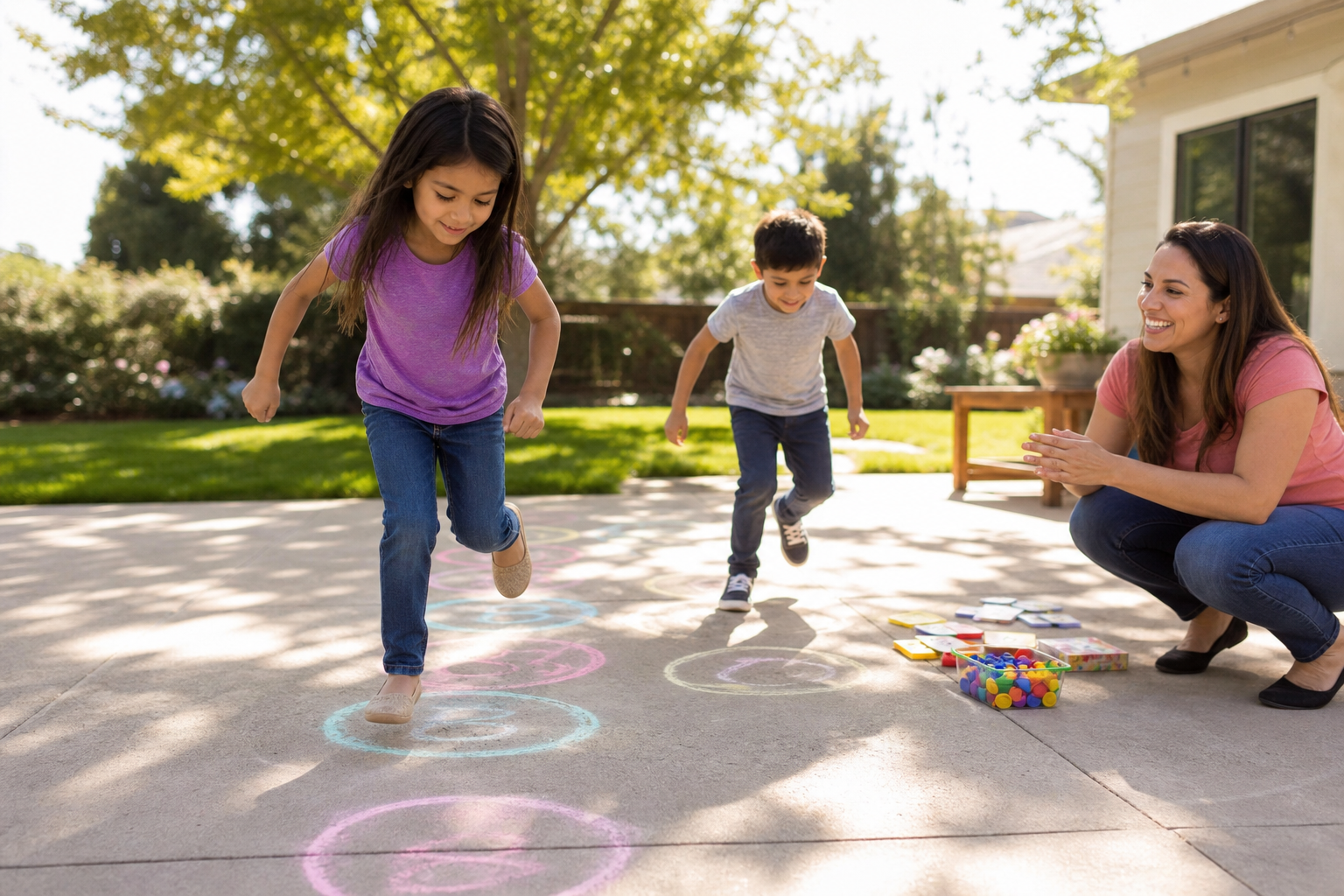
Day 3 is Chalk Number Line. Draw a long number line outside. Small children jump from 0 to 20 by ones, twos, or fives. Older children mark halves, quarters, negative numbers, or decimals. Physical movement makes abstract order visible. The CDC guidance on children’s physical activity reminds families that children benefit from regular movement, and this activity sneaks movement into practice.
Day 4 is Shopping Estimate. Give your child a pretend budget or a real supermarket receipt. Ask them to round prices, predict the total, find the better deal, or calculate a discount. This works beautifully for ages 8–14 because it connects number sense to family life. It also prepares children for percentage and ratio thinking without announcing, “Today we study percentages.”
Day 5 is Card Target. Draw four playing cards and try to make 10, 24, 50, or 100 using operations your child knows. Younger children can simply make pairs that add to 10. Older children can use parentheses and exponents. This is a compact way to practice flexible computation. If your child enjoys this, pair it with a related lesson from Khan Academy math or a quick worksheet from MathSpark so the skill transfers to written problems.
Day 6 is Sports Stats. Track football shots, swimming laps, basketball points, or step counts. Ask for the difference, average, maximum, minimum, or percentage improvement. Children who dislike “math” often accept math when it explains something they care about.
Day 7 is Puzzle Day. Use tangrams, Sudoku-style grids, Kakuro, logic riddles, or pattern blocks. Logic puzzles build persistence, the ability to test a hypothesis, and the habit of checking constraints. The free tools in NCTM Illuminations are useful when you want digital manipulatives rather than another app full of distractions.
Day 8 is Map Math. Plan a walk, beach trip, or imaginary road trip. Estimate distance, time, fuel, or stops. Younger children compare near and far. Older children calculate speed, scale, and unit rates. This one is especially good for mixed-age siblings because everyone can contribute at a different level.
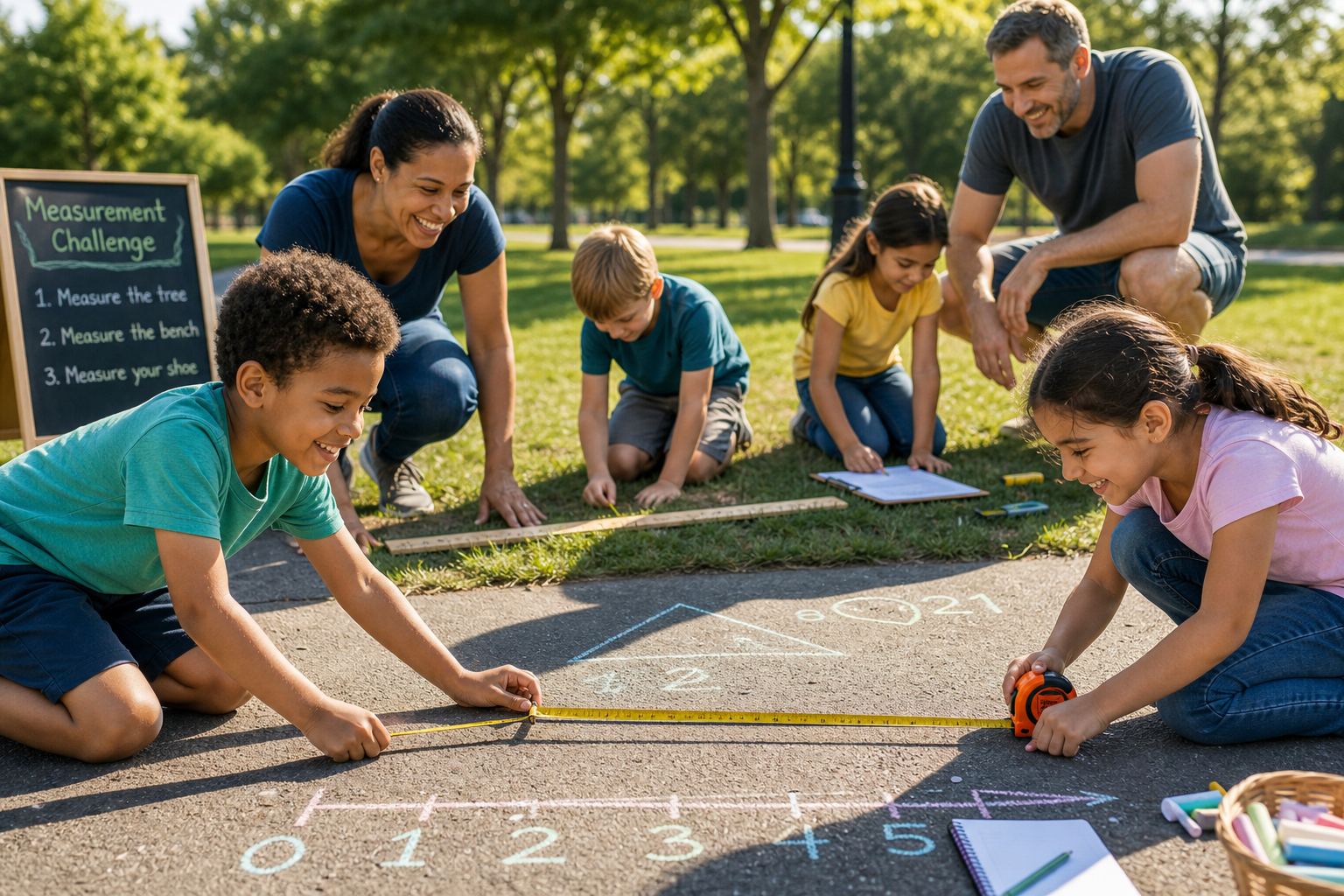
Day 9 is Build and Measure. Use LEGO, paper, boxes, or sticks to build a bridge, tower, or tiny city. Measure height, area, perimeter, symmetry, or volume. Ask what changed after a redesign. This supports spatial reasoning and makes geometry feel useful.
Day 10 is Create the Challenge. Your child invents a math game for you. They write the rules, choose the numbers, and test whether the game is fair. This final day matters because ownership changes the emotional tone. A child who designs a challenge has to think like a mathematician: define rules, check cases, and explain why the game works.
📝 Important Note
Do not use every activity as a test. If your child is frustrated, reduce the numbers, switch to mental estimation, or stop after one successful round. Summer practice should protect confidence first.
How to adapt the same plan for ages 5–14
For ages 5–7, keep the activity concrete. Use shells, toys, snacks, coins, blocks, and body movement. Ask questions like “Which group has more?”, “How many are left?”, “Can you make ten?”, and “What shape do you see?” At this age, accuracy matters, but language matters too. Children are building the words that later support formal math.
For ages 8–10, add written recording. After a game, ask your child to write two equations, draw a quick model, or explain one strategy in a sentence. This is where number sense practice and word-problem confidence begin to connect. If your child struggles, use visual models before procedures. Arrays, bar models, number lines, and fraction strips prevent rules from becoming empty steps.
For ages 11–14, increase choice and complexity. Let them plan a budget, compare phone plans, calculate sale prices, analyze sports data, or write a simple equation for a real situation. Middle school students are often allergic to anything that feels childish, so present the activity as a practical problem, not a cute game. You can still keep it short.
The most important adaptation is emotional. Children with math anxiety need safety before challenge. The OECD brief Does Math Make You Anxious? reports that many teenagers worry math classes will be difficult or fear poor grades. Parents can counter that by praising strategies, not speed, and by making mistakes normal. Try saying, “That strategy did not work yet. What could we change?” instead of “You know this.”
A simple weekly rhythm parents can actually keep
If ten straight days feels unrealistic, turn the Summer Math Advent into a weekly rhythm. Monday can be mental math, Tuesday measurement, Wednesday games, Thursday real-life money math, and Friday a short worksheet. Weekend practice can be optional: puzzles, cooking, or map planning. The secret is not intensity. The secret is recurrence.
This is where spaced practice helps. Instead of doing one giant fractions session in July, touch fractions briefly every few days: a recipe on Monday, a number line on Thursday, and a short worksheet on Friday. The What Works Clearinghouse practice guide collection repeatedly points educators toward cumulative review and structured routines. Parents can use the same principle in a lighter way.
Keep a visible tracker, but avoid turning it into a pressure chart. A simple calendar with stickers works for younger children. Older children can choose the activity order and rate the difficulty from 1 to 5. If an activity earns a 5, repeat it later with easier numbers. If it earns a 1, make it harder next time. This teaches self-monitoring, which is useful far beyond math.
For bilingual families in Greece, you can also switch language intentionally. Say the problem in Greek, write the equation in symbols, then ask for the explanation in English, or the reverse. Math symbols travel well across languages, but explanations reveal understanding. This is especially helpful when children move between Greek schoolwork and English online resources such as CK-12.
✓ Quick setup checklist
- ✓ Choose one skill before you start.
- ✓ Use real objects whenever possible.
- ✓ Stop while the child still feels successful.
- ✓ Ask “how did you know?” after the answer.
- ✓ Repeat the same game with new numbers two days later.
When to use worksheets without killing the fun
Worksheets are not the enemy. Bad timing is. A worksheet works best after a child has explored the idea with objects, movement, or a game. If your child jumps on a chalk number line, then solves five number-line problems on paper, the page feels like a record of something they understand. If the page appears first, it can feel like a test.
A good summer worksheet should be short, targeted, and slightly below panic level. For a child who is rebuilding confidence, start easier than you think. One clean page on multiplication arrays is better than four pages of mixed stress. This is exactly why AI-generated practice can help: with MathSpark you can choose a grade, topic, and difficulty quickly instead of searching for the “least bad” printable at midnight.
Use worksheets for three purposes: to check whether a playful activity transferred to paper, to review a skill that keeps fading, or to prepare for September without cramming. Do not use worksheets to punish mistakes. Do not stack them because your child “should know this by now.” The home advantage is that you can respond to the child in front of you.
If you want to connect this post with deeper homework support, read a related parent guide such as helping with math homework without stress or a confidence-building activity like math games for everyday practice. Internal linking matters less than the bigger point: children need a coherent experience where games, explanations, and written practice all point in the same direction.
The real goal: confidence that survives September
The Summer Math Advent is not about getting ahead for the sake of getting ahead. It is about keeping mathematical thinking alive in a season when routines disappear. A child who estimates, compares, measures, explains, and laughs with numbers several times a week returns to school with less rust and more courage.
UNESCO frames foundational numeracy as part of the learning base children need for school success and lifelong learning, and its foundational learning work keeps numeracy beside literacy as a global priority. That sounds big, but at home it becomes small: count the shells, double the recipe, compare the prices, measure the jump, explain the strategy.
If you remember one thing, remember this: consistency beats intensity. Ten playful minutes repeated across the summer will do more for most children than one heroic Sunday of forced review. Keep it warm, keep it specific, and let your child feel the quiet pride of getting better.
Frequently Asked Questions
How long should summer math activities take each day?
Ten to fifteen minutes is enough for most families. Stop sooner if your child is tired, and repeat the activity later with easier numbers.
What if my child hates math?
Start with games, movement, money, food, or sports data. Avoid speed pressure. Praise strategies and persistence before correct answers.
Should I use worksheets during summer?
Yes, but use short targeted worksheets after hands-on practice. They should confirm learning, not replace playful exploration.
How can siblings of different ages play together?
Use the same materials with different questions. One child counts dice dots while another multiplies, creates fractions, or writes equations.
What is the best activity for older children?
Budgeting, sports statistics, recipe scaling, map planning, and card target games work well because they feel practical rather than childish.