Outdoor Measurement Games for Warm-Weather Learning
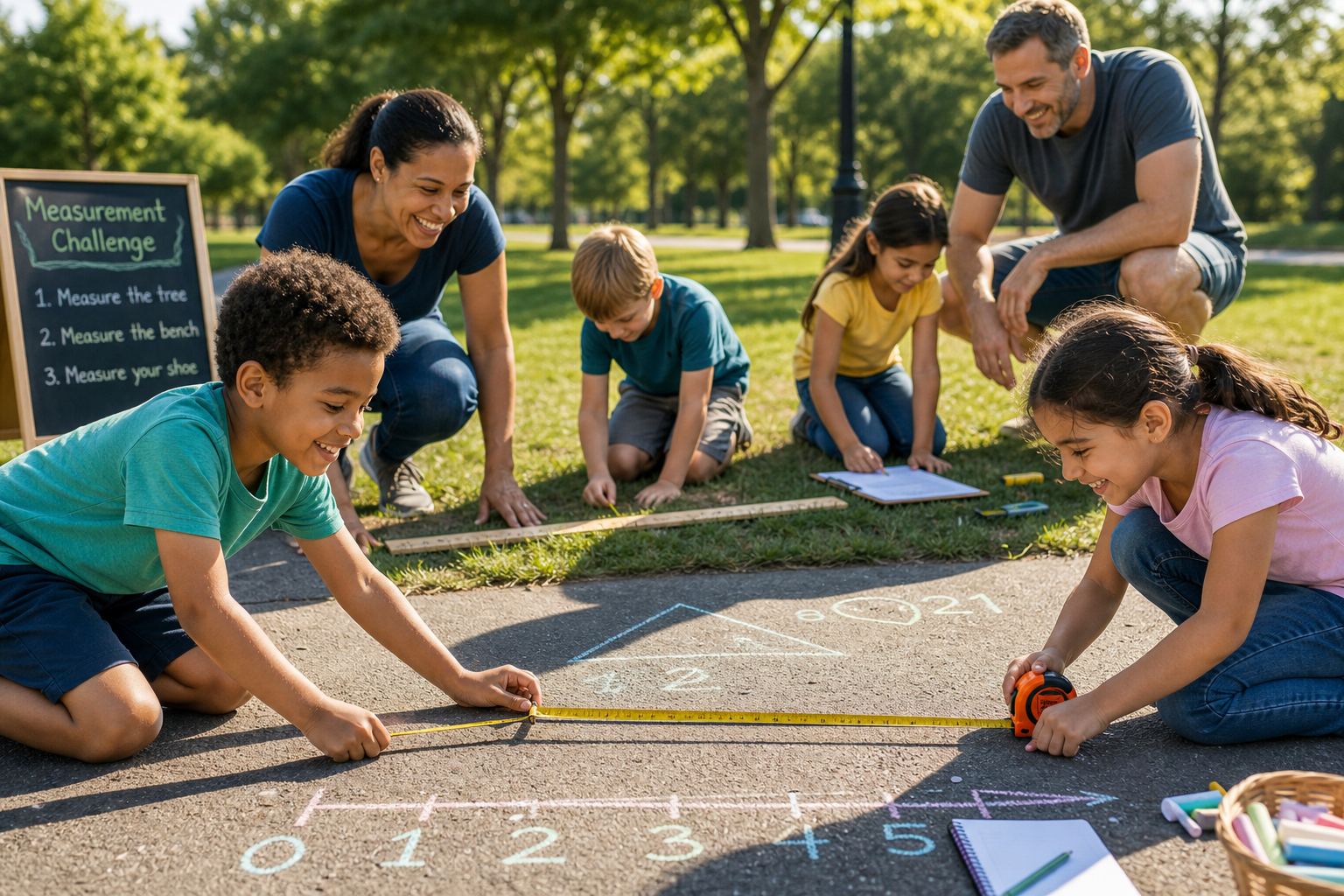
Outdoor measurement games are one of the easiest ways to turn warm-weather energy into calm, useful math practice. Instead of asking a child to sit still with a workbook after a long school year, you give them a tape measure, chalk, a stopwatch, a bucket, or a handful of sticks and ask them to investigate the real world. That shift matters: measurement is naturally physical, visual, and practical, so children can see why centimeters, meters, time, capacity, perimeter, and estimates actually exist. The goal is not to create a perfect mini-lesson. The goal is to create ten to twenty minutes of confident practice without a fight.
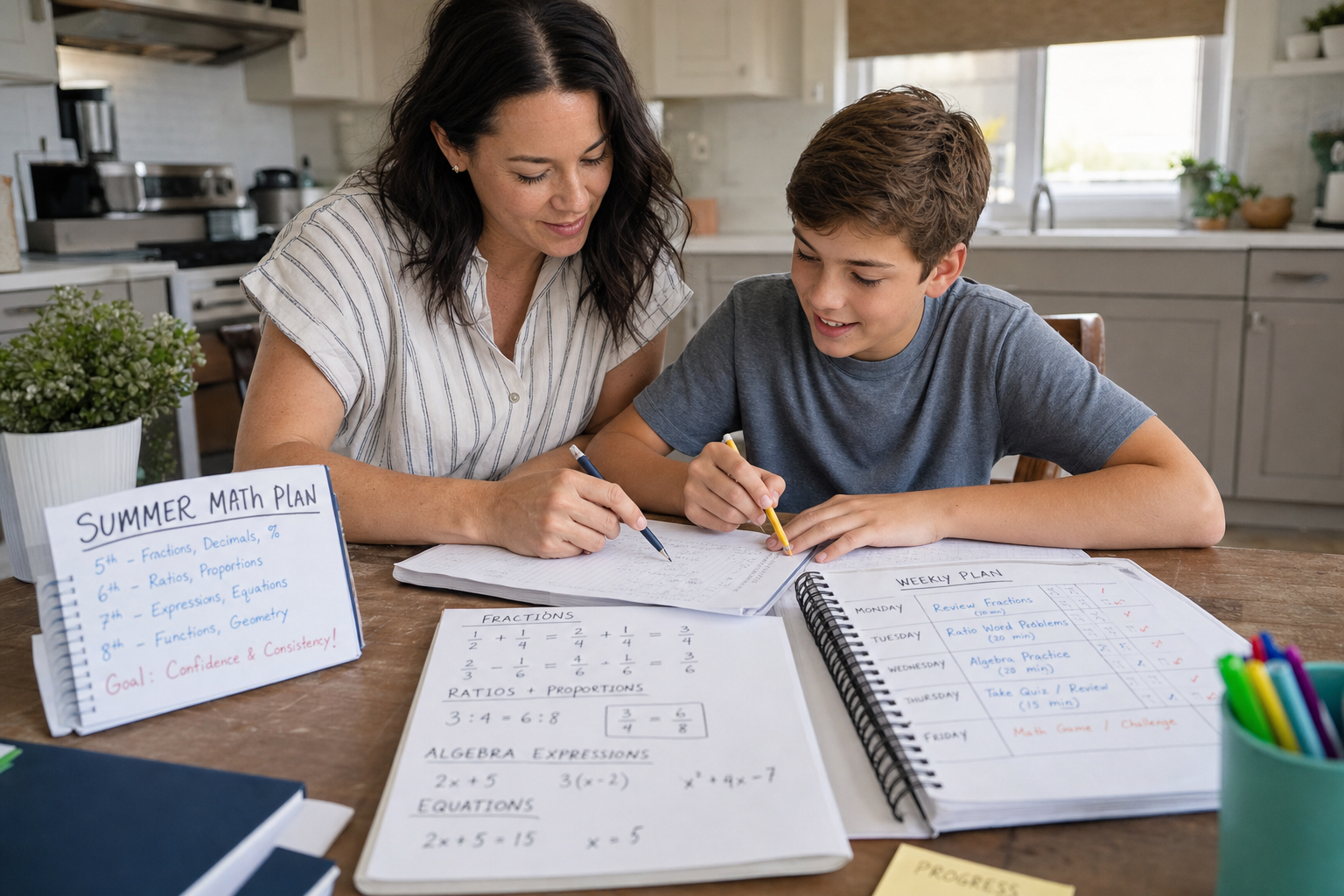
This guide is written for parents of children in grades 1 to 9, with adjustments for younger and older learners. It follows a simple progression recommended across early math education: compare first, use informal units next, then introduce standard tools. The National Council of Teachers of Mathematics highlights measurement as a core school strand, while the Common Core measurement standards organizes measurement and data expectations around real tools, real units, and practical problem solving. If you want a printable follow-up after the game, MathSpark can generate grade-appropriate math worksheets in about 10 seconds, including practice that connects outdoor play with the Greek school curriculum and Pythagoras-style reasoning.
📺 Video Guide
Why outdoor measurement games work
Measurement is different from many other math topics because children can test it immediately. If they estimate that a garden path is 20 steps long, they can walk it. If they think a bucket holds more than a bottle, they can pour water and check. This immediate feedback lowers pressure because the child is not waiting for an adult to announce whether the answer is right. The environment gives the answer, and the parent becomes a coach rather than a judge.
Outdoor learning also supports attention. Warm weather, movement, and fresh tasks help children who struggle with desk-based practice. Research available through NCBI research on physically active math found that math lessons with task-relevant physical activity can improve math achievement for young learners when movement is part of the learning rather than a random break. Stanford DREME also notes that outdoor settings naturally invite children to compare, sort, count, and measure, which makes Stanford DREME outdoor math guidance especially useful for families who want math practice to feel less forced.
The best part is that outdoor measurement games are cheap. You do not need special equipment. A tape measure, chalk, string, cups, a kitchen scale, a stopwatch, and paper are enough. If your child already enjoys posts like Δραστηριότητες με Κλάσματα και Καλοκαιρινά Σνακ, this is a natural next step: move the math from the table to the balcony, courtyard, park, beach, or playground.
✓ What children practice outside
- ✓ Estimation before exact calculation
- ✓ Standard and non-standard units
- ✓ Length, perimeter, area, capacity, mass, time, and temperature
- ✓ Data recording, comparison, and mathematical language
- ✓ Confidence because mistakes become experiments
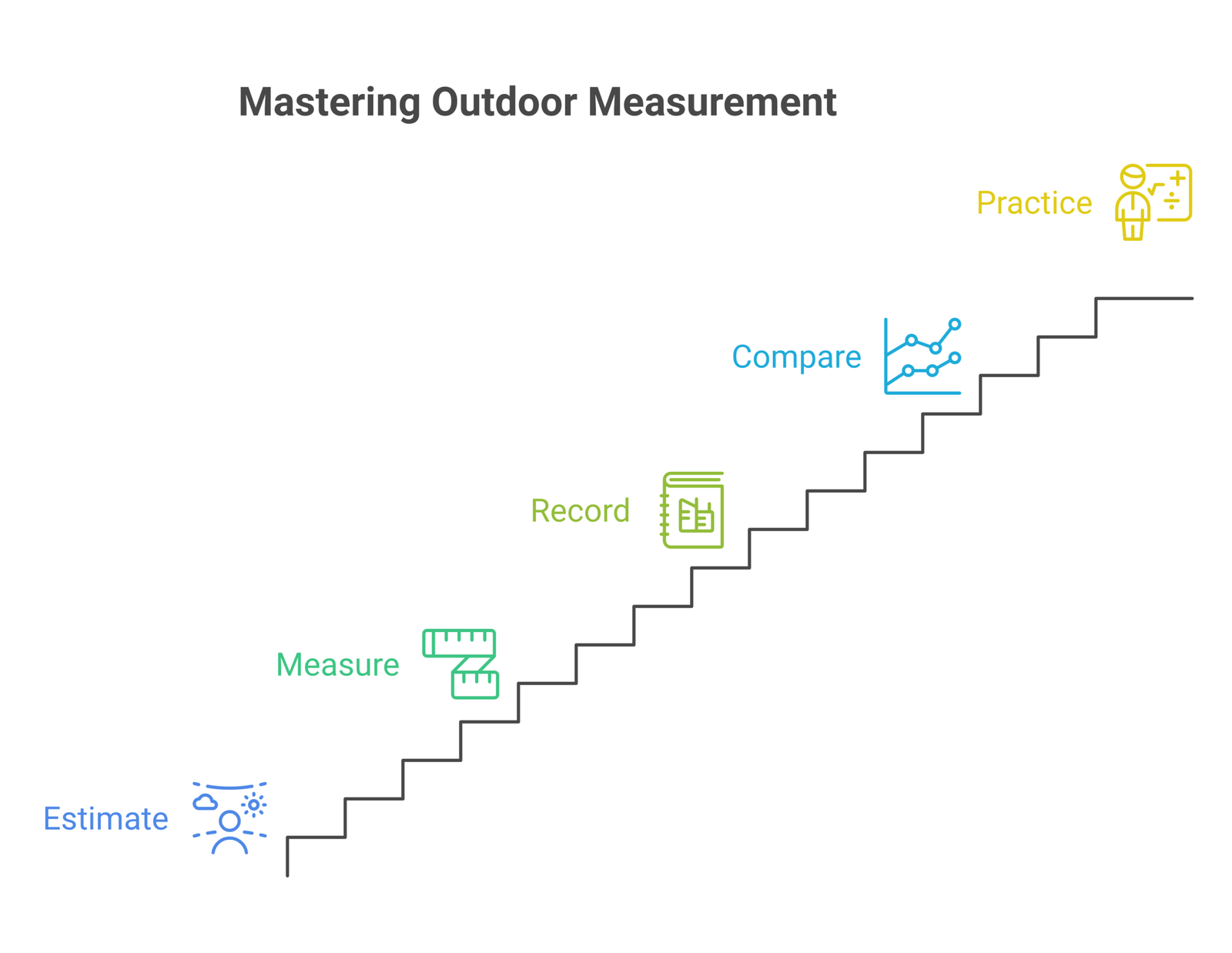
Game 1: Step-count trail
Choose two clear points: the door to the gate, one tree to another, the start of a path to the bench, or the edge of the balcony to the flowerpots. Ask your child to predict how many heel-to-toe steps it will take to travel from start to finish. Then have them walk slowly, count aloud, and record the result. Repeat with another family member and compare the numbers.
This simple game teaches non-standard units. A step is a unit, but it changes from person to person. That is why two people can measure the same path and get different answers. After the discussion, use a tape measure or meter stick to measure the same distance in meters. This mirrors the learning progression described in resources like iKnowIt non-standard measurement lesson, where children begin with informal units before moving to standard tools.
For younger children, keep the question simple: “Who used more steps?” or “Which path was longer?” For older children, ask them to calculate the difference between the estimate and the real count, find the average of three attempts, or convert meters to centimeters. If your child enjoys mental calculation, connect this activity to Fun Fraction Activities with Summer Snacks so the physical counting becomes written number practice later.
💡 Pro Tip
Always estimate first. Estimation turns measuring into a prediction game, and prediction makes children curious about the answer.
Game 2: Chalk perimeter patrol
Draw three rectangles with chalk: a tiny “pet house,” a medium “garden,” and a large “sports court.” Give your child side lengths or let them measure the sides with a tape measure. The mission is to find the perimeter of each shape. For grades 2 to 4, add all sides. For grades 5 and above, introduce formulas and ask why opposite sides of a rectangle match.
The NCTM geometry expectations connects geometry with describing and analyzing shapes, and this game makes that connection visible. Children see that perimeter is the distance around a shape, not the space inside it. Once that idea is clear, draw two rectangles with the same perimeter but different shapes. For example, a long thin rectangle and a compact rectangle can both have a perimeter of 12 meters, but they look and feel different.
Parents can make this playful by creating roles: surveyor, architect, coach, or inspector. The child has to “approve” whether a pretend dog run, toy car garage, or mini football field has enough boundary space. That role-play keeps the math practical and reduces the feeling of a test.
Game 3: Water capacity relay
On a hot day, capacity games are almost unfairly effective because children want to play with water anyway. Set a large bucket with a line drawn halfway up. Give your child a small cup, a larger cup, and a bottle. Ask: “Which tool will fill the bucket fastest? How many trips will each one take?” Then let them test it.
This game builds the vocabulary of more, less, full, empty, half, capacity, and volume. For older children, record the number of trips and compare ratios. If one cup takes 12 trips and another takes 6, the second cup holds twice as much. Online practice such as Topmarks measures games, Math Games measurement practice, and MathNook measurement games can reinforce reading scales and units after the child has experienced the idea physically.
Keep safety and water use sensible. Use a small bucket, reuse the water for plants, and avoid slippery surfaces. The point is not to flood the garden. The point is to make capacity concrete enough that worksheet problems stop looking abstract.
📝 Important Note
For summer 2026 practice, use short sessions: 15 minutes of active measuring is usually better than 45 minutes of tired worksheet resistance.
Game 4: Nature measuring hunt
Give your child a mission list: find something shorter than your hand, longer than your foot, about one meter long, heavier than a pinecone, lighter than a stone, and wider than a leaf. They collect or point to items, estimate, then check using the right tool. This creates a bridge between comparison language and formal measurement.
The strongest version is a recording table with columns for object, estimate, tool, actual measurement, and difference. That table turns the game into data work. Project Learning Tree describes the value of Project Learning Tree nature-based math ideas because nature offers endless examples of quantity, size, shape, and pattern. A stick is not just a stick when a child has to compare it, order it, measure it, and explain it.
If you want to connect this to school-style practice, take three items from the hunt and write word problems about them. “The leaf is 9 cm long. The stick is 27 cm long. How many times longer is the stick?” That is exactly where tools like MathSpark help: generate a worksheet from the same objects your child just measured, so practice feels connected instead of random.
Game 5: Stopwatch Olympics
Create three tiny events: run to the tree and back, do ten jumps, and carry a ball around a cone. Time each event with a stopwatch. Your child records the seconds, compares results, and calculates differences. For younger children, compare fastest and slowest. For older children, repeat each event three times and calculate the average.
Time is a measurement topic children often meet on paper before they understand it physically. Stopwatch games make time visible because a child feels what 8 seconds, 14 seconds, and 30 seconds mean. You can also connect time to distance: if the same route is run twice, what changed? speed, effort, shoes, attention, or starting position?
This is also a good moment to teach fair tests. Keep the distance the same, start from the same line, and use the same timing method. Children begin to see that measurement is not only about numbers; it is about consistency. That habit matters in science, math, sports, cooking, and everyday decision making.
How to adapt outdoor measurement games by age
For ages 5 to 7, focus on words and comparisons: longer, shorter, heavier, lighter, more, less, full, empty, before, after. Use informal units such as steps, hands, blocks, or sticks. Do not rush to formulas. The child is building the mental image that a number can describe a real attribute.
For ages 8 to 10, introduce standard tools and written recording. Children can use rulers, tape measures, measuring jugs, and stopwatches. Ask them to estimate, measure, calculate the difference, and explain which unit makes sense. This is where perimeter, centimeters, meters, milliliters, grams, and seconds become useful rather than decorative.
For ages 11 to 14, add multi-step reasoning. Let them design the game, calculate area, compare rates, make graphs, convert units, and write their own word problems. They can also critique measurement errors: Was the tape straight? Did everyone start at the same place? Was the container filled to the same line? That kind of reasoning supports exam readiness far more than memorizing isolated answers.
If your family is already working through math confidence topics like Κυνήγι σχημάτων, μοτίβα και ταξινόμηση για μικρότερους μαθητές or homework stress, outdoor activities can reset the emotional tone. A child who says “I hate math” indoors may happily measure how far a water balloon traveled outdoors. Use that opening.
✓ A simple 20-minute routine
- ✓ Minute 1-3: choose the object, route, or challenge
- ✓ Minute 4-6: estimate before measuring
- ✓ Minute 7-12: measure with a tool and record results
- ✓ Minute 13-16: compare, subtract, or average
- ✓ Minute 17-20: turn one result into a written problem
How to keep the math calm
The parent’s language matters. Replace “No, that’s wrong” with “Let’s test it.” Replace “You should know this” with “Which tool would help?” Replace “Hurry up” with “What is your estimate?” Outdoor measurement games work because they make math investigative. Keep that tone, and children are more likely to stay with the task.
Also separate the game from correction. During the activity, let your child explore. Afterward, choose one small skill to formalize: subtracting the difference, writing the unit, converting centimeters to meters, or drawing a table. One clear follow-up is better than trying to teach five concepts at once.
Finally, stop while the child still has energy. Math confidence is built through repeated successful experiences, not heroic marathons. If the session ends with “Can we do one more?” you have won. Save the next challenge for tomorrow.
⚠️ Disclaimer
This article reflects general parent guidance for June 2026 and is not a substitute for a child-specific learning assessment. If your child shows persistent difficulty with number sense, reading word problems, or math anxiety, consider speaking with their teacher or an educational specialist.
Frequently Asked Questions
What age are outdoor measurement games best for?
They work from preschool through early secondary school. Younger children compare and use informal units, while older children calculate perimeter, area, averages, rates, and unit conversions.
Do I need special equipment?
No. A tape measure, chalk, string, cups, a stopwatch, and paper are enough for most games.
How long should one session last?
For most families, 10 to 20 minutes is ideal. Stop before the child is tired or frustrated.
Can outdoor games replace worksheets?
They should not replace all written practice, but they make worksheet practice more meaningful because children understand the real-world idea first.
How do I connect this to school math?
After the game, write two or three problems using the exact numbers your child measured, or generate a quick worksheet with MathSpark.