Back-to-School Math Review: Late Summer Activities
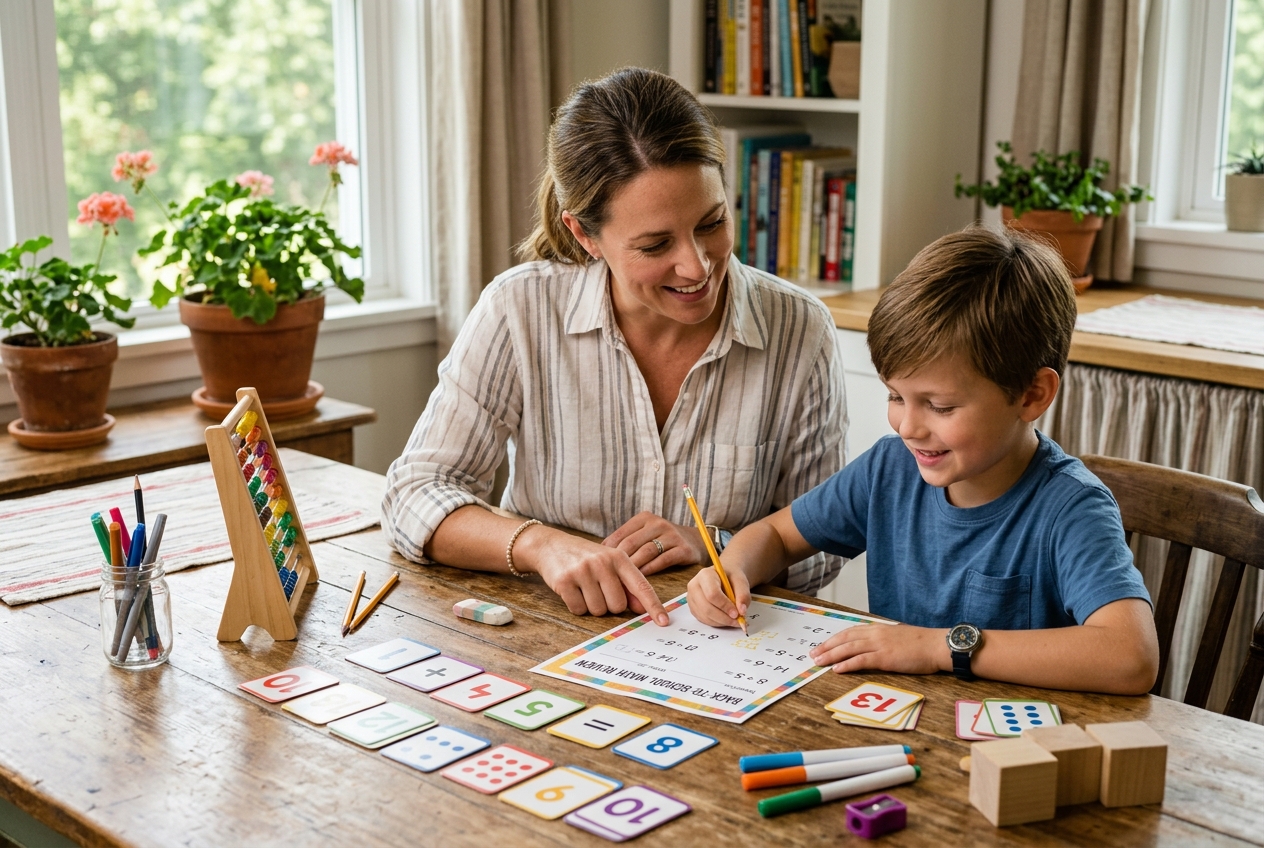
Back-to-school math review works best when it feels calm, short, and doable. Late summer is not the moment to recreate a full classroom at the kitchen table. It is the moment to help your child remember what they already know, rebuild confidence, and walk into September without the familiar “I forgot everything” panic. A good review plan uses ten to twenty minutes at a time, mixes easy wins with a few stretch problems, and keeps the mood lighter than homework season. If you want a fast source of grade-appropriate practice, MathSpark can generate AI-powered worksheets for grades 1-9 in about ten seconds, aligned with Greek curriculum needs and inspired by Pythagoras Exams methodology.
The goal is not to race ahead. The goal is retrieval, spacing, and confidence. Research summaries from the Institute of Education Sciences practice guide and the What Works Clearinghouse consistently point toward regular, low-stakes practice as a better bet than one huge review session. For parents, that means you can do a lot with a notebook, a few number cards, a timer, and printable worksheets that target the right skill.
📺 Video Guide
Back-to-school math review starts with a quick skill snapshot
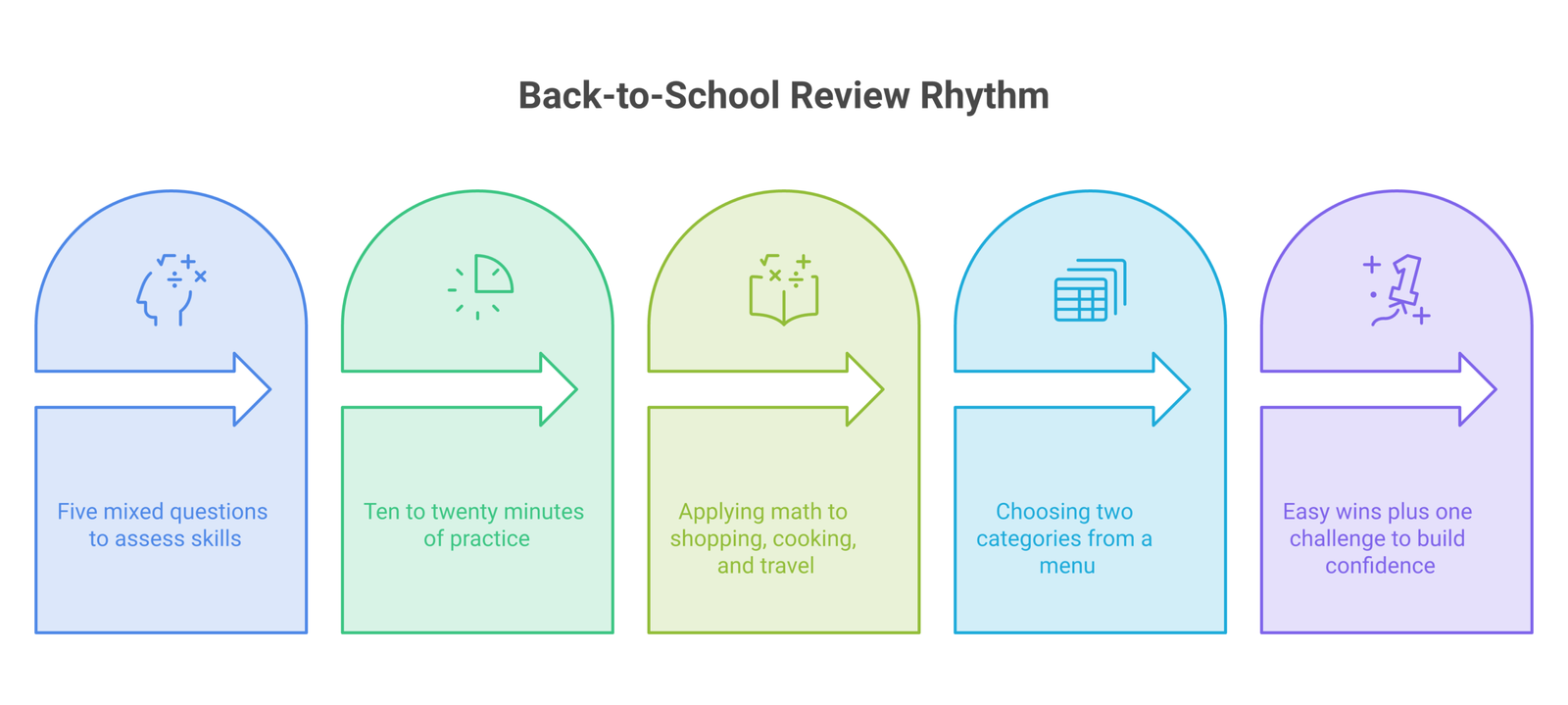
Before choosing activities, spend one relaxed session finding out what is still solid and what feels rusty. Ask your child to solve five mixed problems from last year: one calculation, one word problem, one measurement or geometry question, one fraction or decimal item if grade-appropriate, and one mental math challenge. Keep it conversational. The U.S. Department of Education family resources encourages parents to support learning at home through routines and communication, not pressure, so treat the snapshot like information rather than a test.
Use a simple traffic-light code. Green means “I can do this alone,” yellow means “I remember it after a hint,” and red means “teach me again.” This gives you a map for the next two weeks. It also prevents the common parent trap of reviewing everything. If your child is already fluent with addition facts but freezes on multi-step questions, spend your energy on word problem practice rather than another page of sums.
✓ Two-week review rhythm
- ✓ 3 days of short worksheet practice
- ✓ 2 days of games or real-life math
- ✓ 1 confidence check with mixed questions
- ✓ 1 rest day with no math talk
Use retrieval practice before reteaching
Retrieval practice simply means asking the brain to pull knowledge back out before you explain it again. This matters because many children say “I do not know” when the skill is only asleep, not gone. Show one example, pause, and ask: “What do you remember about how this works?” If they remember the first step, let them own it. Guidance connected to the Education Endowment Foundation homework guidance also supports homework routines that are purposeful and not endlessly long.
A strong late-summer routine is “try, hint, model, try again.” First, your child tries one problem. Second, you give one tiny hint, such as “look at the denominator” or “draw the tens and ones.” Third, you model a similar problem if needed. Fourth, your child solves a fresh one. That last fresh problem matters because copying your model is not the same as understanding it.
Build a printable review menu instead of a fixed workbook
A fixed workbook can be useful, but many children get discouraged when every page looks the same. A review menu gives choice. Create five categories: number facts, word problems, fractions or decimals, geometry and measurement, and logic puzzles. Let your child pick two categories each day. Resources such as Khan Academy math practice, Mathigon interactive math, and NRICH math activities are useful for interactive practice, while printable sheets are better when you want handwriting, working out, and quiet focus.
The trick is to match the question level to the first month of school, not the final exam. For example, a child entering Grade 4 may need multiplication facts, place value, simple division, and word problems that use addition or multiplication. A child entering Grade 7 may need fraction operations, decimal fluency, ratios, and integer rules. The Common Core math standards can help parents see how skills connect across grades, even if your school follows a different curriculum.
💡 Print fewer pages
Choose one focused worksheet and one playful task. Ten good questions that get discussed are more valuable than forty silent questions that end in frustration.
Turn everyday situations into low-pressure review
Late summer gives you plenty of natural math. At the supermarket, ask your child to estimate the total before checkout, compare unit prices, or calculate a simple discount. While cooking, double a recipe and talk through fractions. On a short trip, estimate travel time, distance, or average speed. These tasks connect to the mathematical practice of modeling real situations, which appears in many standards frameworks and international education discussions such as OECD education research.
The parent advantage is context. A worksheet can ask about percentages, but a sale sign makes percentages feel useful. A textbook can show elapsed time, but a bus timetable makes elapsed time real. This is also a gentle way to help a child who has math anxiety in children. They get to experience math as something practical, not just something marked wrong in red pen.
Make the first week feel familiar with three anchor activities
Anchor activities are repeatable routines your child can recognize quickly. The first is “number of the day.” Pick one number and represent it in as many ways as possible: expanded form, factors, multiples, equations, fraction equivalents, or a word problem. Younger children can draw tens frames or tally marks. Older children can use prime factorization or percentages. The second is “error detective.” Write a solved problem with one mistake and ask your child to find it. The third is “two ways.” Ask for two different methods to solve the same problem.
Professional organizations such as the National Council of Teachers of Mathematics family resources often emphasize reasoning and communication, not just answers. These anchor routines train exactly that. They also fit the Pythagoras Exams mindset: understand the structure of the problem, choose a strategy, check the result, and explain the reasoning. If you already have summer math activities, rotate one of these routines into each page so practice does not become mechanical.
Choose review activities by grade band
For Grades 1-2, focus on counting, comparing numbers, place value, addition and subtraction facts, shapes, and simple word stories. Keep manipulatives nearby: coins, blocks, beads, or pasta. For Grades 3-4, prioritize multiplication facts, division meaning, multi-digit operations, fractions as parts of a whole, and measurement. For Grades 5-6, review fraction operations, decimals, percentages, coordinate grids, and multi-step word problems. For Grades 7-9, include ratios, integers, equations, geometry vocabulary, graphs, and proportional reasoning.
Parents do not need to diagnose everything perfectly. Use patterns. If your child understands a skill verbally but makes careless mistakes, slow the layout down and require one line of working per step. If they cannot explain the idea, go back to visuals. If they can solve isolated calculations but struggle in context, spend more time on word problem practice. Data from the National Center for Education Statistics reminds us that math progress is built over years, so a calm review plan should strengthen foundations rather than chase every possible gap at once.
💡 Avoid the confidence trap
If every task is difficult, children conclude they are bad at math. Start each session with two questions they can definitely answer, then add one challenge.
How to use worksheets without triggering resistance
Worksheets work when they are targeted, short, and followed by discussion. They fail when they become a punishment. Tell your child the plan before you start: “We are doing twelve minutes, then stopping.” Use a visible timer. Sit nearby for the first two problems, then step back. Mark only the skill you are practicing. If today is about multiplication, do not turn messy handwriting into the main event.
When you use MathSpark, generate a worksheet for one precise goal, such as “Grade 5 adding unlike fractions” or “Grade 3 multiplication word problems.” Then ask your child to circle the two easiest problems and the two hardest problems before solving. This tiny choice reduces resistance because the page becomes something they can inspect, not something that attacks them.
A simple seven-day late-summer plan
Day 1: skill snapshot and traffic-light list. Day 2: number facts plus one short word problem. Day 3: real-life math through cooking, shopping, or travel planning. Day 4: worksheet menu with two chosen categories. Day 5: error detective and two ways to solve. Day 6: mixed review with a small reward for effort, not score. Day 7: rest, then a five-minute conversation about what feels easier.
Repeat the cycle once more if school starts in two weeks. If you only have a few days, do Days 1, 2, 4, and 6. Keep notes simple: one strength, one skill to revisit, one win. Harvard education writing on Harvard Graduate School of Education family engagement often highlights family engagement as a relationship, and that is the point here. Your child should finish late summer thinking, “I can warm up,” not “I am behind.”
📝 Important Note
Curriculum details vary by country, school, and grade. Use this plan as a parent-friendly review structure, then align the exact skills with your child’s teacher or school materials.
Frequently Asked Questions
How long should daily back-to-school math review take?
For most children, ten to twenty minutes is enough. Consistency matters more than marathon sessions.
Should I review old skills or teach next year’s topics?
Review old skills first. Preview only when the foundations feel comfortable.
What if my child gets upset during review?
Stop early, lower the difficulty, and restart later with two easy wins. Confidence is part of the learning goal.
Are worksheets better than games?
Use both. Worksheets show written thinking; games build fluency and reduce pressure.
How do I know which grade skills to choose?
Start with last year’s core skills, then check school guidance or teacher notes for the first unit of the new year.