How to Prevent Summer Math Slide

Summer math slide is the quiet skill leak that can turn September homework into a daily battle, even for children who were doing fine in June. The good news is that preventing summer math slide does not require a strict school-at-home schedule. It needs short, consistent, low-pressure practice that keeps number sense, facts, fractions, and problem solving warm while your child still gets a real summer break.
Research summaries from Brookings and the Learning Policy Institute describe summer learning loss as a recurring pattern, with math often more vulnerable than reading because families naturally read stories but rarely practice multiplication, fractions, measurement, or mental math unless they plan for it. That is exactly where parents have leverage: not by becoming teachers, but by making math visible in ordinary life.
If you want a simple tool for the structured part, MathSpark can generate grade-appropriate math worksheets in about 10 seconds, including practice aligned with the Greek curriculum and the Pythagoras Exams methodology. Use it as one small part of the routine, not as a punishment or a giant packet. Ten calm minutes beats an hour of arguing.
📺 Video Guide
Why summer math slide happens
Children forget math in summer for a painfully simple reason: math is cumulative and procedural. Reading can stay alive through bedtime stories, comics, subtitles, and signs in the car. Math needs retrieval. A child has to remember a strategy, choose an operation, test an answer, and adjust when it does not make sense. Without repeated use, those steps get slower.
The RAND Corporation has studied summer learning programs for years, and one consistent lesson is that quality and attendance matter. A child does not need endless worksheets, but he does need repeated contact with ideas that were learned during the school year. Addition facts, times tables, fractions, place value, units of time, and word problems are all easier to keep than to rebuild.
The goal is not to race ahead. The goal is to stop September from feeling like a cold restart. Parents can do that by mixing three ingredients: real-life math, playful fluency, and tiny grade-level review. Organizations like the National Summer Learning Association make the same point in a broader way: summer learning works best when it is engaging, accessible, and part of a child’s normal environment.
✓ Key Benefits
- ✓ Keep school-year skills fresh without recreating school
- ✓ Protect confidence before September homework starts
- ✓ Make math useful through cooking, shopping, travel, and games
- ✓ Catch small gaps before they become tutoring-level problems
The 10-minute rule that actually works
For most families, the best anti-slide plan is this: 10 minutes, four days a week. That is enough time for a short worksheet, a card game, a mental math challenge, or one real-world problem. It is also short enough that the child does not experience math as a summer punishment. The Institute of Education Sciences and What Works Clearinghouse both emphasize evidence over intensity: targeted practice, clear feedback, and routines matter more than big dramatic study sessions.
Start by choosing one skill per week. Week one might be multiplication facts. Week two might be telling time. Week three might be equivalent fractions. Week four might be word problems. A tight focus prevents the common parent mistake of downloading a huge workbook, opening to a random page, and discovering that every session becomes a negotiation.
Use a timer in a visible place. When the timer ends, stop, even if the worksheet is unfinished. That one move protects trust. Your child learns that you mean what you say, and that math practice has a beginning and an end. If you need printable practice, generate one focused sheet with AI-powered worksheets and keep the session small.
💡 Pro Tip
Attach math practice to an existing routine: after breakfast, before swimming, after lunch, or before screen time. New habits survive better when they ride on habits that already exist.
A 7-day routine to prevent summer math slide
This weekly rhythm works because it rotates the type of effort. Children do not do worksheets every day, and parents do not have to invent a new activity every morning. The structure is predictable enough to reduce resistance but flexible enough to keep summer feeling like summer.
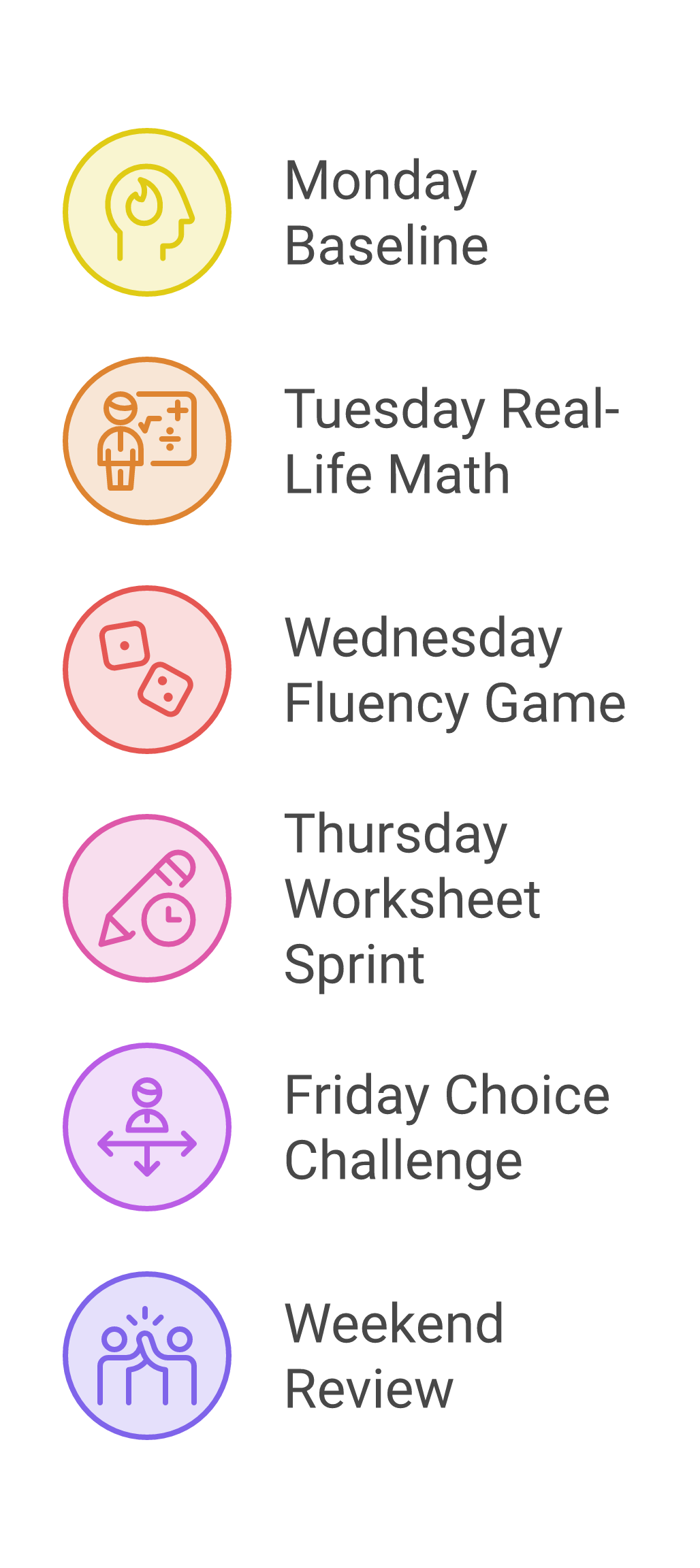
Monday is the baseline day. Choose one small skill and do five example problems together. Tuesday is real-life math: compare prices, measure ingredients, count travel time, or estimate the total cost of snacks. Wednesday is fluency day with cards, dice, dominoes, or a beach ball. Thursday is a worksheet sprint. Friday is child choice: the same skill, but the child chooses the format. Weekend review is just a two-minute conversation about what felt easier.
This approach also fits guidance from the National Council of Teachers of Mathematics: mathematical understanding grows when children reason, explain, represent, and connect ideas, not just when they fill in blanks. The worksheet has a place, but the conversation around the answer is where confidence often grows.
Best summer math activities by age
For younger children in grades 1 and 2, the priority is number sense. Count collections of shells, Lego bricks, cherries, or coins. Ask questions like, “How many more do we need to make 20?” or “Can you show the same number in two different ways?” Young children need concrete objects because numbers still feel physical to them.
For grades 3 and 4, focus on multiplication, division, place value, and measurement. Cooking is perfect here because doubling a recipe turns multiplication into something useful. Shopping is useful because rounding and estimating totals make mental math feel practical. Keep facts warm, but avoid turning every session into speed pressure.
For grades 5 and 6, fractions, decimals, percentages, area, and multi-step word problems matter most. Let children plan a small budget for a family outing, compare discounts, or scale a recipe. For grades 7 to 9, use sports statistics, maps, exchange rates, simple algebra puzzles, and geometry from real rooms. Older children resist babyish activities, so give them problems that feel grown-up.
📝 Important Note
If your child had a difficult school year, do not begin summer with the hardest topic. Start with something they can succeed at in the first session. Confidence is not decoration; it is the fuel for the next attempt.
How to use worksheets without creating meltdowns
Worksheets are useful when they are focused, short, and matched to the child. They become harmful when they are too long, too random, or used as proof that a child is behind. A good summer worksheet should have one clear purpose: practice regrouping, review equivalent fractions, solve five word problems, or refresh times tables. It should not try to cover the whole year in one sitting.
Platforms like Khan Academy can provide video explanations and adaptive practice, while MathSpark worksheets are helpful when you want printable, curriculum-aware practice quickly. The parent move is to stay calm, sit nearby, and ask, “What is the problem asking?” before giving hints. That question teaches problem solving better than simply correcting the answer.
When a child misses a problem, avoid the dramatic voice. Say, “Good, we found the part to practice.” Then solve one similar example together and let them try the next one. Summer math slide is easier to prevent when mistakes are treated as information, not as evidence of failure.
Make math part of ordinary summer life
The best summer math often does not look like math class. In the kitchen, children measure, halve, double, compare, and estimate. In the supermarket, they round prices, compare unit costs, calculate change, and manage a tiny budget. In the car, they estimate arrival time, count kilometers, or compare speeds. Education resources from Edutopia often highlight this kind of playful, practical learning because it lowers resistance.
Games help too. Card games build comparison and fact fluency. Board games build counting, probability, and planning. App-based games can be useful if they are age-appropriate and not overloaded with ads; Common Sense Media is a practical place for parents to check options before handing over a device.
For families who want level-matched activities, the Quantile Framework offers a “find a math activity” tool that can connect practice to a child’s level. The exact tool matters less than the pattern: short, regular, varied, and calm.
What to do if your child hates math
If your child says, “I hate math,” do not start with a lecture about future careers. Start by reducing threat. Many children who say they hate math actually hate feeling slow, exposed, or corrected. Summer is a chance to rebuild the emotional side of learning because the stakes are lower.
Use choice: “Do you want cards or a worksheet?” Use collaboration: “Let’s solve the first one together.” Use visible progress: a simple checklist of completed 10-minute sessions. Avoid comparison with siblings or classmates. The child should feel that math is a skill being trained, not a personality test.
Global organizations like UNESCO education and international assessments such as OECD PISA keep reminding us that confidence, access, and opportunity shape learning. At home, that becomes very practical: make math safe enough that your child is willing to try again tomorrow.
⚠️ Disclaimer
This June 2026 guide is educational advice for parents, not a diagnosis or a replacement for a teacher, school psychologist, or specialist. If your child shows persistent difficulty with number sense, memory, attention, or anxiety, ask the school for a structured assessment and support plan.
A simple plan for the next four weeks
Week one: review the skill that caused the most friction during the school year, but make the first session easy. The purpose is to restart momentum. Week two: add real-life math twice, such as cooking, shopping, travel planning, or sports statistics. Week three: introduce one light preview skill from the next grade so September feels familiar. Week four: repeat the strongest routine and celebrate consistency.
Keep a tiny log with three columns: date, activity, mood. Mood matters because the best plan is the one your family will actually repeat. If every worksheet ends in tears, switch to games for a week. If games become too silly, use a short printable. The method should serve the child, not the other way around.
Preventing summer math slide is not about producing a perfect student by September. It is about protecting the skills your child already earned, keeping math language alive, and showing that practice can be calm. That is more than enough.
Frequently Asked Questions
How much math should my child do in summer?
For most children, 10 to 15 minutes, three or four times per week is enough to keep skills warm. Children who struggled during the year may need a more structured routine, but it should still feel manageable.
Are worksheets enough to prevent summer math slide?
Worksheets help when they are short and focused, but they work best alongside real-life math, games, and conversation. A worksheet-only plan often creates resistance.
Should I teach next year’s math in summer?
Light preview is helpful, but review should come first. Build confidence with familiar skills, then introduce small previews so new topics feel less intimidating in September.
What if my child refuses to practice?
Shrink the task. Offer two choices. Use a timer. Start with games or real-life math before worksheets. Refusal often means the task feels too big or too risky.
Can apps help?
Yes, if they are age-appropriate, focused, and used briefly. Apps should support practice, not replace parent conversation or hands-on activities.