Shape Hunts, Patterns, and Sorting Activities for Younger Learners
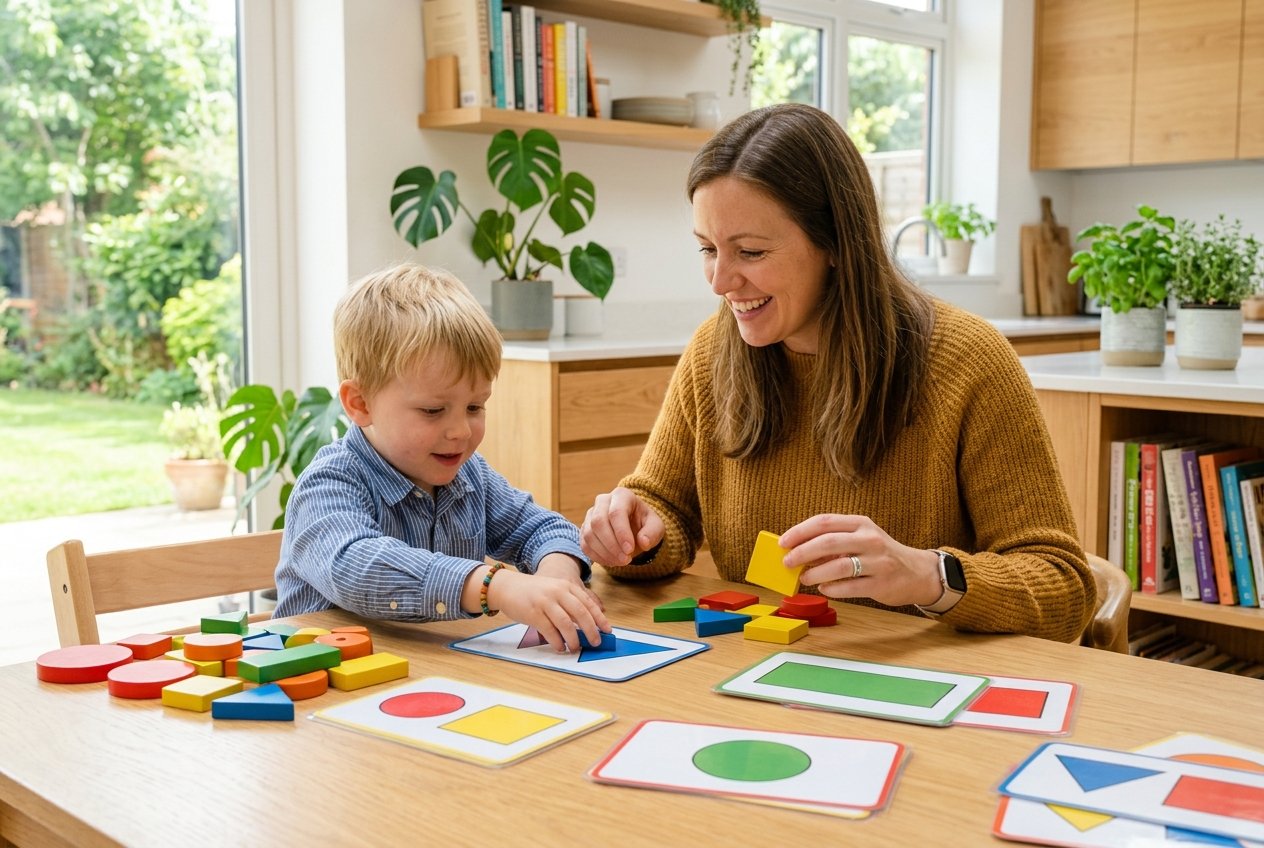
Shape Sorting Activities are one of the easiest ways to turn early math into movement, noticing, and conversation. If your child is in preschool, kindergarten, or the early primary years, you do not need a formal lesson to build strong mathematical thinking. You need a few household objects, a curious question, and ten calm minutes where the goal is exploration rather than performance.
The big idea is simple: children learn geometry and classification when they handle real objects, describe what they see, and explain how they grouped things. That is why organizations such as NAEYC and Stanford DREME emphasize hands-on shape talk, spatial language, and playful comparison. A child who says “this one has corners” is already building the language needed for later geometry.
For parents, the win is that these activities are low-prep and low-stress. They also fit beautifully alongside MathSpark worksheet generator, which can generate quick age-appropriate practice when your child is ready to move from objects to paper. Use play first, then a worksheet if it helps consolidate the idea.
📺 Video Guide
Why Shape Sorting Activities Work So Well
Young learners do not experience math as separate subjects. A shape hunt is geometry, vocabulary, comparison, counting, measurement, and reasoning all at once. When your child finds a rectangle on a door, a circle on a plate, and a cylinder in a can, they connect school words to the real world. The Common Core Kindergarten Geometry standards specifically highlight naming shapes correctly, regardless of size or orientation, and describing objects using shape names.
Sorting adds another layer. A child who groups buttons by color is making a rule. A child who regroups the same buttons by size is discovering that one object can belong to different categories depending on the question. Michigan State University Extension notes that sorting and classifying begin early and support children’s ability to notice similarities and differences, which is a foundation for later number sense.
Patterns then turn sorting into prediction. Red-blue-red-blue is not just a pretty line of blocks. It is an early version of algebraic thinking: something repeats, and the child can predict what comes next. If your child enjoys pattern recognition, these games make that skill visible and active before formal symbols appear.
✓ Key Benefits
- ✓ Builds geometry vocabulary without pressure
- ✓ Strengthens comparison, classification, and reasoning
- ✓ Turns everyday rooms, parks, and walks into math spaces
- ✓ Gives children success before pencil-and-paper practice
Start with a Five-Minute Shape Hunt
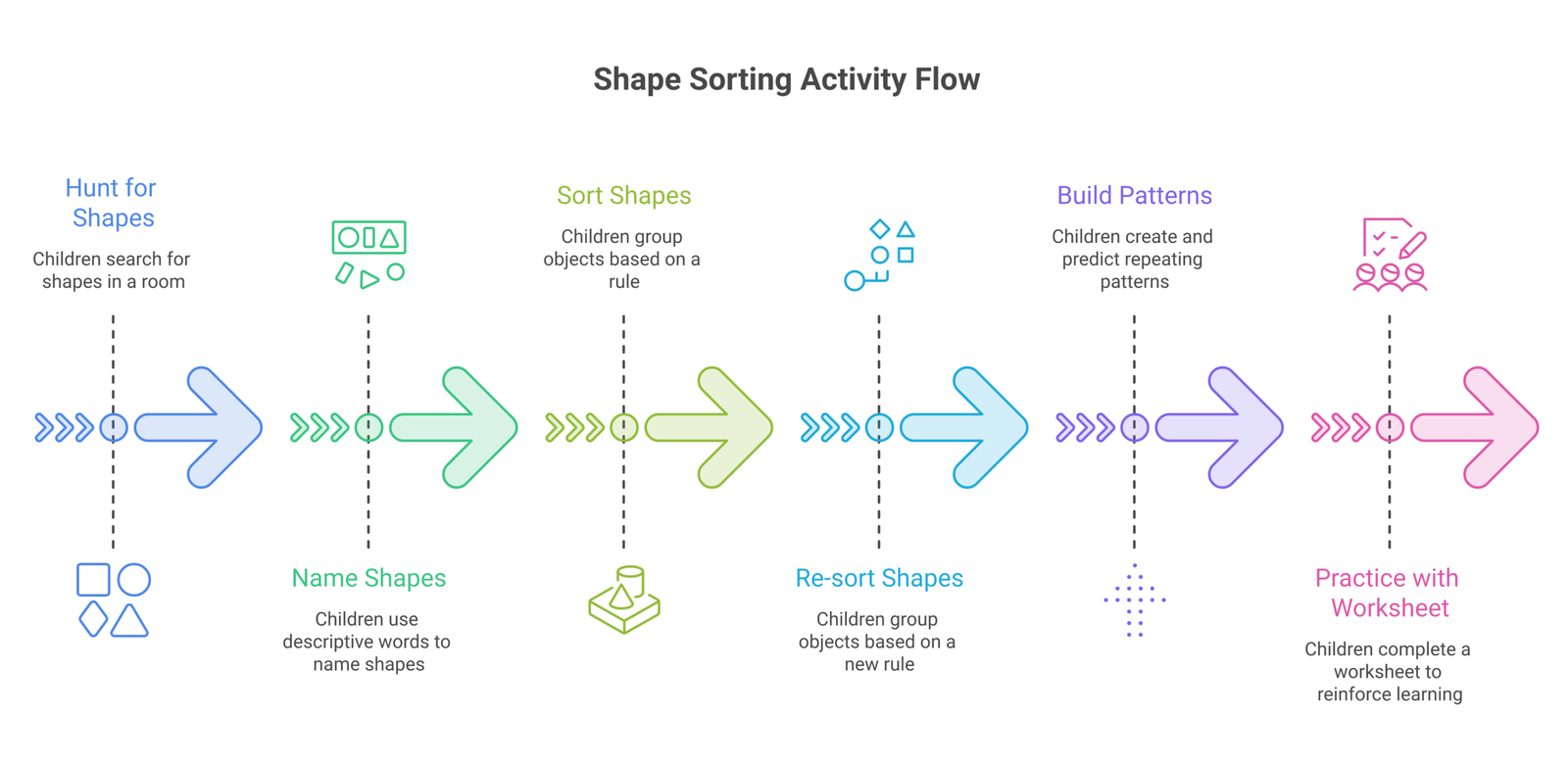
Choose one room, one outdoor path, or one page in a picture book. Ask your child to find circles, squares, rectangles, triangles, ovals, and any “almost shapes” they notice. Keep the tone light. If they call a window a square when it is really a rectangle, say, “I see why you noticed that. It has four corners like a square. Let’s check whether all the sides match.” That small correction teaches without turning the activity into a test.
A strong shape hunt uses language. Try words like side, corner, edge, curve, straight, flat, round, longer, shorter, above, below, inside, and outside. The Illinois Early Learning Project recommends this kind of geometric talk because it helps children move from simply seeing shapes to describing their properties.
For younger children, hunt for only one shape at a time. “Let’s find five circles” is easier than “find every shape.” For older children, add a challenge: find a rectangle that is taller than it is wide, a triangle pointing down, or a 3D object such as a cube, sphere, cone, or cylinder. This helps children understand that a shape remains the same even when it is turned, stretched, or seen in a different place.
💡 Pro Tip
Take a quick phone photo of three shapes your child finds. Later, ask them to explain why each object belongs in its shape group.
Add Sorting Rules That Change
After the hunt, collect safe objects: blocks, toy cars, bottle caps, leaves, shells, snack pieces, socks, or picture cards. Ask your child to sort them. Do not give the rule immediately. Let them create one first. You might hear “these are blue,” “these are big,” or “these roll.” That explanation matters more than the neatness of the piles.
Next, change the rule. Sort the same objects by shape, then by size, then by texture, then by whether they can roll. This is where flexible thinking grows. Head Start’s Early Learning Outcomes Framework includes classification, comparison, and measurement-related language as part of early learning because these skills help children organize information.
If your child is stuck, model one simple rule: “I’m putting all the things with curved edges here and straight edges there.” Then invite them to make a new rule. For children ages 5 to 7, ask them to count each group and compare: Which group has more? How many more? Could one object fit in two groups? These questions connect sorting to addition, subtraction, and early data handling.
Use Patterns to Build Prediction
Pattern play begins with copying. Make a simple AB pattern with blocks: circle, square, circle, square. Ask, “What comes next?” Then let your child build one for you. Move to AAB patterns, such as red, red, blue, red, red, blue, or shape patterns like triangle, triangle, circle. Keep the materials familiar so the thinking is about the rule, not the object.
Young Mathematicians and PBS SoCal Family Math both share playful early math games that use everyday objects, which is exactly the point here. Patterns should feel like play. Clap patterns, step patterns, snack patterns, sticker patterns, and Lego patterns all count.
When a child can extend a pattern, ask them to describe it. “It goes big-small-big-small” is a rule. “It goes spoon-fork-fork” is a rule. The ability to name the rule is what later helps children understand skip counting, multiplication patterns, number sequences, and eventually algebra.
📝 Important Note
Do not rush from hands-on play to worksheets. For younger learners, touching, moving, and explaining objects is real math practice.
A Simple Weekly Plan for Parents
Monday can be a kitchen shape hunt. Look for circles on plates, rectangles on cupboards, cylinders in cans, and cubes in boxes. Tuesday can be toy sorting. Wednesday can be outdoor sorting with stones, leaves, and sticks. Thursday can be pattern building with snacks or blocks. Friday can be a quick review with a printable or AI-generated worksheet.
This rhythm keeps practice short and varied. It also avoids the “sit down and do math now” battle that many families know too well. If you want a paper follow-up, try one of your child’s favorite discoveries as the theme. For example, after a beach shell sort, generate a worksheet about counting shells, comparing shell sizes, or completing shell patterns. The existing printable summer math worksheets guide is useful if you want seasonal practice without overloading the day.
For children who need movement, take the plan outside. outdoor math activities are especially good for younger learners because they reduce pressure and make math feel useful. A child can measure a stick, sort leaves, find symmetry in flowers, or create a pattern with pebbles. The math is still precise, but the setting feels free.
How to Adjust by Age
For ages 3 to 4, keep activities sensory and short. Sort two groups only: big and small, red and blue, round and not round. Use clear words and stop before your child gets tired. For ages 5 to 6, add shape names, corners, sides, simple AB and AAB patterns, and counting each group. For ages 7 to 8, ask for explanations, multiple sorting rules, Venn-style overlap, and simple recording.
Older younger learners can also connect shapes to measurement. Ask which rectangle is longer, whether two triangles can make a square, or how many small blocks cover a book. Research summarized in the NCBI spatial reasoning literature links spatial skills with later STEM learning, so these playful tasks are not “extra.” They are part of the foundation.
If your child is advanced, invite them to design the hunt for someone else. They can draw a checklist, create a secret pattern, or make sorting cards. Teaching the activity back to you shows deeper understanding and gives them ownership.
Common Mistakes to Avoid
The first mistake is correcting too quickly. If your child says a cereal box is a square, ask a question before giving the answer. “What do you notice about the sides?” leads to better thinking than “No, it is a rectangle.” The second mistake is making the activity too long. Ten focused minutes can be more powerful than forty tired minutes.
The third mistake is using only flat worksheet shapes. Children also need real 3D objects, unusual orientations, and messy real-world examples. The fourth mistake is treating sorting as babyish. Classification is a serious thinking skill. Scientists classify, librarians classify, programmers classify, and mathematicians classify. Your child is practicing a grown-up habit in a child-friendly way.
Finally, avoid turning every game into a score. The Education Endowment Foundation often emphasizes structured practice and feedback, but feedback does not need to feel like grading. A calm “Tell me how you decided” is often enough.
⚠️ Disclaimer
This June 2026 guide is educational and not a substitute for individualized advice from your child’s teacher, learning specialist, or pediatric professional.
Turning Play Into Confident Practice
Once your child has played with shapes, sorting, and patterns, a short worksheet can help them transfer the idea to symbols and pictures. This is where MathSpark worksheet generator fits naturally: generate a few targeted questions based on what your child just explored, not a random page of problems. If the activity was sorting buttons, make the worksheet about sorting by color, counting each group, and completing a pattern.
The goal is not to make children “ahead.” The goal is to make them comfortable noticing math in the world. The OECD Learning Compass frames learning as knowledge, skills, attitudes, and values working together. Shape hunts do exactly that: children learn words, practice reasoning, build confidence, and see themselves as capable problem solvers.
Keep it playful, keep it specific, and keep it short. Shape sorting activities work because they meet children where they are: curious, active, and ready to make sense of their world.
Frequently Asked Questions
What age are shape hunts best for?
They work especially well from ages 3 to 8, with simpler hunts for preschoolers and more detailed property-based challenges for older children.
Do I need special math materials?
No. Blocks, buttons, socks, snack pieces, leaves, books, and kitchen items are enough for strong early math practice.
How long should one activity take?
Five to fifteen minutes is plenty. Stop while your child is still engaged so math remains positive.
Should I correct wrong shape names?
Yes, but gently. Ask what they notice first, then model the precise word.
How do these games help later math?
They build spatial reasoning, classification, pattern recognition, vocabulary, comparison, and flexible thinking.