Summer Math Skills: Parent and Teacher Guide

Summer math skills do not stay sharp by accident. By late August, many parents see the same pattern: a child who understood fractions in May suddenly hesitates, multiplication facts feel rusty, and the first homework sheet of the new school year turns into a confidence problem instead of a math problem. The good news is that a calm, realistic summer plan can protect progress without turning vacation into school at home.
Research on summer learning loss shows that math is especially vulnerable because children stop using procedures, facts, and multi-step reasoning for long stretches. A Harvard Graduate School of Education review explains that summer math loss often affects procedures more than broad concepts, while NWEA notes that seasonal patterns in achievement are stronger in math than in reading. This guide gives parents and teachers a practical middle path: short routines, real-life math, games, targeted worksheets, and gentle check-ins that keep skills alive while summer still feels like summer.
If you want one practical tool to make the routine easier, a 15-minute summer math routine works well with MathSpark. MathSpark lets parents generate AI-powered math worksheets for grades 1-9 in about 10 seconds, aligned with Greek curriculum needs and inspired by Pythagoras Exams style reasoning. Use it as a quick source of fresh practice, not as a punishment or a giant packet.
📺 Video Guide
Why Summer Math Skills Fade Faster Than Parents Expect
Math is a use-it-or-lose-it subject in a very specific way. A child may remember the idea of multiplication, but if they have not retrieved facts or solved mixed problems for eight weeks, the speed and accuracy drop first. That drop matters because children often interpret slowness as failure. Teachers then spend precious September time rebuilding confidence and routines before they can move into new material.
This is why summer practice should focus on retrieval, spacing, and variety. Retrieval practice research shows that pulling information from memory strengthens learning more than simply rereading examples. Spaced practice also helps because revisiting a skill after a day, a week, and later in the month is more durable than doing thirty problems in one sitting. Parents do not need a complicated system. They need a simple rhythm that brings old skills back before they disappear.
The aim is not to race ahead. A summer plan should protect core number sense, facts, procedures, vocabulary, and problem-solving habits. That means addition and subtraction for younger children, multiplication and division for upper elementary, fractions and decimals for middle grades, and pre-algebra reasoning for older students. If you already use printable summer math worksheets, rotate topics instead of giving the same type of page every day.
✓ Why a Light Summer Plan Works
- ✓ Short practice prevents rust without creating resistance
- ✓ Real-life contexts make math feel useful, not abstract
- ✓ Mixed review helps children remember older skills
- ✓ Games and puzzles protect confidence while still building fluency
- ✓ Teachers get students back in September with less reteaching
The 15-Minute Daily Plan for Parents
The most sustainable plan is small enough to repeat. Try five minutes of old-skill warm-up, five to seven minutes of current or grade-level practice, and two to three minutes of reflection. In the warm-up, ask four to eight quick questions from earlier topics. A rising fourth grader might see two multiplication facts, one time problem, one fraction comparison, and one word problem. A rising first grader might count objects, compare numbers, and solve a tiny addition story.
The middle block is where you choose one focus skill. This can be a worksheet, a mental math prompt, a game move that requires calculation, or a short MathSpark-generated page. Keep the work short enough that your child finishes while still feeling capable. If a page has twenty problems, assign six. If six are accurate, stop. Winning the emotional part of math practice is more important than filling every blank.
The reflection block is the secret ingredient. Ask, “What was easy today?” and “Which one should we bring back tomorrow?” This turns mistakes into planning data instead of drama. For teachers sending home summer guidance, this same structure works as a family handout. Link families to ways to prevent the summer math slide and give them a short topic rotation rather than a thick packet.
💡 Pro Tip
Choose consistency over volume. Ten calm minutes four times per week beats one exhausting hour on Sunday night.
A Teacher-Friendly Weekly Rotation
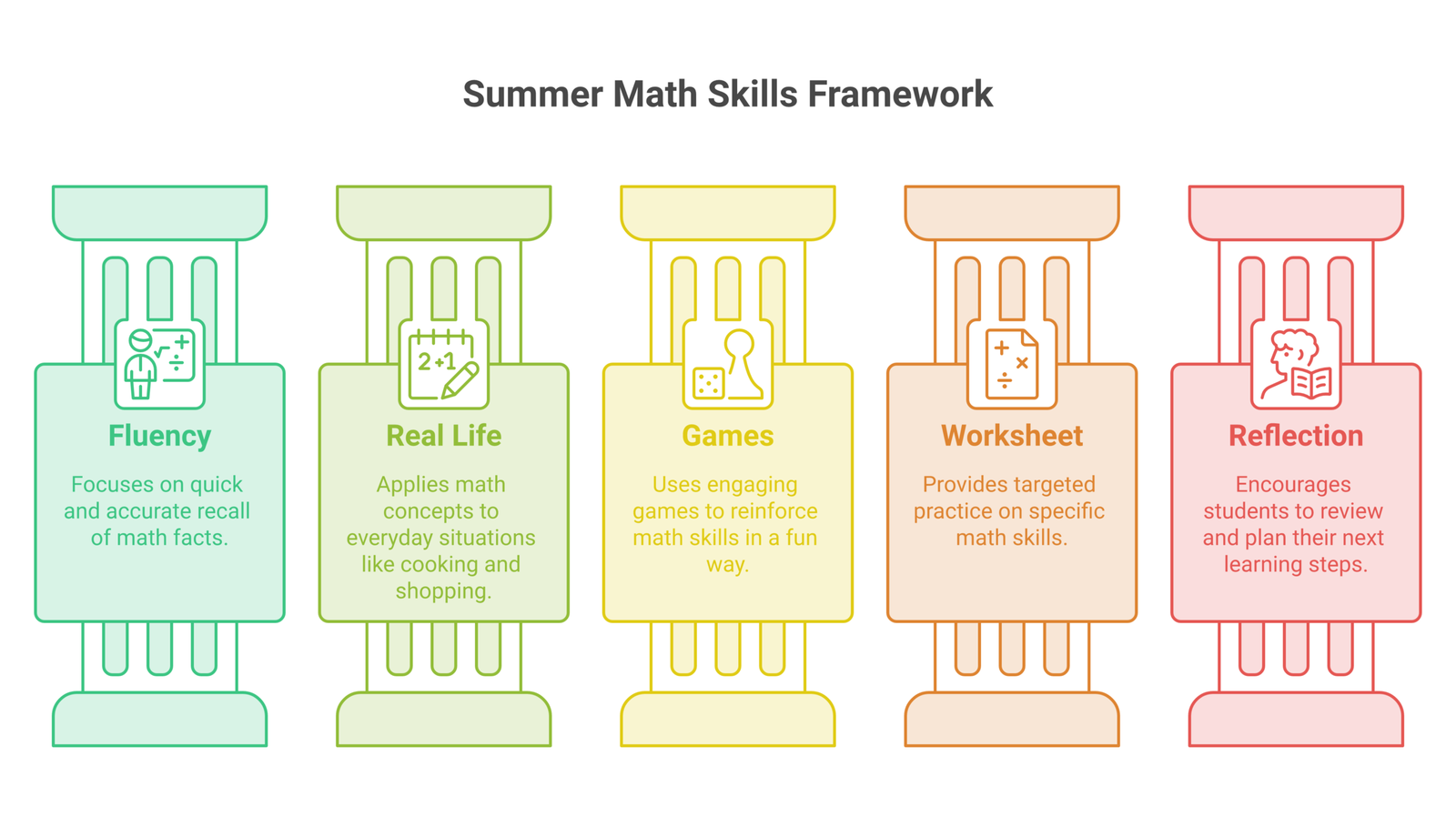
Teachers can make summer math easier by suggesting a weekly rotation that parents can follow without specialist knowledge. Monday can be facts and fluency, Tuesday real-life word problems, Wednesday games or puzzles, Thursday worksheets, and Friday a family math conversation. This gives variety while still repeating the same core skills. It also prevents the common mistake of sending a single packet that children either rush through or avoid completely.
For younger grades, the weekly rotation should include counting, comparing, composing and decomposing numbers, shapes, patterns, time, and money. For upper elementary, include multiplication, division, fractions, decimals, measurement, and multi-step word problems. For middle school, include ratios, percentages, integers, graphing, and early algebra. The National Council of Teachers of Mathematics emphasizes reasoning, communication, and connections, so summer work should include “explain how you know” prompts, not only answers.
Parents appreciate guidance that sounds doable. Instead of “practice math every day,” say: “Pick three days per week. Do one short review, one real-life activity, and one game.” Add a choice board with options such as cooking fractions, grocery estimates, sports statistics, map distances, or a five-question worksheet. If families need digital support, resources like Khan Academy, Zearn, and PBS Kids for Parents can supplement practice, but they should not replace conversation.
Real-Life Math That Does Not Feel Like School
The easiest summer math happens in places families already go. At the grocery store, ask children to compare unit prices, estimate the total, or calculate a discount. In the kitchen, double a recipe, halve a cup of flour, or talk about oven temperature and time. On a road trip, estimate arrival time, compare distances, or turn fuel stops into subtraction and multiplication problems. These small moments build number sense because the numbers matter in context.
Sports, gardening, and beach days work too. Children can track scores, calculate averages, measure plant growth, sort shells by size, or graph daily temperatures. These activities connect beautifully with real-life math activities because they show that math is not just a subject. It is a way to make decisions. For reluctant learners, real-life math often lowers the emotional barrier because nobody says, “Sit down and do math.” The math is already inside the activity.
To keep it rigorous, ask one follow-up question: “How did you know?” or “Can you prove it another way?” YouCubed by Stanford is especially useful for parents who want to build a growth mindset around problem solving. A child who explains an estimate, revises it, and checks the answer is practicing mathematical thinking, even if the activity looks like shopping or cooking.
Worksheets Without the Meltdown
Worksheets can help, but only when they are targeted, short, and matched to the child. Generic pages can become busywork. A better approach is to choose one micro-skill at a time: regrouping subtraction, comparing fractions, finding area, interpreting a graph, or solving one-step equations. Give enough questions for retrieval, not enough to exhaust attention.
This is where MathSpark is useful for families and teachers who want fresh practice without spending the evening searching online. Generate a worksheet for the exact grade and skill, then use only part of it. If your child is shaky, lower the difficulty and rebuild fluency. If they are confident, add one challenge problem. The point is to create a feedback loop: practice, notice, adjust, repeat.
For teachers, a printable packet should be modular. Label sections by skill, include answer keys, and tell parents which pages to prioritize. A child who has mastered multiplication facts does not need ten more pages of facts; they may need mixed word problems or fraction work instead. Families can also use back-to-school math review in late summer to identify which skills need a final tune-up before school starts.
📝 Important Note
Avoid using math as a punishment for screen time, behavior, or boredom. Children remember the emotional context, and that context shapes how they approach math later.
Games, Books, and Conversations That Build Fluency
Games make repetition feel natural. Card games build comparison, counting, probability, and mental math. Board games develop counting, money skills, strategy, and spatial reasoning. Dice games are excellent for addition, multiplication, and probability. Puzzle games strengthen pattern recognition and flexible thinking. A family does not need expensive materials; a deck of cards, dice, paper, and a timer can create dozens of math routines.
Math stories help too. Bedtime Math is a strong example because it turns daily stories into quick math prompts at different levels. Parents can also invent “would you rather” questions: Would you rather have 3 bags with 8 shells each or 4 bags with 6 shells each? Which is more? How do you know? These questions build reasoning and language together.
Teachers can encourage summer math talks by sending home sentence starters: “I noticed a pattern,” “My estimate is,” “Another way to solve it is,” and “I disagree because.” This matters because mathematical confidence grows when children hear themselves reasoning aloud. The Education Endowment Foundation repeatedly highlights the value of high-quality feedback and metacognition, both of which can happen in a two-minute parent-child conversation.
What to Do When Your Child Resists
Resistance is information. It may mean the work is too hard, too long, too repetitive, or attached to a history of frustration. Start by shrinking the task. One problem together is better than ten problems with tears. Then lower the stakes: “We are just checking what your brain remembers today.” If the child gets stuck, model the first step and let them finish. Confidence often returns when the task feels possible again.
Use choice whenever possible. Offer two options: worksheet or card game, cooking fractions or grocery estimates, multiplication facts or geometry scavenger hunt. Choice gives children some control while keeping the math goal intact. If a child consistently avoids one topic, that topic probably needs reteaching rather than more practice. Teachers can help by listing prerequisite skills so parents know where to restart.
Praise strategy and effort precisely. Instead of “You are so smart,” say, “You checked your answer two ways,” or “You used a number line when the subtraction felt hard.” This language teaches children what successful mathematicians actually do. It also protects them from the idea that speed equals ability. Summer is the perfect time to rebuild that healthier relationship with math.
A Simple Summer Math Checklist
Use this checklist once per week. It is designed for parents and teachers who want enough structure to be useful without creating a second school day.
1. Did we practice at least three times this week? 2. Did we mix old and current skills? 3. Did we include one real-life math activity? 4. Did we play one game or solve one puzzle? 5. Did we notice one skill to review next week? 6. Did math end calmly most of the time?
If you can answer yes to most of these, the plan is working. If not, reduce the amount before you increase the pressure. A smaller routine that survives the whole summer is more powerful than an ambitious plan that collapses after three days.
⚠️ Disclaimer
This June 2026 guide is educational and general. It does not replace advice from your child’s teacher, learning specialist, or school support team. If your child shows persistent difficulty with number sense, memory, attention, or anxiety, ask the school for targeted guidance.
Frequently Asked Questions
How much math should children do during summer?
Most children do well with 10-15 minutes, three to five times per week. Keep it short, mixed, and calm.
Are worksheets enough to prevent summer slide?
Worksheets help when they are targeted and brief, but they work best with games, real-life math, and parent conversation.
What skills should we review first?
Start with the skills your child will need immediately in September: facts, operations, fractions, measurement, word problems, or pre-algebra depending on grade.
Should teachers send a summer packet?
Yes, if it is modular, clearly prioritized, and paired with real-life activities. A giant undifferentiated packet is less helpful.
What if my child hates math?
Lower the amount, add choice, use games and real contexts, and rebuild success with easier problems before returning to grade-level work.