Best Math Games for Family Road Trips, Beach Days, and Rainy Afternoons
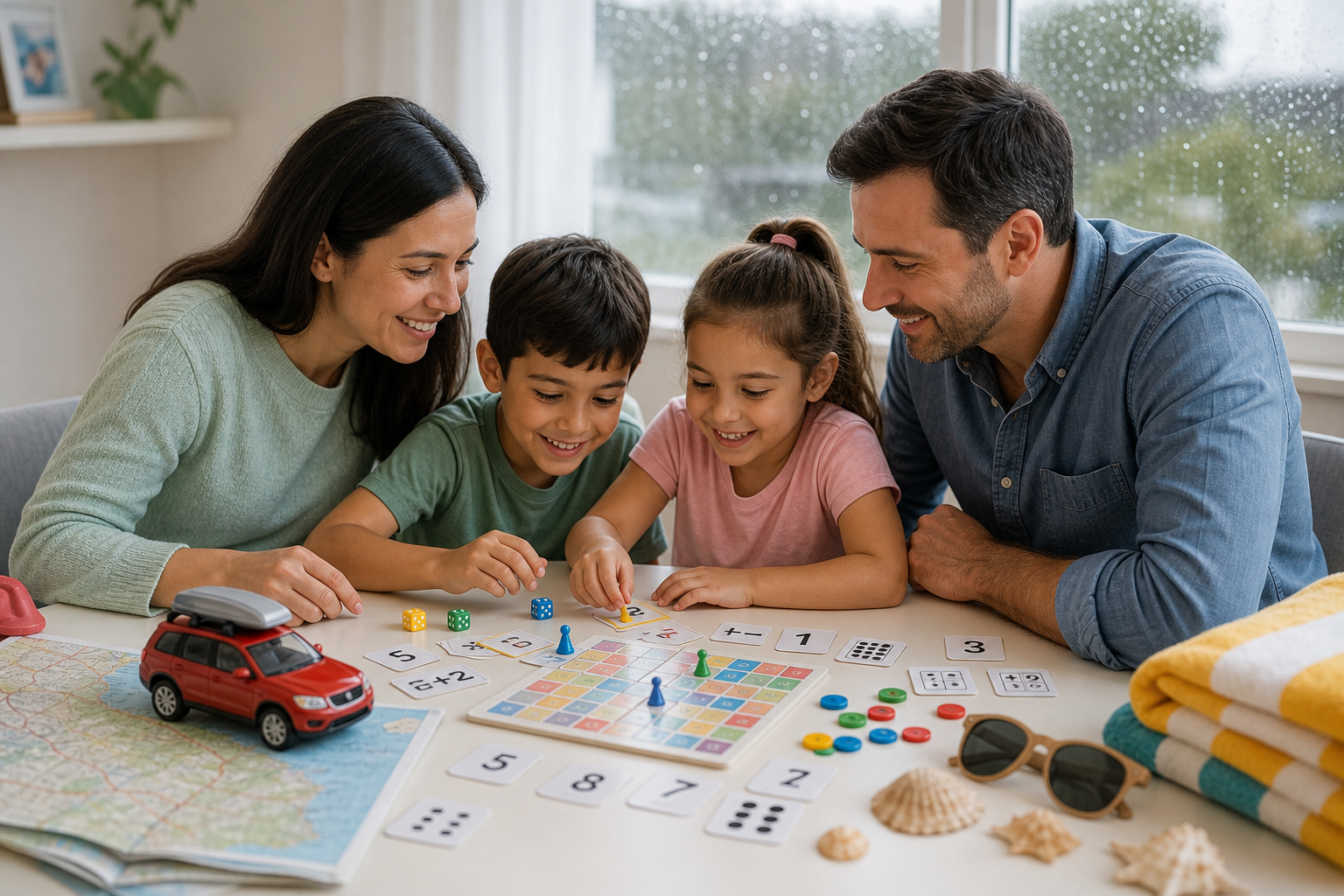
Family math games are the easiest way to keep children thinking during travel, beach days, and rainy afternoons without turning a break into homework. The trick is to choose games that feel light, use materials you already have, and quietly build number sense, estimation, fluency, geometry, and problem solving.
If your child groans when you say “practice,” do not start with a worksheet. Start with a license plate, a deck of cards, a handful of shells, a hotel notepad, or a quick challenge while waiting for lunch. Ten relaxed minutes can do more for confidence than forty tense minutes at the kitchen table.
For families who want a ready-made printable after the game, MathSpark can generate grade-appropriate AI math worksheets in about 10 seconds. It is especially useful when a car game reveals a gap, for example weak multiplication facts or shaky fractions, because you can turn that observation into a calm follow-up activity later.
📺 Video Guide
This guide is grounded in practical family math ideas from trusted education organizations, including the National Council of Teachers of Mathematics, Stanford’s DREME early math project, Family Math resources, Mathnasium’s home game ideas, Third Space Learning activities, YouCubed’s fluency without fear guidance, MIT research on preschool math games, the National Academies on mathematical proficiency, the NCTM procedural fluency position, and kid-friendly game libraries like Math Playground and CoolMath4Kids.
Why Family Math Games Work
Good games give children repetition without the emotional weight of another assignment. A child may resist twenty addition facts on paper, but happily add scores, compare totals, and calculate a winning move when the same facts are inside a game. That shift matters because confidence grows when practice feels safe.
The best games also make thinking visible. When a child says, “I need seven more to reach twenty,” you hear strategy. When he counts every dot one by one, you know subitizing needs work. When she makes 24 from four digits, you see flexible arithmetic in action. These small observations help parents support learning without lecturing.
For children in grades 1 to 9, games can scale almost instantly. Younger children can count shells or compare numbers. Older children can estimate distance, calculate averages, use fractions, build equations, or explain probability. The family activity stays the same, but the mathematical demand changes.
✓ Key Benefits
- ✓ Builds fluency through repeated, meaningful practice
- ✓ Reduces math anxiety because the goal is play
- ✓ Helps parents spot gaps naturally
- ✓ Works anywhere: car, beach, airport, hotel, cafe, or home
Road Trip Games That Need Almost Nothing
Start with the Number Plate Challenge. Pick the digits from the next license plate and ask each child to make the largest number, the smallest number, an even number, or a number closest to 100. For older children, use the digits with addition, subtraction, multiplication, and division to make a target such as 24. This builds place value, operations, and flexible thinking while everyone is already looking out the window.
Play “What Number Am I?” with yes-or-no clues. One person thinks of a number between 1 and 100. Others ask questions: Is it odd? Is it a multiple of five? Is it greater than fifty? Is it between two square numbers? Younger children learn comparison and number properties; older children practice logical elimination.
Try Road Sign Estimation. Before the next exit, each player predicts how many red cars, tunnels, petrol stations, or road signs the family will pass. Keep a quick tally and compare predictions with the result. The math is not only counting; it is estimation, data collection, difference, and reasoning about why one guess was closer.
For multiplication practice, use “Skip-Count Relay.” One person says 6, the next says 12, the next says 18, and so on. If someone hesitates, restart with a friendlier table or let the child choose the next pattern. This is much less threatening than flashcards and is perfect for short bursts between songs.
💡 Pro Tip
Keep car games verbal and short. Stop while your child still wants one more round, not after everyone is tired.
Beach Math Games for Sunny Days
The beach is basically a giant math lab disguised as a holiday. With sand, shells, stones, towels, buckets, shadows, and waves, children can explore measurement, geometry, fractions, counting, patterns, and estimation without a single printed page.
Set up a Shell Shop. Collect shells or pebbles and give each item a price: small shells cost 2 points, striped shells cost 5, large stones cost 10. Give your child a budget of 20 or 50 points and ask what combinations they can buy. Younger children add and count; older children optimize, compare, and explain why two combinations have the same total.
Draw a giant number line in the sand. For ages 5 to 7, mark 0 to 20 and jump forward or backward. For ages 8 to 11, mark fractions between 0 and 2. For older children, use negative numbers, decimals, or coordinate points. Movement helps children who struggle to picture numbers in order.
Use Sand Fractions. Draw a rectangle, circle, or pizza shape and ask your child to divide it into halves, thirds, fourths, or eighths. Then shade parts with shells. The visual and physical nature of the task makes fractions less abstract, especially for children who panic when they only see numerator and denominator symbols.
Turn waves into data. Predict how many waves will reach a line in one minute, tally the result, then repeat. Ask whether the second trial was higher or lower and by how much. This small activity introduces variability, averages, and evidence-based thinking in a way that feels like beach play.
Rainy Afternoon and Hotel Room Games
A deck of cards is the best tiny math kit you can pack. For early learners, play Make 10: lay cards face up and find pairs that total ten. For grades 3 to 5, flip two cards and multiply. For older children, flip four cards and use any operations to make 24. The rules are simple, but the strategy can become surprisingly deep.
Dice games are just as flexible. Roll two dice and add them for younger children, subtract the smaller from the larger for developing subtraction, multiply for times tables, or roll three dice and build the largest possible number. Add a “closest to 100 without going over” rule for strategic thinking.
Try Pattern Detective when everyone is stuck indoors. Make a pattern with coins, socks, snacks, or colored pencils, then ask your child to continue it and name the rule. Older children can create function rules: double the number and add three, square it, or subtract from twenty. This introduces algebraic thinking long before formal algebra.
For a calmer activity, use “Design a Mini Golf Course” on paper. Children draw holes, assign point values, estimate distances, calculate total par, and compare routes. It blends geometry, measurement, addition, and planning. If your child likes drawing more than arithmetic, this is a sneaky win.
How to Choose the Right Game by Age
Ages 5 to 7 need concrete games. Use fingers, dice dots, objects, number lines, counting hunts, and make-ten pairs. Keep numbers small enough that your child can reason, not just guess. The goal is strong foundations: counting accurately, comparing quantities, recognizing patterns, and seeing numbers as made of parts.
Ages 8 to 10 are ready for operations, place value, early fractions, and multi-step reasoning. Use card games, budget games, target numbers, multiplication relays, and measurement challenges. Ask, “How did you know?” more often than “What is the answer?” The explanation is where learning becomes visible.
Ages 11 to 14 need challenge and autonomy. Let them design rules, calculate probabilities, optimize strategies, track scores in tables, or create puzzles for younger siblings. They are more likely to engage when they feel respected, not treated like little kids. Strategy games, estimation challenges, and real-world data work well here.
📝 Important Note
If a game creates tears, it is too hard, too long, or too competitive. Simplify the numbers, play cooperatively, or stop for the day.
A Simple Family Math Kit to Pack
You do not need expensive materials. Pack one deck of cards, four dice, a pencil, a small notepad, sticky notes, and maybe a few counters. That tiny kit can support addition, subtraction, multiplication, division, fractions, probability, graphing, geometry, and logic games for the whole trip.
Before leaving, choose three games only: one car game, one outdoor game, and one rainy-day game. Too many choices create friction. Write the rules on one notepad page so you are not searching your phone while a child is already restless.
After the trip, turn the best game into a short worksheet or challenge page. If your child loved Shell Shop, generate money and addition problems. If license plates revealed weak multiplication, generate a quick multiplication worksheet. This is where MathSpark fits naturally: the game shows the need, and the worksheet reinforces it later without guessing.
Internal MathSpark Reading for Parents
If your family is preparing for a longer summer break, pair these games with a light routine like Summer Math Routine for Kids: 15 Minutes a Day. For children who lose momentum over the holidays, 10 Fun Ways to Prevent the Summer Math Slide gives more playful ideas. If your child enjoys movement and clues, Summer Math Scavenger Hunts for Kids Ages 5-14 is a strong next step. For printable follow-up, use Printable Addition Worksheets for Ages 5-7 when younger children need calm practice.
⚠️ Disclaimer
This June 2026 guide offers general educational ideas for families. It is not a diagnosis or a replacement for advice from your child’s teacher, tutor, or learning specialist.
Frequently Asked Questions
How long should family math games last?
Ten to fifteen minutes is enough. Short, happy repetition beats long sessions that feel like homework.
What if my child hates losing?
Use cooperative goals, such as “Can we reach 100 together?” or let the child beat a previous family score instead of another person.
Are digital games okay?
Yes, when they have clear math goals, feedback, and appropriate challenge. Balance screens with hands-on games using cards, dice, movement, and conversation.
Which game is best for multiplication?
Card multiplication war, dice products, skip-count relays, and target-number games are all strong choices because they require repeated facts in a playful context.
Should I correct every mistake?
No. Ask gentle questions like “How did you get that?” or “Can we check another way?” Keep the mood safe so your child keeps thinking aloud.