Common Math Mistakes and How to Fix Them

Why kids keep making the same math errors
If your child brings home a math test covered in red marks, your first instinct might be worry. But here’s the thing: most common math mistakes kids make aren’t about intelligence or ability. They’re about misunderstanding a rule, rushing through steps, or missing a small-but-important detail. Building a growth mindset around math helps kids see mistakes as learning opportunities rather than failures. The good news? Once you know which errors to look for, fixing them is surprisingly straightforward.
Research from the National Center for Education Statistics shows that procedural errors account for a large share of wrong answers on standardized math assessments. Kids aren’t guessing randomly. They’re applying a rule incorrectly, or skipping a step they don’t realize matters. That’s actually encouraging, because procedural mistakes are fixable with the right practice.
In this guide, we’ll walk through the most frequent math mistakes children make in grades 1 through 8, explain why each one happens, and give you practical ways to help your child correct them at home.
📺 Video Guide
Mixing up addition and subtraction with regrouping
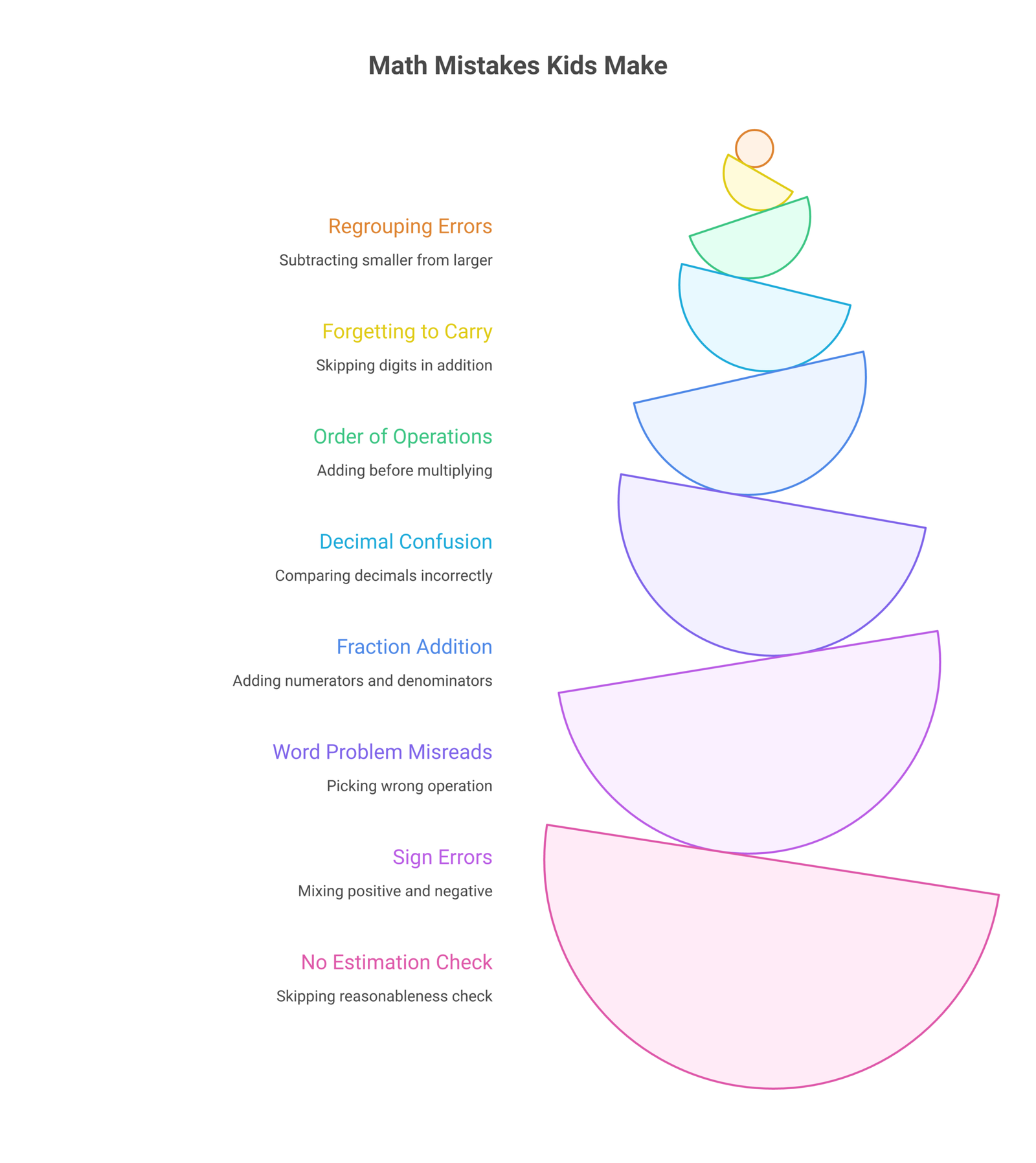
This is probably the single most common mistake in elementary math. When kids subtract multi-digit numbers, they often “borrow” from the wrong column or forget to reduce the digit they borrowed from. For example, in 53 – 27, a child might write 34 instead of 26 because they subtracted 7 from 3 by flipping the digits (7 – 3 = 4) instead of regrouping.
According to research published in the Journal for Research in Mathematics Education, this “smaller-from-larger” bug is one of the most documented error patterns in children’s arithmetic. It happens because kids apply a sensible-sounding rule (subtract the smaller digit from the larger one) without understanding place value.
The fix: Use physical objects. Grab a handful of pennies or blocks. Show your child that 53 really means 5 groups of ten plus 3 ones. When you need to take away 7 ones but only have 3, you break apart one of those groups of ten. Let them physically move the pieces. Once they see the “why” behind regrouping, the procedure clicks. Our place value guide covers this foundation in more depth.
💡 Quick fix
Have your child circle every column where the top digit is smaller than the bottom digit before they start subtracting. This one visual cue catches the regrouping issue before it happens.
Forgetting to carry in multiplication and addition
Carrying (or regrouping upward) is the mirror image of the borrowing problem. In multi-digit addition like 48 + 36, a child writes 714 instead of 84 because they don’t carry the 1 from the ones column. Or in multiplication, they’ll multiply 6 x 7 = 42 and write the 2 but forget to add the 4 to the next column’s product.
The National Council of Teachers of Mathematics emphasizes that these carrying errors often stem from rushing. Kids who understand the concept still skip the step when they’re working quickly or under time pressure.
What helps: Teach your child to write the carried number small but clearly above the next column, every single time. No mental carrying until the procedure is automatic. You can also try having them estimate the answer first. If 48 + 36 should be “around 80,” and they get 714, the estimate acts as a reality check.
Confusing the order of operations
Ask a child to solve 3 + 4 x 2, and many will say 14 instead of 11. They add first, then multiply, working left to right. The order of operations (often taught as PEMDAS or BODMAS) trips up students well into middle school, and even some adults get it wrong.
A study from the ERIC database found that order-of-operations errors persist because students memorize the acronym without truly understanding why multiplication takes priority over addition. The rule isn’t arbitrary. It exists because multiplication is repeated addition, so grouping it first keeps expressions consistent.
To fix this, skip the mnemonic at first. Instead, have your child underline all multiplication and division operations in an expression before solving anything. Solve those first, write the results back in, then handle addition and subtraction. The physical act of underlining forces them to scan the whole problem before jumping in.
✓ Order of operations checklist
- ✓ Scan the whole expression before starting
- ✓ Handle parentheses/brackets first
- ✓ Underline multiplication and division, solve those next
- ✓ Addition and subtraction last, left to right
Place value confusion with decimals
When kids first encounter decimals, they often treat the decimal point like a wall separating two whole numbers. So they’ll say 3.12 is greater than 3.9 because “12 is bigger than 9.” This mistake shows up constantly in grades 4 through 6 and can snowball into problems with percentages, measurement, and money calculations later.
The OECD’s PISA assessments have repeatedly flagged decimal understanding as a weak point for students globally. The core issue is that kids don’t connect decimals to fractions and place value. They see 0.12 and think “twelve” rather than “twelve hundredths.”
For a related deep dive, check out our article on teaching financial literacy through math. The fix is money. Seriously. Kids who struggle with abstract decimal comparison will correctly tell you that $3.90 is more than $3.12 without hesitation. Use coins and bills to practice. Once the concept clicks with dollars and cents, transfer it back to pure decimal numbers. You can also use a decimal place value chart to visually show that tenths are bigger pieces than hundredths.
Fraction mistakes that keep coming back
Fractions generate more errors than almost any other topic in elementary and middle school math. The classic mistake: adding fractions by adding both numerators and both denominators. So 1/3 + 1/4 becomes 2/7 instead of 7/12. Kids do this because it looks logical on the surface. You’re combining things, so combine all the numbers.
According to the Institute of Education Sciences, fraction errors persist because students lack a solid understanding of what fractions represent. They see 1/3 as “one and three” rather than “one part out of three equal parts.” Without that conceptual foundation, procedures don’t stick.
If you haven’t read our guide on when and how to use math worksheets, it pairs well with this section. Use pizza slices, chocolate bars, or any food your child likes. Cut a piece of paper into thirds and another into fourths. Try physically combining one-third with one-fourth and see that the pieces are different sizes. You can’t just count them. You need same-sized pieces first (common denominators). This hands-on approach, recommended by the NCTM, builds the understanding that makes the procedure meaningful.
📝 Watch for this pattern
If your child consistently adds numerators and denominators separately, they likely need more time with visual fraction models before returning to written procedures. Going back to basics here saves months of confusion later.
Misreading word problems
Word problems trip kids up not because of the math, but because of the reading. A child might see “Sara had 15 stickers and gave away 8” and add instead of subtract because they latched onto the numbers without processing the story. Or they’ll solve the first step of a multi-step problem and write that as their final answer.
The RAND Corporation’s math education research found that reading comprehension is the strongest predictor of word problem performance in elementary school, stronger even than computation skill. Kids who read well but struggle with word problems usually aren’t reading the problem carefully enough, or they lack a strategy for breaking it down.
Teach the “CUBES” method: Circle the numbers, Underline the question, Box key words, Evaluate the steps needed, Solve and check. Or simply have your child retell the problem in their own words before touching a pencil. If they can’t explain what’s happening in the story, they’re not ready to solve it yet. Tools like MathSpark generate grade-appropriate worksheets that include word problems alongside computation, so kids get regular practice translating stories into equations.
Negative number sign errors
Once kids hit middle school and encounter negative numbers, a whole new category of errors appears. The most frequent: treating -3 + 5 as -(3 + 5) = -8 instead of the correct answer, 2. Or believing that multiplying two negatives gives a negative result. These sign errors cascade through algebra, making equations nearly impossible to solve correctly. Real-world math examples can help ground these abstract concepts.
A temperature analogy works well here. Most kids understand that if it’s -3 degrees and the temperature rises 5 degrees, you end up at +2, not -8. Use a number line drawn on paper, or use an elevator going up and down floors (including basement levels). The Khan Academy negative numbers module offers free interactive practice that reinforces these concepts with visual models.
Sloppy handwriting causing calculation errors
This one might surprise you, but it’s backed by research. A study from the Journal of Educational Psychology found that students who write digits poorly are significantly more likely to make arithmetic mistakes, not because they don’t understand the math, but because they misread their own writing. A 4 that looks like a 9, or a 6 that could be a 0, leads to wrong answers even when the child knows the correct procedure.
The solution isn’t hours of handwriting drills. Just insist on graph paper for math work. Each digit gets its own square. Columns stay aligned. Numbers stay readable. It’s a small change that prevents a lot of careless errors, especially in long division and multi-digit multiplication.
💡 Graph paper trick
You don’t need special math graph paper. Turn regular lined paper sideways (landscape orientation). The lines become vertical columns that keep digits aligned perfectly.
Not checking answers with estimation
Many kids finish a problem, write the answer, and move on without ever asking, “Does this make sense?” The Common Core Mathematical Practices specifically call out “checking for reasonableness” as a skill students need to develop, and it’s often the missing piece that would catch most of the errors on this list.
If a child calculates 23 x 4 = 812, a quick estimate (20 x 4 = 80, so the answer should be near 92) would flag the error instantly. But kids don’t estimate because nobody taught them to make it a habit.
Build estimation into your routine. Before your child solves any computation problem, ask: “About how much do you think the answer will be?” It takes five seconds and catches a surprising number of mistakes. Over time, this becomes automatic. The Understood.org guide on estimation strategies offers age-specific activities to build this habit.
Rushing through tests and homework
Careless errors from rushing are the most frustrating kind because the child actually knows the material. They just didn’t slow down enough to execute it correctly. Skipped negative signs, forgotten carry digits, copied the wrong number from the problem to their work space. Teachers see this constantly.
What helps is a simple “check step” at the end. Teach your child to go back and redo 2-3 problems they feel least confident about. Not all of them, just a few. Research from Contemporary Educational Psychology shows that even brief self-checking improves test accuracy by 10-15%, which can mean a full letter grade difference.
Also worth noting: timed tests can make rushing worse. If your child’s school uses timed math drills and your kid is making lots of careless errors, the time pressure might be the problem, not the math skill. Talk to the teacher about alternatives. Regular practice with tools like MathSpark’s AI-generated worksheets builds speed naturally without the stress of a ticking clock, since worksheets can be completed at the child’s own pace.
How to create an error-correction routine at home
Knowing the common mistakes is half the battle. The other half is building a routine that helps your child catch and correct them. Here’s what works, based on what math teachers and education researchers recommend:
First, keep an “error journal.” When your child gets a problem wrong, have them write down: (1) what mistake they made, (2) why they think it happened, and (3) the correct solution. The Edutopia guide on math journals shows how this reflection process builds metacognition, which is the ability to think about one’s own thinking.
Second, focus on one mistake type at a time. If your child is struggling with regrouping in subtraction, don’t also tackle fractions and order of operations that same week. Concentrated practice on a single concept, even just 10 minutes a day, produces better results than scattered practice on multiple topics. The What Works Clearinghouse confirms that focused, spaced practice is one of the most effective strategies for building math fluency.
Third, praise the process, not the result. When your child catches their own mistake, that’s worth celebrating more than getting a perfect score. You’re building a problem-solver, not just someone who gets right answers.
✓ The 5-minute daily error check
- ✓ Review yesterday’s homework or worksheet
- ✓ Find any wrong answers together (no judgment)
- ✓ Ask: “What happened here?” and let your child explain
- ✓ Redo the problem correctly
- ✓ Note the error type in the journal
⚠️ Disclaimer
This article provides general educational guidance based on published research and widely-used teaching practices. Every child learns differently. For persistent math difficulties, consider consulting with your child’s teacher or an educational specialist. Information is current as of March 2026.
Frequently Asked Questions
What is the most common math mistake kids make?
Regrouping errors in subtraction and addition are the most frequently documented mistakes in elementary math. Kids apply the “smaller from larger” rule without understanding place value, leading to consistently wrong answers in multi-digit problems.
At what age should I worry about math mistakes?
Making mistakes is normal at every age. Concern is warranted when the same error patterns persist after repeated practice and explanation, usually if a specific mistake type continues for more than 4-6 weeks despite targeted practice. In that case, talking to your child’s teacher or a math specialist is a good next step.
How can I help my child with math without doing it for them?
Ask guiding questions instead of giving answers. “What do you need to do first?” or “Does that answer seem reasonable?” are more helpful than showing the solution. Let your child struggle a bit before stepping in, as productive struggle builds real understanding.
Are timed math tests helpful or harmful?
It depends on the child. For kids who already have solid number sense, timed tests can build fluency. But for children who are still developing their understanding or who experience math anxiety, time pressure often leads to more careless errors and increased stress. Untimed practice typically produces better long-term results.
What worksheets help fix common math mistakes?
Look for worksheets that target specific skills rather than general practice. Tools like MathSpark let you generate AI-powered worksheets by grade and topic, so you can create focused practice on exactly the skill your child needs. Mixing a few review problems in with new concepts also helps reinforce correct procedures.