Math Worksheets for Kids: When and How to Use Them
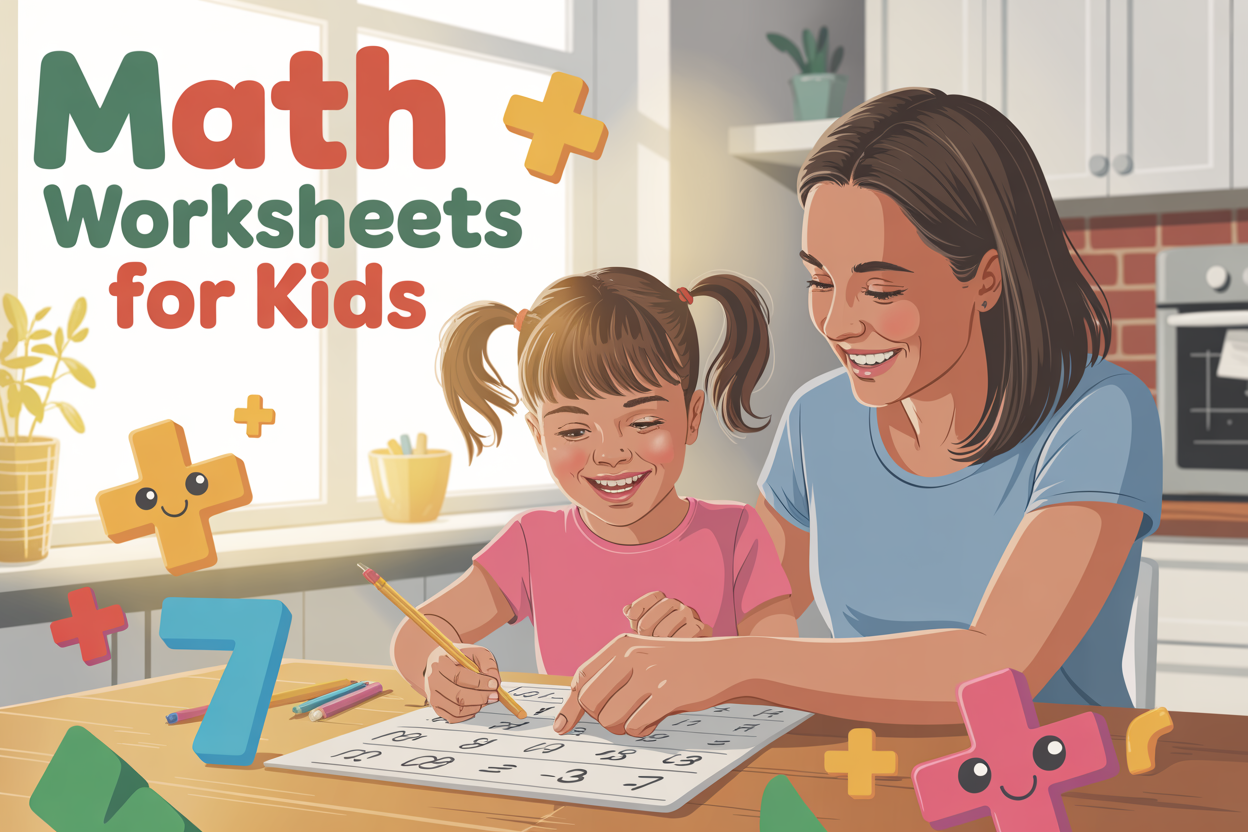
Math worksheets for kids get a bad reputation. Some parents swear by them, others think they kill any interest a child might have in numbers. The truth? Worksheets are a tool, and like any tool, they work brilliantly when used right and terribly when used wrong. A National Council of Teachers of Mathematics position statement makes this clear: effective math practice requires purposeful repetition paired with understanding, not mindless drilling.
This guide breaks down exactly when math worksheets help your child, when they hurt, and how to use them so practice time actually sticks. Whether your kid breezes through multiplication or freezes at the sight of fractions, there’s a smart way to fit worksheets into their routine.
📺 Video Guide
Why math worksheets for kids still matter in 2026
With apps, games, and interactive whiteboards everywhere, paper worksheets might seem outdated. But research from the Institute of Education Sciences shows that structured written practice remains one of the most effective ways to build math fluency. Writing problems out by hand activates different cognitive pathways than tapping a screen, which strengthens memory retention.
That said, worksheets should never be the only method. They work best as one piece of a bigger puzzle that includes hands-on activities, verbal explanations, and real-world math. The Understood.org math strategies guide recommends rotating between methods to keep kids engaged while reinforcing the same concepts from different angles.
The real power of worksheets is repetition with purpose. A child who practices 10 carefully chosen problems on equivalent fractions will learn more than one who grinds through 50 random problems. Quality matters far more than quantity here.
When to use worksheets (and when to skip them)
Timing is everything. Hand a child a worksheet when they’re already frustrated and you’ll create a homework battleground. Give them one after they’ve grasped a concept and you’ll watch their confidence grow in real time.
According to research published by the American Psychological Association, spaced practice (short sessions spread over days) beats massed practice (long cramming sessions) every time. This means 15 minutes of focused worksheet work daily outperforms an hour-long weekend session.
✓ Best times to use worksheets
- ✓ After a new concept clicks and your child needs practice to lock it in
- ✓ During test prep, starting 1-2 weeks before an exam
- ✓ Over summer breaks to prevent the well-documented “summer slide”
- ✓ When school homework doesn’t cover a specific weak spot
- ✓ As a warm-up before tackling harder material
📝 When to skip worksheets
If your child is confused about the underlying concept, more worksheets won’t help. They’ll just practice doing it wrong. Go back to explaining with physical objects, drawings, or real-life examples first. Worksheets reinforce understanding. They don’t create it.
How to choose the right worksheets
Not all worksheets are equal. A poorly designed worksheet wastes time and demoralizes kids. A well-designed one builds skills step by step and actually feels satisfying to complete.
The Massachusetts Department of Education math framework emphasizes that effective practice materials should progress from concrete to abstract. This means worksheets should start with easier problems to build confidence, gradually increase difficulty, and include a few challenge problems at the end for kids who are ready.
Look for worksheets that match your child’s exact grade level and skill gaps. Generic “grade 3 math” sheets often cover too much ground without enough depth. The most productive worksheets target one specific skill, like two-digit addition with regrouping or identifying equivalent fractions.
Tools like MathSpark solve this problem by generating AI-powered worksheets tailored to your child’s grade level in about 10 seconds. The worksheets follow the Pythagoras Exams methodology and cover the Greek school curriculum, so you get targeted practice without hunting through generic worksheet libraries. It’s free to start, which removes the barrier to trying it.
Setting up a productive worksheet routine
The biggest mistake parents make with worksheets? Treating them as punishment or busywork. “Go do your math sheet” said in a frustrated tone teaches kids that math practice is something to dread. Instead, build worksheets into a routine that feels as normal as brushing teeth.
Research from Cambridge’s Journal of Experimental Psychology supports keeping practice sessions between 10 and 20 minutes for children ages 5-12. Beyond that, attention drops sharply and errors increase, which can actually undo the benefits of practice.
💡 The 10-10-10 routine
Try this daily structure: 10 problems, 10 minutes, at 10 o’clock (or whatever consistent time works for your family). The predictability removes negotiation. Kids know it’s coming, it’s short, and then it’s done. Parents report that this routine alone reduces homework battles by more than half.
Pick a consistent, low-stress time. Right after school is usually terrible because kids are mentally drained. After a snack and some free play? Much better. Weekend mornings before screen time also work well because kids are fresh and motivated to get it done.
The environment matters too. A clear desk, a sharpened pencil, and zero screens nearby. The Edutopia research review on learning environments shows that minimizing distractions during short practice windows improves retention by up to 40%.
Common worksheet mistakes parents make
Even well-meaning parents sabotage worksheet time without realizing it. Here are the patterns that consistently backfire, based on guidance from the National Association for the Education of Young Children.
Too many problems at once. A worksheet with 50 problems looks like a wall to a seven-year-old. Fifteen problems maximum for younger kids, 20-25 for older ones. If the worksheet is too long, cover half with a piece of paper and reveal the rest after the first set is done.
Correcting every mistake immediately. Hovering over your child and pointing out errors as they happen creates anxiety. Let them finish the worksheet, then review together. Circle the ones to fix and ask them to explain their thinking. You’ll often discover the error was a misread number, not a conceptual gap.
Using worksheets as the only practice method. Worksheets should make up about 30-40% of math practice time, according to NRICH (University of Cambridge). Mix in board games like Monopoly for money skills, cooking for fractions, and sports for data tracking. Variety keeps the math brain active without burning out on any single format.
Picking worksheets that are too hard. The sweet spot is about 80% accuracy on the first attempt. If your child gets less than 60% right, the worksheet is too advanced. If they get everything right with zero effort, it’s too easy. Finding that challenge zone matters more than the specific topic.
Worksheets by age group: what works when
Ages 5-6 (Kindergarten to Grade 1): Keep worksheets very visual. Counting objects, tracing numbers, simple pattern recognition. Sessions should be 5-10 minutes maximum. Stickers or stamps as “rewards” for completing a sheet work wonders at this age. The CDC’s developmental milestones guide reminds us that attention spans at this age are naturally short, so shorter bursts of practice are developmentally appropriate.
Ages 7-9 (Grades 2-4): This is where worksheets really start paying off. Addition, subtraction, early multiplication, and basic fractions all benefit from written repetition. Target 10-15 minutes per session. Let kids use scratch paper alongside the worksheet so they have room to work through problems. A Journal of Experimental Child Psychology study found that children in this age range who practiced with pencil and paper retained math procedures 23% better than those using apps alone.
Ages 10-14 (Grades 5-9): Worksheets shift toward problem-solving rather than drill. Multi-step problems, word problems, and mixed operations challenge kids to apply what they know. Sessions can extend to 15-20 minutes. At this stage, self-checking (providing an answer key) builds independence and metacognition, which the OECD PISA framework identifies as critical for long-term mathematical success.
Digital worksheets vs. paper: the honest comparison
Parents often ask whether printable worksheets or online interactive ones are better. Both have legitimate advantages.
Paper worksheets let kids write out their work, which engages motor memory. There are no distracting notifications, no temptation to switch tabs, and you get a physical record of their progress. Research from Frontiers in Psychology has consistently shown that handwriting activates learning-related brain regions more than typing or tapping.
Digital worksheets, on the other hand, give instant feedback and can adapt difficulty automatically. Platforms that generate worksheets on demand, like MathSpark, offer the best of both worlds: generate the worksheet digitally with AI-powered customization, then print it for pencil-and-paper practice. This way your child gets targeted, curriculum-aligned problems without the screen-time downside.
The practical answer? Use both. Digital for generating and occasionally for game-style practice. Paper for the actual skill-building sessions. Let your child’s preference guide the ratio, but make sure handwriting stays in the mix.
Tracking progress with worksheets
One of the most underused benefits of worksheets is the paper trail they create. Unlike app-based practice where data lives in a dashboard you rarely check, a stack of completed worksheets tells a visible story of improvement.
Keep a simple folder for each subject. Once a month, flip through the stack together with your child. Let them see how problems that once took five minutes now take 30 seconds. That visual proof of progress is more motivating than any gold star system.
For structured tracking, record three things on each completed worksheet: the date, how long it took, and the accuracy percentage. After a few weeks, patterns jump out. You might notice that word problems always take twice as long, or that Friday sessions have more errors (fatigue from the school week). The RAND Corporation’s education research shows that parents who track practice data make better decisions about when to move on to new topics versus when to review.
💡 Quick tracking method
Write “D/T/A” in the top corner of each worksheet before your child starts. After they finish, fill in the Date, Time taken (in minutes), and Accuracy (e.g., 12/15 correct). Takes five seconds and gives you months of useful data.
Making worksheets less boring (yes, it’s possible)
Worksheets don’t have to feel like drudgery. Small changes in how you present them can shift the experience entirely.
Use a timer (but positively). Say “Let’s see if you can beat your own record from yesterday,” not “You have 10 minutes or else.” The goal is personal improvement, not pressure. Research from PubMed-indexed studies on math anxiety shows that competitive time pressure increases math anxiety, while self-paced timing reduces it.
Let them grade their own work. Give them a red pen and the answer key. Kids love playing teacher. This also builds the habit of self-checking, which is a skill they’ll need throughout school.
Add a “challenge corner.” Put one or two bonus problems at the bottom that are slightly above their level. Mark them clearly as optional. Many kids will try them just because they’re “extra” and not required. The Khan Academy math curriculum uses this progression approach, placing stretch problems after mastery-level ones.
Pair worksheets with something they enjoy. “Finish your math sheet and then we’ll play a round of your favorite game” works far better than threats. The worksheet becomes a gateway, not a wall.
Where to find quality math worksheets
The internet is flooded with free math worksheets, but finding ones that are actually well-structured takes some digging. Here are sources worth your time:
MathSpark generates custom worksheets using AI in about 10 seconds, aligned to the curriculum and tailored to specific grade levels (1-9). The Pythagoras Exams methodology ensures problems build logically, and the free tier gives parents plenty to work with.
Khan Academy offers both interactive exercises and printable practice sheets across all grade levels. The exercises adapt to your child’s performance.
Math-Drills.com has thousands of free printable worksheets organized by operation and difficulty. The layout is clean and printer-friendly.
Your child’s teacher is another resource. Ask for extra practice sheets or recommendations. Teachers often have curated collections and can point you toward exactly what your child needs based on classroom assessments.
⚠️ Disclaimer
This article provides general educational guidance for parents. Every child learns differently. If your child consistently struggles with math despite regular practice, consider consulting their teacher or a learning specialist. Information current as of March 2026.
Frequently asked questions
How many math worksheets should my child do per day?
One focused worksheet of 10-15 problems is plenty for most children. Quality matters more than quantity. If your child finishes quickly and wants more, offer an optional challenge sheet. If they’re struggling, cut the session short and return to it tomorrow.
At what age should kids start doing math worksheets?
Around age 5, when children start recognizing numbers and basic counting. At this stage, worksheets should be very visual with plenty of pictures, colors, and counting objects rather than abstract numbers. Keep sessions under 10 minutes.
Are printable worksheets better than online math exercises?
Both have value. Printable worksheets activate motor memory through handwriting and eliminate screen distractions. Online exercises provide instant feedback and adaptive difficulty. The best approach combines both: generate worksheets digitally, then print them for pencil-and-paper practice.
My child hates math worksheets. What should I do?
First, check if the worksheets are too hard or too boring. Both cause resistance. Try shorter sessions, easier problems to build confidence, and non-worksheet math activities like cooking or board games. Sometimes the issue is timing, not the worksheet itself. After-school fatigue is real.
How do I know if a worksheet is the right difficulty level?
Aim for about 80% accuracy on the first attempt without help. If your child gets fewer than 60% right, the worksheet is too advanced. If they breeze through with 100% accuracy and no effort, it’s time to increase difficulty. The sweet spot involves some challenge without frustration.