Understanding Place Value: A Parent’s Complete Guide
What Is Place Value and Why Should You Care?
Place value is the reason the digit 3 means something completely different in 30 than it does in 300. It tells us what each digit in a number is actually worth based on its position. And honestly, if your child doesn’t get this concept, every other math topic from addition with regrouping to long division is going to feel like trying to read a book in a language they half-understand.
The National Council of Teachers of Mathematics (NCTM) calls place value understanding one of the most fundamental concepts in elementary mathematics. That’s not exaggeration. It’s the scaffolding that supports everything else your child will learn in math for the next decade.
Most kids encounter place value formally around first or second grade, but the seeds get planted earlier than that, every time your child counts past nine and realizes they need a new digit to keep going. The tricky part? Many children can recite that the 5 in 53 is “in the tens place” without actually understanding what that means. And that gap between memorizing and understanding is where problems start showing up later.
How our number system actually works
We use a base-10 system, which means we only have ten digits (0 through 9) and we reuse them over and over by shifting their position. Each position is worth ten times more than the one to its right. The Encyclopaedia Britannica explains this as a positional notation system, but for a seven-year-old, it helps to think of it like a money system.
Picture it this way: you have three types of bills. Singles (ones), ten-dollar bills (tens), and hundred-dollar bills (hundreds). If someone hands you 4 hundred-dollar bills, 2 ten-dollar bills, and 7 singles, you have $427. The digits are the same (4, 2, 7), but their position tells you how much each one is worth. Move the 4 to the ones place and suddenly it’s worth… four bucks.
According to research published by the Institute of Education Sciences (IES), children who develop strong place value understanding in early grades perform significantly better in multi-digit arithmetic later on. The connection isn’t surprising when you think about it: you can’t add 47 + 38 properly if you don’t understand that you’re really adding 40 + 30 and 7 + 8.
✓ Place value positions your child should know
- ✓ Ones (1) – the rightmost digit
- ✓ Tens (10) – second from right
- ✓ Hundreds (100) – third from right
- ✓ Thousands (1,000) – introduced around grade 3
- ✓ Ten thousands and beyond – grades 4-5
- ✓ Decimals (tenths, hundredths) – typically grade 4+
Signs your child might be struggling with place value
Sometimes place value confusion hides behind other symptoms. Your child might seem like they “can’t add” or “keep making careless mistakes,” but the real issue is that they don’t fully grasp what each digit represents. Here are some red flags to watch for:
They write numbers backwards or in the wrong order (writing 31 when they mean 13). They struggle with regrouping during addition or subtraction. They can’t explain why 60 + 5 equals 65. They have trouble comparing numbers, like deciding whether 89 or 91 is bigger takes too long. Or they treat each digit in a number independently, adding 45 + 23 as 4+2=6 and 5+3=8 to get 68, which happens to be correct, but for the wrong conceptual reason.
Research from the NCTM’s Teaching Children Mathematics journal notes that place value misconceptions often go undetected until students hit multi-digit multiplication or division, where the gaps become impossible to work around. Catching these misunderstandings early saves a lot of frustration down the road.
Hands-on activities that actually build understanding
Worksheets have their place, but place value really clicks when kids can touch it, move it around, and see it with their own eyes. The Understood.org research on multisensory learning shows that combining visual, tactile, and verbal approaches helps concepts stick far better than reading alone.
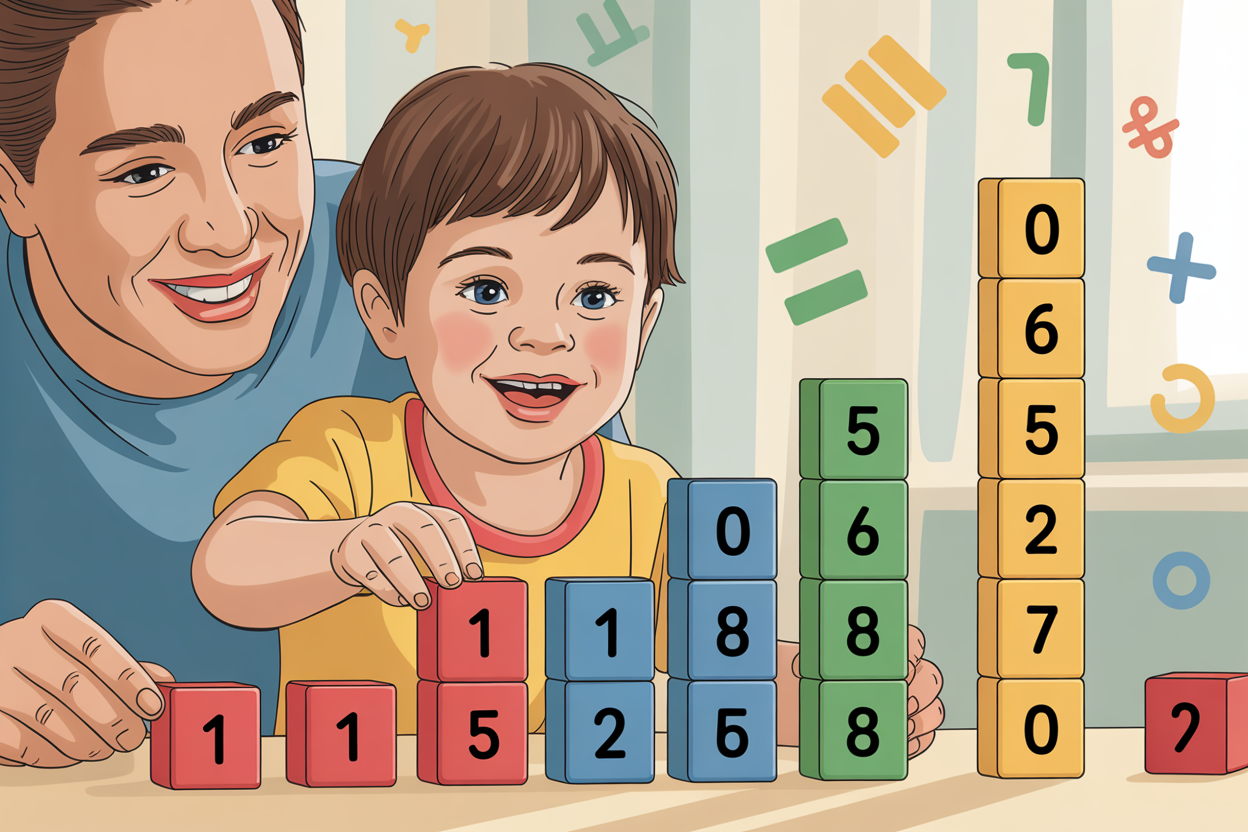
Base-10 blocks: These are the gold standard. Get a set of unit cubes, rods (tens), flats (hundreds), and a big cube (thousands). Have your child build numbers physically. Ask them to show you 347 using the blocks. Then ask: “What would happen if we added 5 more tens?” Watch them physically trade ten ones for a rod, or ten rods for a flat. That “aha” moment when they see the trading in action is worth more than a hundred fill-in-the-blank exercises.
Place value mats: Draw columns on a large sheet of paper labeled “Hundreds,” “Tens,” “Ones.” Use dried beans, buttons, or coins as counters. Call out a number and have your child place the right amount in each column. This is a technique recommended by Khan Academy’s 2nd grade math curriculum and it works because it separates each place visually.
The trading game: Roll a die. Put that many cubes in the ones column. Every time you get 10 ones, trade them for a tens rod. First person to reach 100 (one flat) wins. This game teaches regrouping through play, and kids usually want to play again and again without realizing they’re drilling a fundamental math skill.
Real money: If you’re comfortable with it, use actual coins and bills. Nothing makes place value more real than understanding that ten dimes equal one euro (or one dollar). The Consumer Financial Protection Bureau even has resources connecting money skills with math education for different age groups.
💡 Pro tip
When using base-10 blocks, always ask your child to say the number in expanded form first: “300 + 40 + 7 = 347.” This bridges the gap between physical manipulation and abstract number sense. Skip this step and kids often just mimic block placement without connecting it to the actual math.
Place value across grade levels
Place value isn’t a one-and-done lesson. It’s a concept that grows with your child over several years, and each grade adds new layers. The Common Core State Standards for Mathematics spread place value instruction across multiple grade levels for good reason.
Kindergarten and Grade 1: Kids learn to count to 100 and start understanding that “teen” numbers are made of a ten and some ones. The number 14 is one ten and four ones. This is where the foundation gets poured. If your child is at this stage, focus on counting objects into groups of ten and talking about “how many tens, how many ones.”
Grade 2: Students work with numbers up to 1,000. They learn to read, write, and compare three-digit numbers. They also start using place value to add and subtract (understanding why you “carry the one” in addition). The Education.com resources for second grade offer structured activities that align with this progression.
Grades 3-4: Numbers get bigger (up to millions) and decimals enter the picture. Your child needs to understand that the same base-10 pattern extends in both directions: leftward into thousands and millions, and rightward into tenths and hundredths. This is also when rounding becomes important, and rounding depends entirely on place value understanding.
Grade 5 and beyond: Students work with decimals extensively, learn about powers of 10, and use place value to multiply and divide by 10, 100, and 1,000. A solid place value foundation makes all of this intuitive rather than mysterious.
Worksheet practice that reinforces understanding
After your child has spent time with physical manipulatives, worksheets become a useful tool for practice and reinforcement. The key is choosing the right kind of worksheet, one that asks your child to think about place value rather than just filling in blanks mechanically.
Look for worksheets that include expanded form (writing 463 as 400 + 60 + 3), number comparison (which is greater: 782 or 728?), and decomposition tasks (what number has 5 hundreds, 0 tens, and 9 ones?). These types of exercises test genuine understanding rather than rote recall.
Tools like MathSpark let you generate place value worksheets tailored to your child’s exact grade level in about 10 seconds. The worksheets follow the Pythagoras Exams methodology and align with the Greek school curriculum, though they work well for any student practicing place value concepts. Being able to generate fresh worksheets on demand means your child always gets new problems to work on rather than repeating the same sheet.
Common mistakes parents make when teaching place value
Rushing to abstraction. It’s tempting to skip the blocks and beans and jump straight to writing numbers on paper. But research from the ERIC database consistently shows that children who spend adequate time with concrete manipulatives before moving to abstract representation develop stronger and more lasting number sense.
Confusing place with face value. Some kids say the 7 in 73 is “just 7” instead of “70.” If your child does this, go back to physical models. Have them build 73 with blocks and count the tens rod: “This rod is 10, right? And you have 7 of them. So that’s 70.” The Math is Fun place value page has clear interactive visuals that can help reinforce this distinction.
Only practicing with “nice” numbers. Many parents practice with round numbers (200, 350, 500) and skip numbers with zeros in the middle, like 302 or 4,050. But those zeros are where place value understanding really gets tested. A child who can explain what the 0 means in 502 (zero tens, not “nothing”) has genuinely internalized the concept.
Treating it as a single lesson. Place value isn’t something kids master in a week and move on from. It’s a concept that deepens over years, as noted by the NCTM Principles and Standards. Circle back to it regularly, especially when introducing new operations like multiplication or working with decimals.
📝 Watch for this
If your child can answer place value questions correctly on worksheets but struggles with multi-digit addition or subtraction, they may have memorized procedures without building real understanding. Go back to the base-10 blocks and have them explain their thinking out loud as they work through problems.
Digital tools and apps for place value practice
Physical manipulatives are ideal, but digital tools can supplement learning well, especially when you’re on the go. The NCTM Illuminations platform offers free virtual base-10 blocks that work on tablets and computers. Kids can drag and drop blocks, trade tens for ones, and build numbers interactively.
Khan Academy has a well-structured place value progression with video explanations and practice exercises that adapt to your child’s level. The videos feature clear visual explanations that many kids find easier to follow than a textbook.
For targeted worksheet practice, MathSpark generates grade-appropriate place value exercises that you can print or complete on screen. The exercises cover expanded form, comparing numbers, identifying digit values, and more, all matching the specific grade level your child is working at.
Connecting place value to everyday life
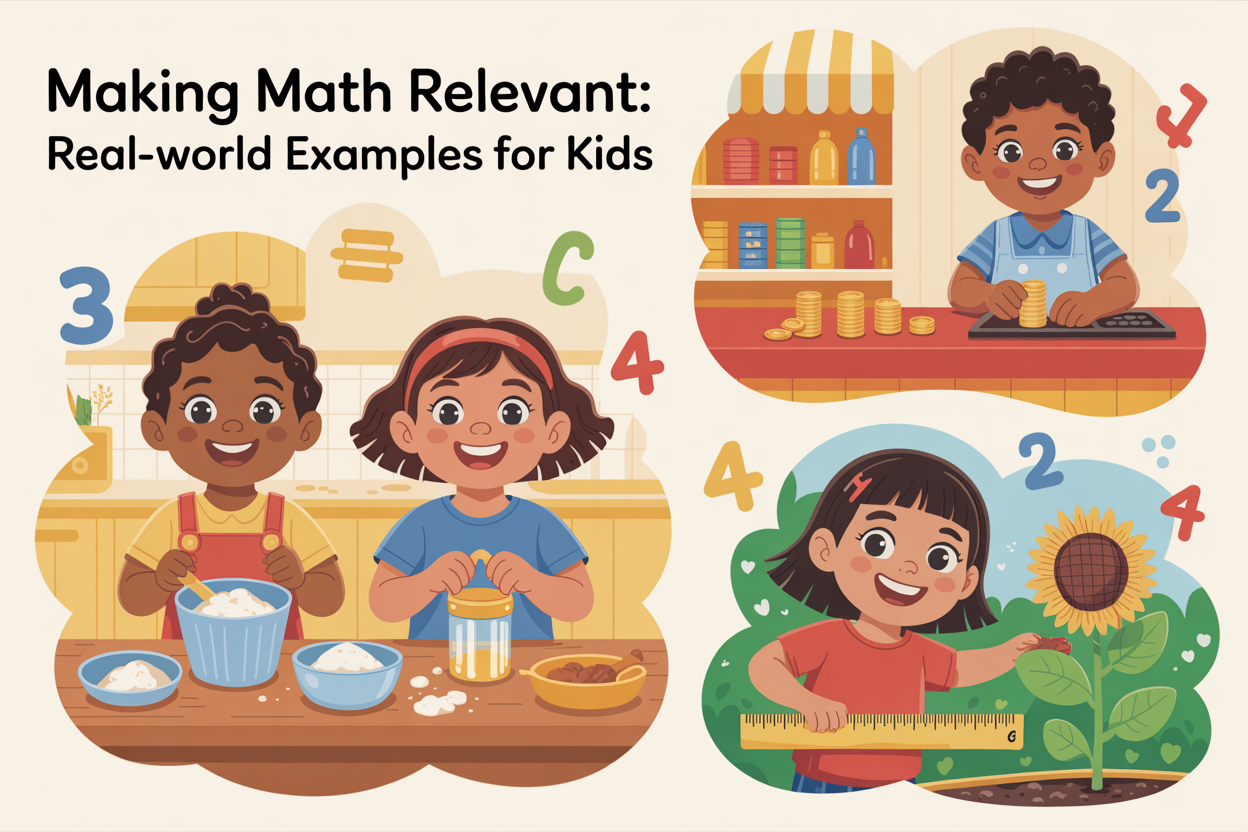
The best way to solidify place value is to point it out in daily situations. At the grocery store, look at prices: “This costs 3 euros and 45 cents. How many tens of cents is that?” When driving, read road signs: “We need to go 120 kilometers. How many hundreds is that? How many tens?” These brief conversations do more than you’d think.
Cooking works well too. A recipe that calls for 250 grams of flour is a great chance to ask your child to identify the digit in the hundreds place, the tens place, and the ones place. According to NAEYC (National Association for the Education of Young Children), embedding math in familiar contexts helps children see numbers as meaningful rather than abstract.
Sports scores, page numbers in books, building addresses, phone numbers: place value is everywhere once you start looking. The goal isn’t to turn every outing into a math lesson, but to casually notice numbers together and talk about what the digits mean.
⚠️ Disclaimer
This article provides general educational guidance for parents and is current as of March 2026. Every child learns at a different pace. If you have concerns about your child’s math development, consult with their teacher or a learning specialist for personalized advice.
Frequently Asked Questions
At what age should my child understand place value?
Most children begin learning place value concepts around age 6-7 (first grade), starting with tens and ones. By age 8-9 (third grade), they should comfortably work with numbers up to 1,000. Full mastery through millions and decimals typically develops by grades 4-5.
What are the best manipulatives for teaching place value?
Base-10 blocks (unit cubes, rods, flats, and big cubes) are the most widely recommended by math educators. You can also use bundled straws, snap cubes, dried beans grouped in cups, or even coins. The physical act of grouping and trading objects into tens is what builds understanding.
Why does my child keep making mistakes with borrowing in subtraction?
Borrowing (regrouping) is directly tied to place value. When a child doesn’t fully understand that a tens rod can be broken into 10 ones, the regrouping procedure feels arbitrary and confusing. Go back to base-10 blocks and physically demonstrate the trading process before returning to written problems.
How is place value connected to decimals?
Decimals extend place value to the right of the decimal point. Just as moving left multiplies by 10 (ones to tens to hundreds), moving right divides by 10 (ones to tenths to hundredths). Children who have a solid understanding of whole-number place value generally transition to decimals more smoothly.
Can I teach place value with money?
Yes, money is one of the most effective real-world models for place value. Euros and dollars both work well: 1 cent = one, 10 cents = ten, 1 euro/dollar = one hundred cents. Having your child count mixed coins and bills, make change, or “shop” at a pretend store reinforces place value in a way that feels meaningful to them.