Making Math Relevant: Real-World Examples Kids Use Every Day
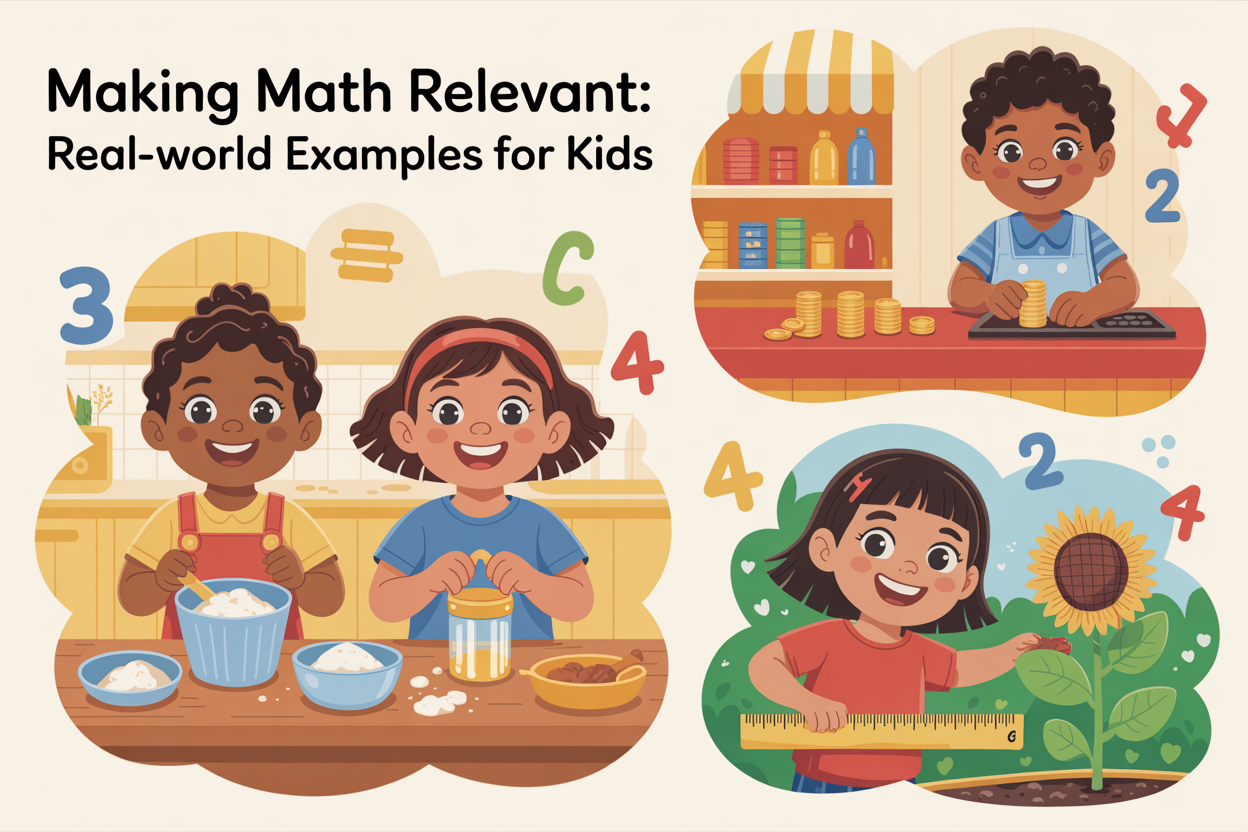
Your kid asks “when am I ever going to use this?” and honestly, it’s a fair question. Sitting at a desk filling in worksheets can feel disconnected from the actual world. But math is everywhere once you know where to look. The grocery store, the kitchen, a road trip, even picking teams for a backyard game. This guide is packed with real-world math examples you can use right now to help your child see that math isn’t just a school subject.
Why Real-World Math Matters More Than Textbook Drills
Research from the National Council of Teachers of Mathematics (NCTM) has shown for decades that connecting math to real situations improves both understanding and retention. When kids see math working in context, it stops being abstract and starts being useful.
A 2023 study published in the Journal of Mathematical Behavior found that students who practiced math through real-life scenarios scored 23% higher on problem-solving assessments compared to those who only did traditional exercises. The reason? Context gives math a purpose, and purpose drives motivation.
This is especially true for kids who struggle with math anxiety. When your child helps you figure out a tip at a restaurant or measures flour for a recipe, the pressure disappears. They’re just solving a problem that actually needs solving.
The grocery store is a math classroom
Grocery shopping is one of the best real-world math examples you’ll find. Every aisle has numbers, prices, weights, and comparisons waiting to happen.
Price comparison: Hand your child two boxes of cereal and ask which one is the better deal. A 400g box for €3.50 versus a 650g box for €5.20. They’ll need division to figure out the price per gram, and suddenly they’re doing math because they actually want the answer.
Budget tracking: Give your child a calculator (or let them do it in their head) and a budget of €20. They pick the snacks for the week. They’ll add, subtract, round, and prioritize. According to Understood.org, this kind of everyday math activity builds number sense faster than worksheets alone.
Estimation games: Before checkout, ask “how much do you think this will all cost?” Kids who practice estimation regularly develop stronger number sense and mental math skills.
✓ Quick grocery math challenges by age
- ✓ Ages 5-6: Count items in the cart, identify numbers on price tags
- ✓ Ages 7-8: Add up prices of 3-4 items, compare “bigger vs. smaller” packs
- ✓ Ages 9-10: Calculate unit prices, work within a set budget
- ✓ Ages 11-13: Figure out percentage discounts, compare value across brands
Cooking and baking: fractions you can eat
If your child groans at fractions (most kids do), the kitchen is your secret weapon. Recipes are built on fractions, multiplication, and measurement. The National Association for the Education of Young Children (NAEYC) recommends cooking as one of the most effective ways to teach early math concepts.
Start simple. A pancake recipe calls for 1/2 cup of flour. Ask your child: “What if we want to make double? What’s 1/2 plus 1/2?” Then try halving a recipe that calls for 3/4 cup of sugar. These are the exact fraction problems they’ll see on tests, but here they get to eat the result.
For older kids, try unit conversions. A recipe uses ounces but your measuring cup shows milliliters. How do you convert? Or scale a recipe from 4 servings to 7. That’s proportional reasoning, and it’s a skill the Common Core math standards don’t introduce formally until middle school, even though a 9-year-old can handle it in context.
💡 Pro tip
Let your child measure ingredients independently, even if it gets messy. The hands-on practice with math in the kitchen is worth the cleanup. If they make a mistake, even better. “We used 2 cups instead of 1.5. How much extra did we add?” That’s real learning.
Money math: the one skill they’ll actually thank you for
Teaching kids about money is teaching them math with stakes. The Consumer Financial Protection Bureau found that children who learn financial concepts alongside math perform better in both areas.
Give your child an allowance and let them manage it. Even €5 per week teaches addition, subtraction, saving (multiplication over time), and delayed gratification. Ask questions like: “If you save €3 each week, how many weeks until you can buy that €18 toy?”
For middle schoolers, introduce percentages through real scenarios. Sales tax, discounts, and tipping all use percentages. “The bill is €34 and we want to leave a 15% tip. How much is that?” You’d be surprised how fast kids learn financial math when real money is involved.
Comparison shopping online works well too. If a video game costs $49.99 in the US and €52.99 in Europe, is it cheaper to buy from the US store? That’s currency conversion, subtraction, and critical thinking in one question.
Sports and games: math kids choose to do
If your child plays any sport or video game, they’re already doing math. They just don’t call it that.
Basketball stats are pure math. “You made 7 out of 12 free throws. What’s your shooting percentage?” That’s fractions and percentages. Soccer involves angles (“Where should you aim the shot to get past the goalkeeper?”) and distance estimation. Even board games like Monopoly use addition, subtraction, and probability every turn.
The NCTM’s classroom resources include dozens of sports-based math activities. One popular approach: have kids track their own sports performance over a week and create graphs. That covers data collection, averages, and graphing, all from something they already care about.
Video games work too. Minecraft uses coordinates, area, and volume. Fortnite involves angles, distance, and resource management. Rather than fighting screen time, use it. “How many blocks do you need for a 5x5x3 room? Show me the math.”
Road trips and travel math
Long car rides are boring. But they’re also perfect for math practice. The Khan Academy recommends turning travel time into learning opportunities, and it doesn’t require any materials.
“We’ve driven 120 km in 1.5 hours. How fast are we going?” That’s division. “The GPS says 230 km left. At this speed, when will we arrive?” Now they need division and time addition. These questions feel natural because they are natural. Everyone in the car wants to know when you’ll get there.
Fuel math is another great one. “The tank holds 50 liters and uses 7 liters per 100 km. Can we make it 300 km without stopping?” This is proportional reasoning in action. For younger kids, simpler questions work just as well: “Count how many red cars you see in 5 minutes. Now how many blue ones? Which color is more common?”
Time, schedules, and planning
Time is one of the most practical real-world math examples, and kids encounter it daily. “Your show starts at 4:30 and it’s 3:45 now. How many minutes do you have?” Simple, useful, math.
Let your child plan a family activity. “We need to leave by 10:00. Breakfast takes 30 minutes, getting dressed takes 15 minutes, and packing takes 20 minutes. What time should we start?” Working backwards through time develops logical thinking and subtraction skills simultaneously.
For older kids, introduce time zones. “It’s 3:00 PM here in Athens. What time is it in New York?” That’s subtraction across a number line with negative differences. And if your family communicates with relatives abroad, it becomes genuinely useful information. Studies from the Institute of Education Sciences confirm that situational math like this strengthens number line understanding.
Nature and the outdoors
Math shows up in nature more than most people realize. Patterns, symmetry, measurement, and counting are all around you the moment you step outside.
Have your child measure shadows at different times of day and plot the data. They’ll see a pattern (geometry and data). Count petals on flowers. Many flowers follow the Fibonacci sequence: 3, 5, 8, 13 petals. That’s a math lesson hiding in a garden.
Gardening itself is full of math. “We have a 2m by 3m plot. Each plant needs 30 cm of space. How many can we fit?” Area, division, and spatial reasoning, all in one question. The Edutopia research hub has found that outdoor math activities increase engagement by up to 40% compared to indoor equivalents.
📝 Important note
The goal isn’t to turn every outing into a quiz. Sprinkle math naturally into conversations. If your child notices patterns on their own (“look, the tiles make a pattern!”), that’s the best outcome. You’re building math confidence without stress, which pays off in the classroom.
Building and DIY projects
Got a kid who likes building things? Every construction project is a math project. Measuring wood, calculating angles, estimating materials. These are applied geometry and arithmetic.
“We need to build a shelf that’s 80 cm long. Our board is 2 meters. How many shelves can we cut from one board?” Division with remainders, and the leftover piece isn’t just a math answer. It’s a real piece of wood that’s too short for another shelf. That makes the math tangible in a way textbooks can’t replicate.
Even LEGO counts. A study from the University of Cambridge found that children who regularly play with construction toys develop stronger spatial reasoning, which is directly linked to math performance. If your kids already love LEGO math activities, you’re already ahead.
How to make this a habit (without making it feel like homework)
The trick is consistency without pressure. You don’t need to schedule “real-world math time.” Just ask questions when opportunities come up. A few tips that work for most families:
Start with what they already like. Sports fan? Use stats. Gamer? Use in-game math. Chef-in-training? Use recipes. Meeting kids where their interests are makes all the difference.
Ask, don’t tell. Instead of “let me show you the math here,” try “how would you figure this out?” Questions put them in the driver’s seat. The American Psychological Association notes that children retain math concepts better when they discover the solution themselves rather than being told.
Celebrate the process, not just the answer. If your child tries a calculation and gets it wrong, that’s still progress. Say “I like how you approached that” before correcting. Building growth mindset around math errors prevents the anxiety that shuts down learning.
Use tools when it helps. MathSpark generates AI-powered worksheets tailored to your child’s grade level in about 10 seconds. It follows the Pythagoras Exams methodology and covers the Greek school curriculum, but the real-world connection is what makes it click. After your child practices measuring in the kitchen, a focused worksheet on fractions reinforces what they just did. That combination of hands-on experience plus targeted practice is how math sticks.
✓ Daily real-world math checklist
- ✓ Ask one math question during a daily activity (cooking, shopping, driving)
- ✓ Let your child handle money at least once (paying, counting change)
- ✓ Point out one pattern or number in nature or around the house
- ✓ Follow up with a short practice session using a tool like MathSpark
Frequently Asked Questions
At what age should I start using real-world math examples with my child?
You can start as early as age 3-4 with counting objects, sorting by color or size, and comparing quantities (“you have more grapes than your sister”). By age 5-6, kids can handle simple addition during shopping or cooking. The earlier you start, the more natural math feels.
My child hates math. Will real-world examples actually help?
Often what kids hate isn’t math itself but the way it’s presented. When math becomes “figure out how many pizzas we need for the party,” it feels like problem-solving rather than homework. Many parents report that kids who resist worksheets happily do math when it’s embedded in something they enjoy.
How do I connect real-world math back to what they’re learning in school?
Check what topics your child is covering in class and find matching real-world activities. If they’re learning fractions, cook together. If it’s measurement, do a building project. Tools like MathSpark let you generate worksheets on specific topics so you can bridge the gap between kitchen math and classroom math.
Do real-world math activities replace traditional practice?
They complement each other. Real-world activities build understanding and motivation, while structured practice (worksheets, drills) builds fluency and speed. The best results come from doing both. Use real-world activities to introduce concepts, then follow up with focused practice to cement them.
What if I’m not great at math myself?
You don’t need to be a math expert to do this. The activities described here use basic arithmetic that most adults handle daily without thinking about it. The key is attitude: if you approach math as something fun to figure out together rather than something you dread, your child picks up on that. And it’s okay to say “let’s figure this out together” when you’re not sure of the answer.
⚠️ Disclaimer
This article provides general educational guidance for parents. Every child learns differently, and what works for one may need adjusting for another. If your child shows persistent difficulty with math, consider consulting with their teacher or a learning specialist. Content reviewed March 2026.