Common Math Mistakes Kids Make and How to Fix Them
Your child brings home a math test and you notice the same types of common math mistakes popping up over and over. The formulas are right, the concepts are understood, but somewhere between the brain and the paper, things go sideways. Sound familiar? You’re not alone. According to the National Center for Education Statistics, nearly 60% of U.S. fourth graders score below proficient in math, and many of those struggles trace back to a handful of recurring errors that are completely fixable.
The good news? Most common math mistakes kids make aren’t about intelligence or ability. They’re about habits, attention, and sometimes gaps in foundational understanding. Once you know what to look for, you can help your child catch these errors before they snowball into bigger problems.
Why kids make math mistakes (and why that’s actually okay)
Before diving into specific errors, it helps to understand why math mistakes happen in the first place. Research from Stanford University‘s math education department shows that errors are actually a normal and productive part of learning. When kids make mistakes and then correct them, the brain forms stronger neural connections than when they get the answer right on the first try.
The problem isn’t making mistakes. It’s making the same mistakes repeatedly without catching them. That’s where parents come in. By identifying patterns in your child’s errors, you can target practice where it matters most, rather than doing more of the same generic worksheets.
Mistake 1: Forgetting to regroup (carry or borrow)
This is probably the single most common math mistake in elementary school. A child adds 47 + 35 and writes 712 instead of 82. They added 7 + 5 = 12 and wrote the whole thing down instead of carrying the 1 to the tens column. The same thing happens in subtraction: 63 – 28 becomes 45 instead of 35 because they forgot to borrow.
The fix is hands-on practice. Use base-ten blocks or even coins (ten pennies = one dime) so your child can physically see what happens when a column overflows past 9. Once they understand the “why” behind regrouping, the mechanical step of carrying becomes automatic.
💡 Pro Tip
Have your child circle every column where the sum exceeds 9 before they start writing answers. This simple “scan first” habit catches regrouping errors before they happen.
Mistake 2: Reversing digits and place value confusion
Writing 31 when they mean 13. Thinking 205 is smaller than 25. These place value mistakes are surprisingly persistent, especially in grades 1 through 3. The National Council of Teachers of Mathematics (NCTM) considers place value understanding one of the most critical building blocks for all later math work.
The root cause is usually that kids learn to count before they really understand what each digit position means. They can recite “thirteen” but don’t always connect it to “1 ten and 3 ones.”
Try this: write a number like 347 on paper and ask your child what each digit represents. If they can say “3 hundreds, 4 tens, 7 ones” without hesitation, they’ve got it. If they pause or guess, that’s the gap to fill. A place value chart taped to their desk works wonders.
Mistake 3: Misaligning columns in multi-digit operations
This one is sneaky because the child knows the math perfectly well but gets the wrong answer anyway. When adding 1,234 + 56, they line up the 5 under the 2 instead of the 3, and suddenly everything is off by a factor of ten. It’s even more common in multiplication and long division.
Graph paper is your best friend here. According to Understood.org, using grid paper so each digit gets its own box eliminates alignment errors almost entirely. Some teachers call this the cheapest math intervention that exists. You can also turn regular lined paper sideways so the lines run vertically, creating instant columns.
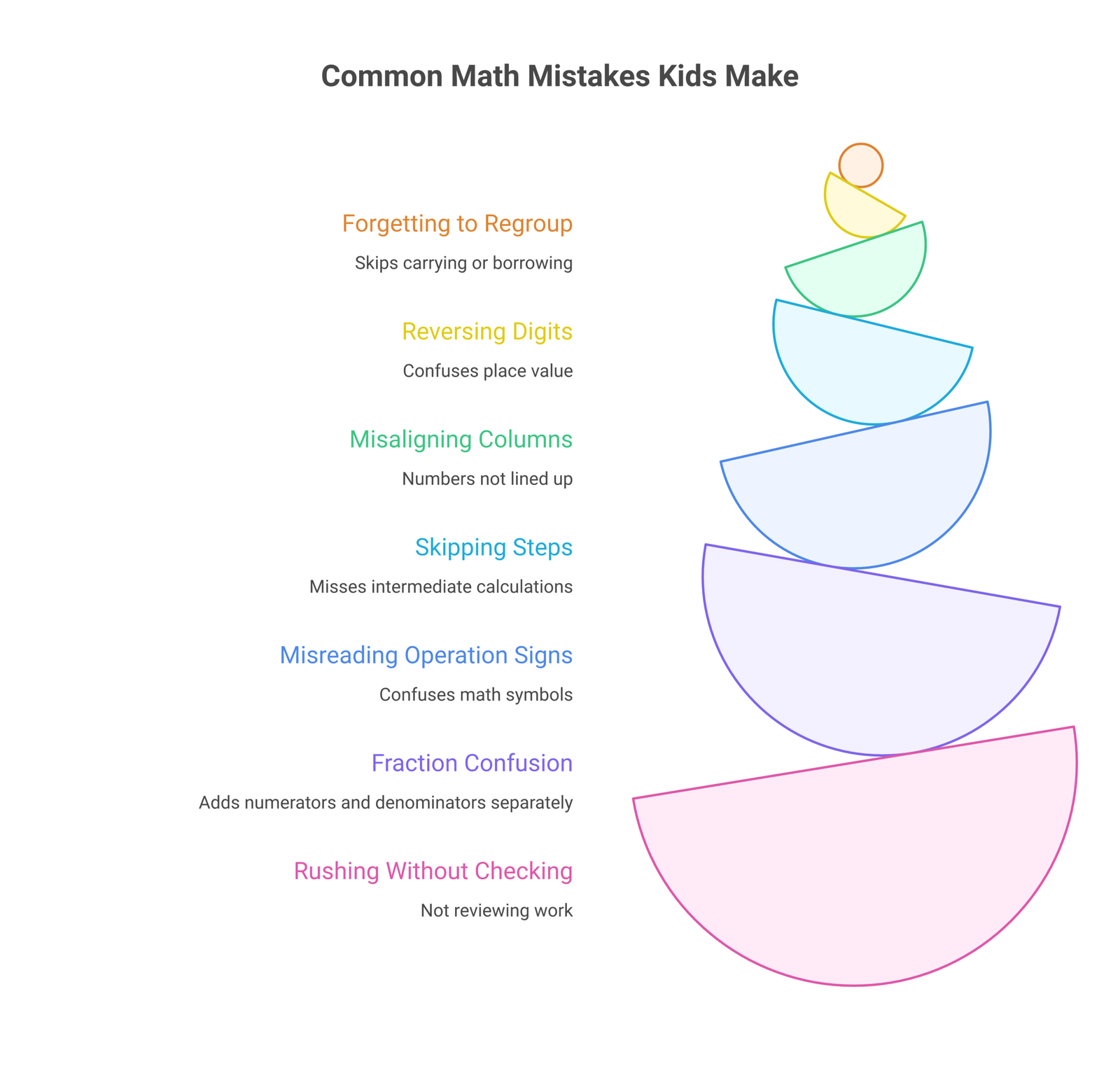
Mistake 4: Skipping steps in multi-step problems
Kids who are quick with mental math often skip writing intermediate steps, and that’s where errors creep in. They’ll solve a two-step word problem by jumping straight to the final calculation and missing a step in the middle. Or they’ll do part of a long multiplication in their head and lose track of a partial product.
The counterintuitive fix? Slow them down. Require written work for every step, even when they insist they can do it in their head. Research published in the Journal of Experimental Child Psychology found that students who write out intermediate steps score 23% higher on complex problems than those who try to hold everything in working memory.
Frame it positively: “Showing your work isn’t about proving you did it. It’s about having a trail you can check.” That reframe helps kids who feel insulted by being asked to write more.
Mistake 5: Misreading operation signs
Confusing + with x, or – with ÷. It happens more than you’d think, especially on worksheets where problems are crammed together. A child powers through 20 addition problems, hits a subtraction problem mixed in, and keeps adding on autopilot.
The What Works Clearinghouse recommends having kids circle or highlight the operation sign before solving each problem. This forces a momentary pause that breaks autopilot mode. It takes about two extra seconds per problem and cuts sign-reading errors dramatically.
Another version of this mistake appears in order of operations (PEMDAS/BODMAS). Kids often add before multiplying because they read left to right. If your child is in grade 4 or above, practice with mixed-operation expressions regularly. The Khan Academy has solid free practice sets for this.
✓ Quick wins that prevent operation errors
- ✓ Circle the operation sign before solving
- ✓ Read the problem aloud before writing anything
- ✓ Use colored pencils for different operations (red for minus, blue for plus)
- ✓ Practice mixed-operation worksheets instead of single-operation drills
Mistake 6: Fraction errors (the big one)
Fractions trip up more kids than almost any other topic. The classic mistake: adding 1/3 + 1/4 and getting 2/7 (adding both numerators and both denominators). This happens because kids apply whole-number addition rules to fractions without understanding that fractions work differently.
According to the National Science Foundation, fraction understanding in fifth grade is the strongest predictor of high school math achievement, even more than whole-number skills. So getting this right matters a lot.
The best approach is visual. Cut a paper plate into thirds and another into fourths. Ask your child to add one piece from each plate. They can physically see that the pieces are different sizes and can’t just be counted together. Once they grasp that fractions need common denominators before adding, the mechanical process makes sense.
Other common fraction errors include confusing the numerator and denominator, thinking bigger denominators mean bigger fractions (1/8 is not bigger than 1/4), and forgetting to simplify. Each of these comes back to the same root: the child is treating fractions like whole numbers. Visual models fix this.
Mistake 7: Rushing through without checking work
This isn’t really a math mistake; it’s a habit mistake. But it’s responsible for a huge chunk of wrong answers. Kids finish a problem, feel confident, and move on without a second glance. The irony is that a five-second check would catch most of these errors.
Teach the “reverse check” method. After solving 45 + 37 = 82, verify by subtracting: 82 – 37 should equal 45. After multiplication, use division to check. This technique, recommended by education researchers, doesn’t require reworking the entire problem. It’s a quick sanity check that takes seconds.
For younger kids, try the “estimation first” approach. Before solving 48 + 33, round to 50 + 30 = 80. If their answer is anywhere near 80, it’s probably right. If they got 711, something went wrong. Estimation gives kids an internal alarm system for wildly wrong answers.
📝 Important note
Never punish mistakes. Kids who fear getting answers wrong develop math anxiety, which actually makes errors more frequent. Instead, celebrate when your child catches their own mistakes. That’s the real skill you’re building.
Mistake 8: Word problem translation errors
“Sarah has 12 apples. She gives away 5 and then gets 3 more. How many does she have?” Many kids will compute 12 – 5 – 3 = 4 instead of 12 – 5 + 3 = 10. The challenge isn’t arithmetic. It’s translating English sentences into mathematical operations.
The RAND Corporation’s education research suggests teaching kids to underline key action words: “gives away” means subtract, “gets more” means add. Have them write the equation before solving. This separation of “understanding the problem” from “doing the math” is a strategy that professional mathematicians use, according to the American Mathematical Society.
A simple three-step process works well: (1) read the whole problem once without writing anything, (2) read it again and underline action words, (3) write the equation, then solve. This structured approach from the NCTM Standards reduces word problem errors by helping kids separate reading comprehension from calculation.
How to build an error-catching routine at home
Knowing the common math mistakes is step one. Building a system to prevent them is step two. Here’s a practical routine you can start this week:
Keep an error log. For one week, have your child save all their math work. At the end of the week, go through it together and tally which types of mistakes appeared most. This gives you concrete data instead of guesses. Most parents are surprised to find that 80% of their child’s errors fall into just one or two categories from the list above.
Target practice, not more practice. If your child’s main issue is regrouping, doing 50 mixed arithmetic problems won’t help as much as 15 targeted regrouping exercises. Tools like MathSpark generate AI-powered worksheets for specific skills and grade levels in about 10 seconds, so you can create focused practice sheets for exactly the mistake patterns you identified. It follows the Pythagoras Exams methodology and covers grades 1 through 9.
Make checking a game. Challenge your child to find the mistake in a pre-made problem. Write out 5 solved problems where 2 have intentional errors, and let them play detective. This builds error-scanning skills without the pressure of solving from scratch.
Praise the process. When your child catches their own error before you point it out, that’s worth celebrating. According to American Psychological Association research on motivation, praising effort and self-correction builds resilience far more effectively than praising correct answers.
💡 The 3-minute check routine
After finishing any math assignment, have your child spend exactly 3 minutes reviewing. First minute: check that all operation signs were read correctly. Second minute: verify that columns are aligned and digits aren’t reversed. Third minute: use estimation to confirm answers are in the right ballpark. This short routine catches the vast majority of careless errors.
When mistakes signal something deeper
Most math errors are normal learning bumps. But persistent, unusual patterns can sometimes point to something that needs professional attention. Dyscalculia, a learning difference that affects number processing, impacts about 5-7% of the population according to the Learning Disabilities Association of America.
Signs that might warrant a conversation with your child’s teacher or pediatrician include: consistent difficulty recognizing numbers, inability to estimate quantities, struggling with basic facts even after extensive practice, or severe anxiety specifically around numbers. These aren’t just “being bad at math.” They may indicate that your child’s brain processes numerical information differently, and targeted support can make a huge difference.
⚠️ Disclaimer
This article provides general educational guidance based on widely recognized math education research as of March 2026. It is not a substitute for professional educational assessment. If you have concerns about your child’s learning, consult their teacher or a qualified educational psychologist.
Frequently asked questions
What is the most common math mistake kids make?
Forgetting to regroup (carry or borrow) in addition and subtraction is the single most frequent error in elementary math. It happens because kids understand the concept of adding single digits but haven’t internalized what to do when a column exceeds 9.
How can I help my child stop making careless math errors?
Build a checking routine. After every problem, have them use the reverse operation to verify (subtract to check addition, divide to check multiplication). Also try the estimation method: round numbers first to get an approximate answer, then check if the actual answer is close.
At what age should I worry about math mistakes?
Occasional mistakes at any age are completely normal. If your child is consistently struggling with the same error after targeted practice over several weeks, or if they show signs of severe math anxiety, it may be worth discussing with their teacher. Persistent difficulty with basic number recognition or counting past age 7 could indicate dyscalculia.
Are math worksheets helpful for fixing mistakes?
Yes, but only when they target the specific mistake. Generic worksheets with mixed problems are less effective than focused practice on the exact error pattern. For example, if your child struggles with regrouping, use worksheets that specifically drill two-digit addition with carrying.
Why does my child make mistakes they know the answer to?
This usually comes down to attention and working memory, not understanding. When kids solve problems quickly, their brains sometimes skip mechanical steps they know well. The fix is building automatic checking habits rather than telling them to “be more careful,” which rarely works on its own.