Teaching subtraction with regrouping
Teaching subtraction with regrouping gets easier once a child understands that they are not “borrowing” in a vague way, they are trading one ten for ten ones. That small shift matters. According to the National Council of Teachers of Mathematics, strong place value understanding is one of the foundations of later arithmetic success, and the NAEP mathematics data keeps reminding us that many students still struggle when procedures arrive before understanding. If your child freezes at 52 – 27 or gets lost halfway through a column problem, that does not mean they are bad at math. It usually means the idea underneath the steps needs to click first.
The good news is that subtraction with regrouping can be taught in a calm, practical way. You do not need long lectures or stacks of worksheets. A short visual explanation, a few well-chosen examples, and steady practice usually work far better. I also like mixing pencil-and-paper work with quick custom practice from MathSpark, which generates grade-appropriate math worksheets in about 10 seconds and fits nicely when a parent wants extra regrouping practice without the usual homework battle.
📺 Video Guide
Why subtraction with regrouping feels hard at first
Children often meet regrouping before their place value knowledge is fully secure. A student may know that 34 means three tens and four ones, but that is very different from using that idea inside a subtraction problem. The Khan Academy lesson on regrouping makes this clear with visual models, and Understood explains it in parent-friendly language: the child is renaming a number, not magically changing it.
There is also a working-memory issue. The student has to compare the ones column, decide whether a trade is needed, rename a ten, keep the total value the same, and then finish the subtraction. That is a lot. The What Works Clearinghouse practice guide recommends explicit instruction with visual representations for exactly this reason. When the process is broken into visible, manageable steps, children make fewer careless errors and feel less pressure.
If your child already understands place value, regrouping will come faster. If not, go back a step. That is not failure. It is smart teaching.
💡 Pro Tip
Say “trade one ten for ten ones” instead of “borrow.” It is more accurate, and kids usually understand the move faster.
Start with concrete models before the algorithm
Before writing numbers in columns, show regrouping with something a child can move. Base-ten blocks are ideal, but coins, straws bundled in tens, or drawn boxes and dots also work. The NAEYC guidance on early math supports this kind of hands-on instruction because it ties symbols to meaning. For 52 – 27, lay out five tens and two ones. Then ask, “Can we take away seven ones from two ones?” When the child says no, trade one ten for ten ones. Now there are four tens and twelve ones. Suddenly the subtraction makes sense.
This stage should not feel rushed. A lot of mistakes disappear when children physically act out the trade several times. That is also why PBS Parents and GreatSchools both emphasize number sense and real objects in home math practice. If a child can show the exchange, they are far more likely to remember the written method correctly later.
This is also a good point to connect the skill with number sense. Regrouping is not a random school trick. It is place value in action.
✓ What concrete practice should include
- ✓ Tens and ones shown with real objects or clear drawings
- ✓ A spoken explanation of why the trade is needed
- ✓ Two-digit problems before larger numbers
- ✓ Short practice bursts instead of one long session
A simple step by step method that works
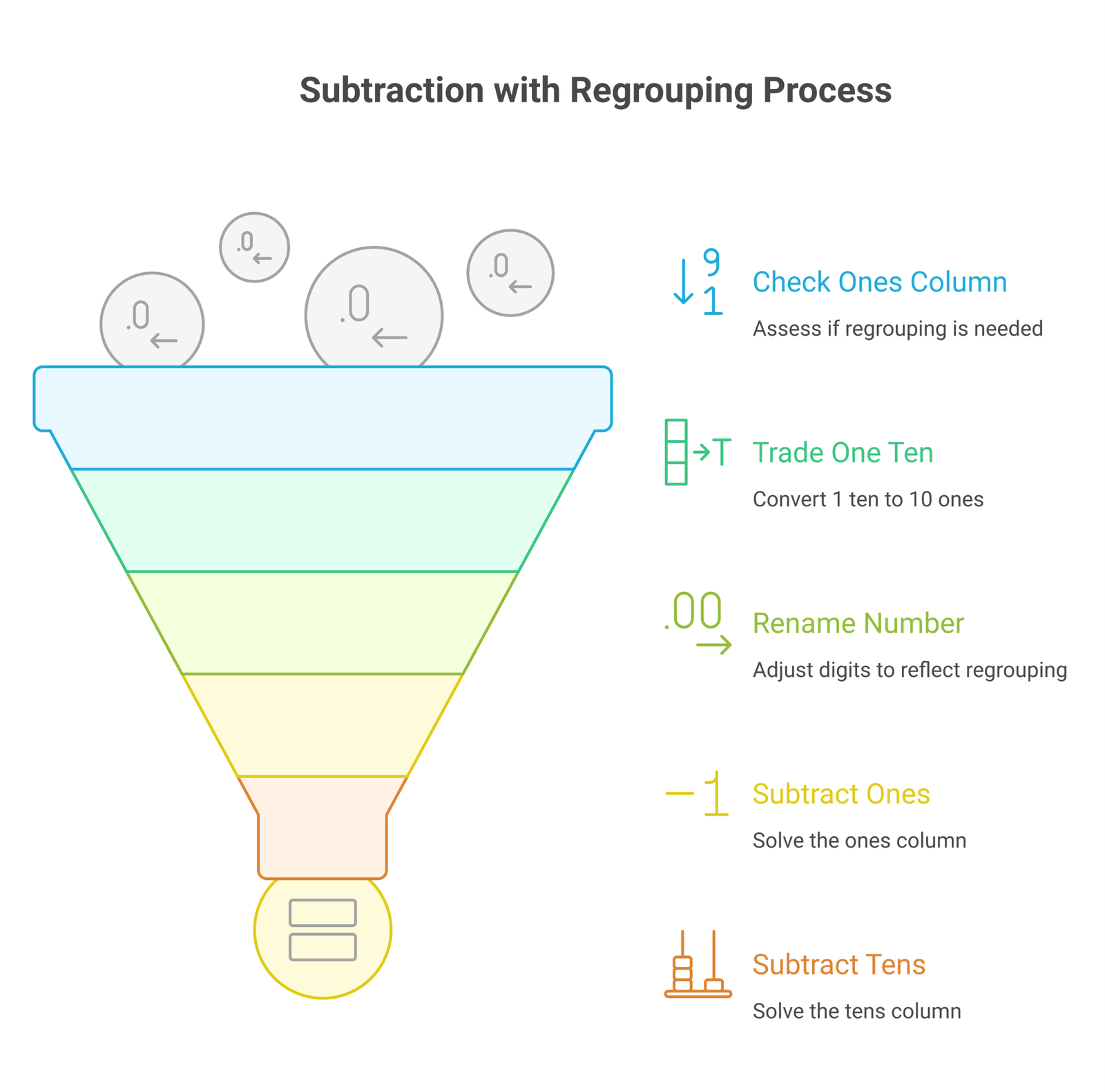
Once the child understands the trade with objects, move to the written algorithm. Keep the language consistent every time. Here is the sequence I recommend for teaching subtraction with regrouping:
First, look at the ones column. Second, decide whether the top number is large enough. Third, if it is not, trade one ten for ten ones. Fourth, subtract the ones. Fifth, subtract the tens. That is it. Clean and repeatable.
Children who benefit from routine often do well when this same checklist is visible beside the page. It reduces panic and helps them self-correct instead of waiting for an adult to rescue them.
📝 Important Note
Do not introduce regrouping and speed practice at the same time. Accuracy comes first. Fluency can grow later.
Worked example: 52 minus 27
Write the problem vertically. In the ones column, 2 is smaller than 7, so the child cannot subtract yet. Cross out the 5 tens and rename it as 4 tens. Then rename the 2 ones as 12 ones. Now subtract 12 – 7 = 5. In the tens column, subtract 4 – 2 = 2. The answer is 25.
What matters here is not the crossing out. It is the meaning. The number 52 did not change value. It was simply renamed as 4 tens and 12 ones. That distinction helps children avoid one of the most common errors, which is treating regrouping like a mysterious rule they have to memorize without understanding.
If your child is making repeated regrouping mistakes, it is worth comparing their work with the patterns in common math mistakes and how to fix them. Often the issue is very specific and easy to correct once you spot it.
Common mistakes and how to fix them
One common mistake is subtracting the smaller digit from the larger digit no matter where it sits. A child sees 2 and 7 and writes 5, then moves on. That usually means the child is reading the problem as a comparison instead of a subtraction procedure. Slow it down and return to the question, “Can I take seven ones from two ones?”
Another common mistake is regrouping the tens but forgetting to reduce the tens digit. So 52 becomes 5 tens and 12 ones instead of 4 tens and 12 ones. This is where visual models help again. If one ten was traded away, it cannot stay in the tens column as if nothing happened.
A third issue is weak fact fluency. Sometimes the child understands regrouping but still gets the subtraction facts wrong. That is when targeted review helps. Short practice with math facts fluency can support regrouping without turning the whole lesson into drill-and-kill.
If zeros are involved, as in 302 – 158, the problem becomes more demanding. Start with easier two-digit examples first. Then move to three-digit problems once the child can explain each trade confidently.
How parents can practice without causing a meltdown
This is the part parents care about most. You want your child to improve, but you do not want every practice session to turn into tears and resistance. The first fix is simple: shorten the session. Ten focused minutes beats forty frustrated ones. The second fix is to mix easy and challenging problems so the page does not feel like a wall of failure.
The Edutopia guidance on building fluent mathematicians points toward discussion, strategy sharing, and reflection, not just answer checking. Ask, “How did you know you needed to trade?” or “Can you show me that another way?” Those questions reveal understanding better than a row of correct answers.
It also helps to separate teaching time from independent practice. Teach one example together. Then let the child try one alone. Then review. That rhythm feels much lighter. For extra support, pair regrouping work with familiar topics like stress-free math homework routines or guided practice through a worksheet generator such as MathSpark, especially if you need a fresh page at the right level rather than random workbook exercises.
And yes, praise matters, but keep it specific. “You remembered to change the 5 into a 4” is better than a vague “Good job.” Kids trust concrete feedback more.
⚠️ Disclaimer
This article shares general educational guidance for parents and teachers as of April 2026. It does not replace instruction from your child’s classroom teacher or school curriculum requirements.
When to move beyond two digit subtraction
A child is ready for larger problems when they can explain the trade, complete several two-digit regrouping problems accurately, and recover from small errors without shutting down. There is no prize for moving too fast. In fact, pushing early usually creates the illusion of progress and then collapses under harder problems.
Once two-digit subtraction feels stable, three-digit subtraction can follow the same logic. The structure stays the same, but the child has to track more columns. This is a good moment to connect regrouping to broader problem solving, including multi-step work and problem solving strategies for kids. If the student understands why each move happens, scaling up is much less scary.
You can also start blending regrouping into short word problems. Real context often helps a procedure feel less abstract. For some children, subtraction becomes more understandable when it is framed as spending, comparing, or taking away objects from a set.
Teaching subtraction with regrouping in a way kids remember
The heart of teaching subtraction with regrouping is not the crossing out marks. It is helping a child see that numbers can be renamed while their value stays the same. Once that idea clicks, the procedure stops feeling random. It becomes logical.
If I had to reduce the whole lesson to one rule, it would be this: make the invisible visible. Use blocks, sketches, spoken steps, and short examples. Keep practice calm. Revisit place value when needed. A child who understands the trade is already more than halfway there.
And if you need a quick way to keep the momentum going, generate a few fresh regrouping worksheets, do three or four problems together, and stop before the frustration spike. Consistency beats intensity almost every time.
Frequently Asked Questions
What is regrouping in subtraction?
Regrouping in subtraction means trading one ten for ten ones when the top digit in the ones column is too small to subtract the bottom digit.
At what grade do kids usually learn subtraction with regrouping?
Many children first meet subtraction with regrouping in Grade 2 or Grade 3, but readiness depends on place value understanding more than age alone.
Should I say borrow or regroup?
“Regroup” or “trade” is usually clearer because the value is being renamed, not borrowed and returned later.
Why does my child keep subtracting the smaller number from the bigger number?
That usually means the child is comparing digits instead of following the subtraction process. Return to concrete models and ask whether the top column has enough ones before subtracting.
How much practice does regrouping need?
Usually a few accurate problems across several short sessions work better than one long drill. Focus on explanation and accuracy first, then speed later.