Math Puzzles for Kids That Build Critical Thinking
If homework has started to feel heavy, math puzzles for kids can change the mood fast. A good puzzle gives children one small challenge at a time, which is often enough to replace panic with curiosity. Instead of racing for the right answer, they slow down, notice patterns, test ideas, and explain what they see. That shift matters. It is how confidence grows.
Parents do not need a teaching degree or a drawer full of expensive materials to make this work. Short logic games, number riddles, visual patterns, and simple strategy tasks can all build stronger thinking habits. Research and classroom guidance from groups like the National Council of Teachers of Mathematics, YouCubed, and the Education Endowment Foundation all point in the same direction. Children learn more deeply when they talk through ideas, compare strategies, and work on problems that make them think instead of memorize.
The goal is not to turn your kitchen table into a high-pressure classroom. The goal is to give your child regular chances to reason, try again, and get a small win. Done well, puzzles make math feel less like a test and more like a game with a point.
📺 Video Guide
Why math puzzles for kids improve critical thinking
Critical thinking in math is really about decision-making. A child sees a problem, decides what matters, ignores what does not, and tries a path forward. That is different from copying a method. The best puzzles create just enough friction to make children think, “What should I try first?”
This is one reason puzzle work stays useful even when a child knows the basic skill already. A simple number sequence can lead to pattern spotting. A Sudoku-style grid can improve attention and working memory. A visual puzzle can push a child to explain why one answer fits better than another. Resources from NRICH and Khan Academy regularly use open-ended tasks for exactly that reason. The answer matters, but the thinking matters more.
There is also a confidence angle here that parents sometimes miss. Children who freeze during worksheets often do better with a puzzle because the format feels less exposed. They are not staring at twenty nearly identical questions. They are solving one interesting problem. That feels manageable. Over time, manageable turns into familiar, and familiar turns into confidence.
✓ What puzzles build beyond arithmetic
- ✓ Pattern recognition that helps with algebra later
- ✓ Flexible thinking when the first idea does not work
- ✓ Clear explanation skills, which strengthen understanding
What counts as a good puzzle at each age
A good puzzle is not always a hard puzzle. For younger children, it might be a pattern task with shapes, a missing-number trail, or a quick game about comparing quantities. For primary grades, it could be a number riddle, a logic grid, or a puzzle where more than one strategy works. Older children can handle multi-step tasks, area challenges, matchstick puzzles, and reasoning questions that ask them to defend an answer.
The best fit is usually just above what your child can do comfortably alone. That is consistent with guidance from NAEYC for early learners and with practical teaching advice gathered by the Institute of Education Sciences. If a child solves everything immediately, there is not much thinking. If they cannot even start, frustration wins. The sweet spot is a task that makes them pause, talk, and try something.
That is why it helps to rotate formats. Some children respond well to visual puzzles. Others prefer short number games. If your child already enjoys problem-solving strategies for kids or likes playful routines such as family math board games, you already know the format matters almost as much as the content.
💡 Pro tip
If your child says, “I don’t get it,” resist jumping straight to the method. Ask, “What do you notice first?” That one question often gets thinking moving again.
Five simple ways to use puzzles at home
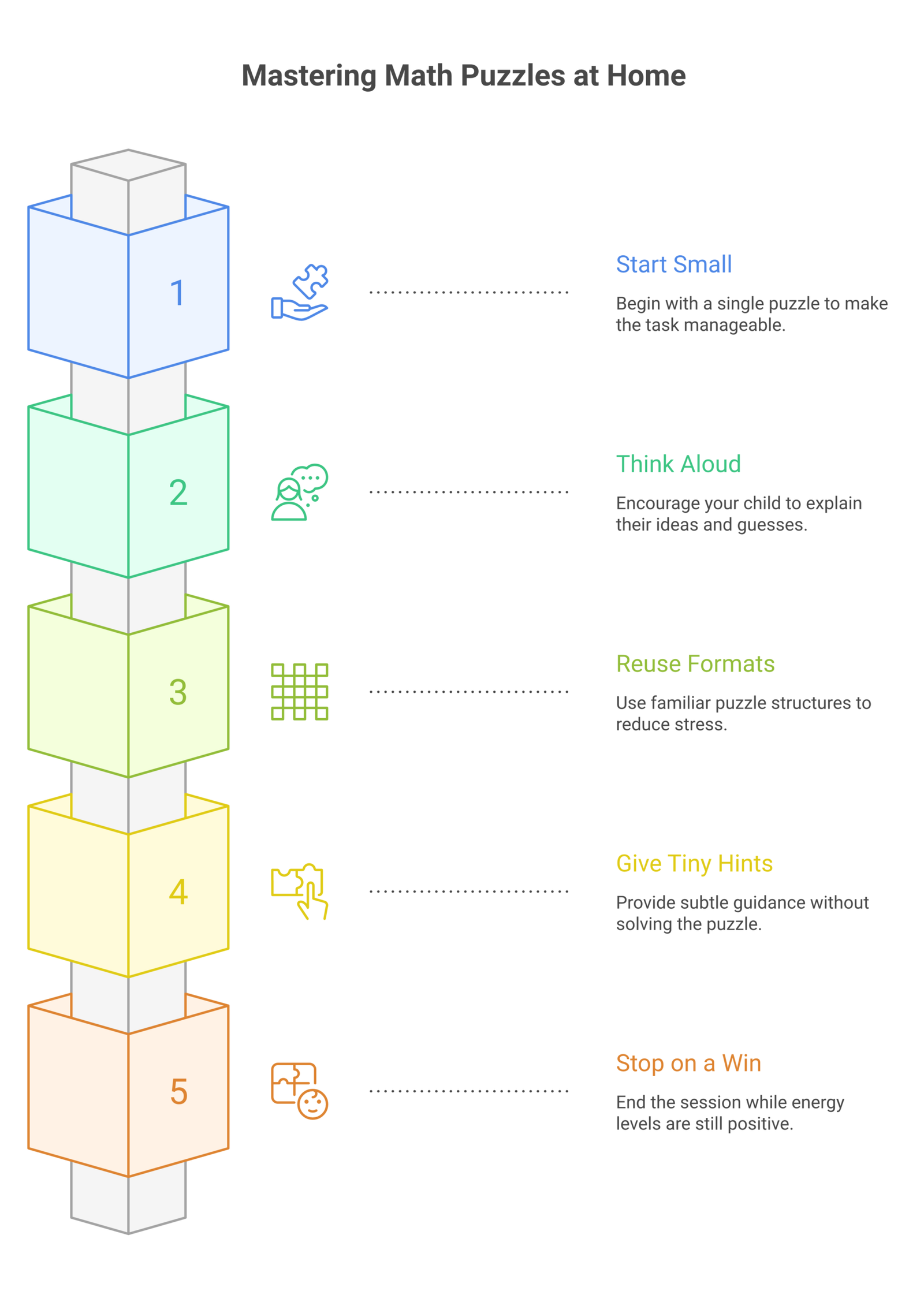
You do not need a long lesson plan. In most homes, ten focused minutes beats a dramatic forty-minute session that everyone regrets. Here are five approaches that work because they are realistic.
1. Start with one puzzle, not a pack. A single puzzle lowers resistance. Children are more willing to try when the finish line is visible.
2. Let your child talk out loud. Verbal reasoning reveals gaps and often leads to self-correction. The OECD’s work on problem solving and mathematical literacy keeps stressing that explanation is part of competence, not an extra.
3. Reuse puzzle types. New context, familiar structure. That mix helps children notice patterns without feeling lost.
4. Keep hints small. Point to one detail, not the whole path. A useful hint keeps ownership with the child.
5. End while energy is still good. Stopping after success makes the next session easier to start. If you want more playful ideas, these math games for car rides and waiting rooms show how short activities can still be meaningful.
Puzzle formats that usually work well
If you want a reliable starting point, try one of these. Number riddles are great for younger learners because they combine clues with basic operations. Logic grids help children track information carefully. Pattern puzzles support early algebraic thinking. Visual arrangement puzzles are useful for children who like to move pieces or draw. Strategy games build patience because the answer often appears only after a few false starts.
You do not have to build everything yourself. Parents can use curated collections from Education.com, printable materials from The Critical Thinking Co., practical ideas from Prodigy, and broader classroom-style suggestions from We Are Teachers. Some are better for quick home sessions, others for weekend challenge time. That is fine. You only need one or two formats your child actually wants to repeat.
This is also where digital tools can help instead of getting in the way. If your child benefits from fresh practice without repetitive busywork, MathSpark is worth trying. It creates grade-appropriate math worksheets in about ten seconds, follows the Pythagoras Exams methodology, and gives parents a quick way to generate extra practice around the exact skill a puzzle exposed. I like it most as a follow-up move. Use the puzzle to reveal the weak spot, then generate a short worksheet for calm practice.
📝 Important note
If your child is already tired after school, treat puzzle time as a reset, not one more assignment. Five strong minutes is enough.
Mistakes that make puzzles backfire
The most common mistake is turning a puzzle into a mini test. Once the parent starts timing, correcting every step, or asking for the “right method,” the activity loses what made it useful. Puzzles work because they invite exploration. If every attempt gets judged too quickly, children stop taking risks.
Another mistake is picking tasks that are too abstract too early. A child who still needs concrete support with number sense may hate formal logic grids, but enjoy hands-on patterns or puzzle cards. The format should match the stage. If you are not sure, start easier than you think and move up once your child starts explaining ideas with less prompting.
Finally, avoid overloading puzzle time with too much variety. Parents often collect ten resources and use none of them well. Pick two formats, repeat them for a week, and watch what happens. That gives you real information. It is the same principle behind effective routines in teaching. Consistency beats novelty when you are trying to build a habit.
⚠️ Disclaimer
This article is for general educational support and reflects commonly recommended home-learning practices as of April 2026. It is not a substitute for advice from your child’s teacher or school support team when a learning difficulty needs individual assessment.
How to tell if the puzzles are helping
You do not need a formal assessment to notice progress. Watch for small changes. Does your child stay with a problem a little longer? Do they explain an idea more clearly? Do they try a second strategy without shutting down? Those are strong signs that thinking is getting more flexible.
Transfer matters too. If puzzle work is useful, you will usually see some carryover into everyday math. A child may spot patterns faster in multiplication, organize information better in word problems, or show more patience during homework. That is why puzzle work pairs nicely with practical articles like Pi Day activities for kids or creative math and art connections. Playful thinking in one area often supports confidence in another.
If your child still resists every task, simplify. Reduce the amount, shorten the time, and pick one puzzle type they already half-like. The answer is usually not “push harder.” It is “lower the friction so they can get moving.”
Where to find strong puzzle ideas without wasting time
Start with one trusted source and one simple routine. For younger children, printable logic and pattern activities are often enough. For older children, challenge problems and strategy games work better. You do not need a giant library. A short weekly rotation is more realistic, and that makes it more likely to happen.
Good places to look include Common Sense Media’s math recommendations, home activity ideas from PBS Parents, game-based suggestions from Oxford Owl, and extension resources from DreamBox. If you want something more structured, pair a puzzle routine with short targeted practice. That combination usually works better than relying on either one alone.
And if your child enjoys challenge-style tasks, keep an eye on engagement rather than difficulty alone. The best puzzle is the one they want to come back to tomorrow. That sounds obvious, but it is the difference between a one-off activity and a habit that actually changes how they think about math.
Frequently asked questions
How often should my child do math puzzles?
Three to four short sessions per week is plenty for most families. Aim for consistency, not marathon sessions.
Are puzzles better than worksheets?
They do different jobs. Puzzles build reasoning and flexibility. Worksheets help with focused practice. Using both is usually the smarter move.
What if my child gets frustrated quickly?
Start with easier visual or pattern puzzles, keep sessions short, and give smaller hints. Early success matters more than challenge at the start.
Can math puzzles help with school performance?
They can support school learning by improving persistence, pattern recognition, and problem-solving habits. They are most effective when paired with regular classroom practice.
What is the best first puzzle type to try?
For most children, simple number riddles or pattern puzzles are the easiest entry point because they feel manageable and still create real thinking.
Math puzzles do not need to be elaborate to be useful. One smart question, one short discussion, one small win. That is enough to help a child think more clearly and feel less intimidated by math. For a lot of families, that is the breakthrough they were actually looking for.