Teaching Probability to Kids: Easy Ways to Make It Click
Teaching probability to kids usually works best when parents stop treating it like an abstract math chapter and start treating it like a game of chance. Children already understand the basic idea when they ask, “What are the chances?” before rolling a die, picking a card, or checking whether it might rain. The goal is to turn that instinct into clear language. Probability is just a way to describe how likely something is to happen, and kids can learn it with coins, spinners, colored blocks, and everyday choices at home.
A solid introduction does not need formal formulas on day one. The Britannica definition of probability gives the adult version, but younger learners need simple comparisons first: impossible, unlikely, likely, and certain. Once that language feels natural, you can connect it to fractions, percentages, and data. That same progression shows up in lessons from Khan Academy, the activity bank at NRICH Cambridge, and practical classroom guidance from the National Council of Teachers of Mathematics.
If your child learns better with short practice bursts, this is also the kind of topic where a custom worksheet can help. MathSpark lets parents generate grade-appropriate math practice in about 10 seconds, which is useful when you want a few quick questions on chance, fractions, or simple data without turning homework into a household event.
📺 Video Guide
What probability means for children
Before you show numbers, teach the idea of chance through ordinary situations. Ask questions your child can picture: Is the sun likely to rise tomorrow? Is it certain that a tossed coin will land on one side? Is it impossible to pull a blue marble from a bag with only red marbles? These examples help kids connect words to outcomes. Resources from PBS Parents and Understood.org both lean on concrete, low-pressure practice because children learn more when the task feels familiar.
Once the language is in place, you can show that probability sits on a scale from 0 to 1. Zero means an event cannot happen. One means it will happen for sure. Everything else falls in between. The National Weather Service gives parents a nice real-world bridge here, because weather forecasts regularly talk about chance in ways children hear all the time. A 30 percent chance of rain is not random adult jargon. It is probability in everyday life.
This is also where many kids start linking new work to older topics. If your child already knows fractions, probability becomes easier because favorable outcomes can be written as part of the total number of outcomes. If they have seen charts, then simple experiments can become mini data lessons, much like the visual work in our guide to graphing for kids.
✓ Key vocabulary to teach first
- ✓ Impossible means there is no chance the event can happen.
- ✓ Unlikely means it could happen, but not very often.
- ✓ Likely means it has a good chance of happening.
- ✓ Certain means it will happen every time.
Why hands-on experiments work so well
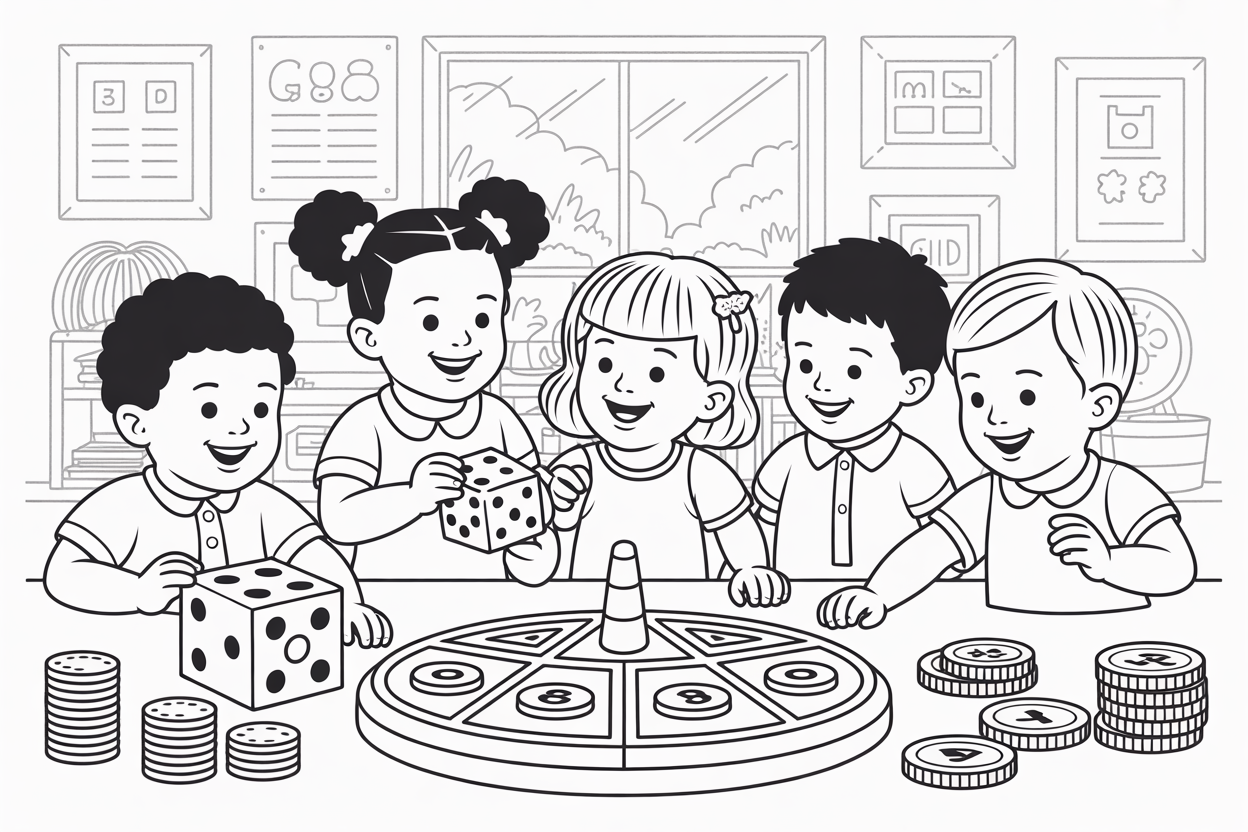
Children trust probability faster when they can test it. A coin toss, a spinner, a bag of colored counters, or a deck of cards turns an invisible idea into something they can see. The NCTM Illuminations collection and activities from YouCubed both use repeated trials for a reason: kids notice patterns when the same experiment is run again and again. They begin to see that possible does not mean guaranteed, and unlikely does not mean never.
That distinction matters because many children think one outcome should balance the next. If they get heads three times in a row, they may decide tails is now due. Probability gives you a calm way to show that each coin toss is a new event. This kind of reasoning also strengthens broader problem solving strategies, because kids learn to separate a guess from evidence.
Keep the experiments short. Ten tosses, not one hundred. A quick round with a spinner, not a lecture. Short sessions make it easier for children to predict, record, and discuss what happened without drifting into boredom. If your child gets frustrated by abstract math, the same low-pressure mindset behind our article on estimation skills works here too.
💡 Pro Tip
Ask your child to predict the result before each experiment and explain why. The explanation matters more than getting the guess right. That is where the math thinking happens.
Seven easy ways to teach probability at home
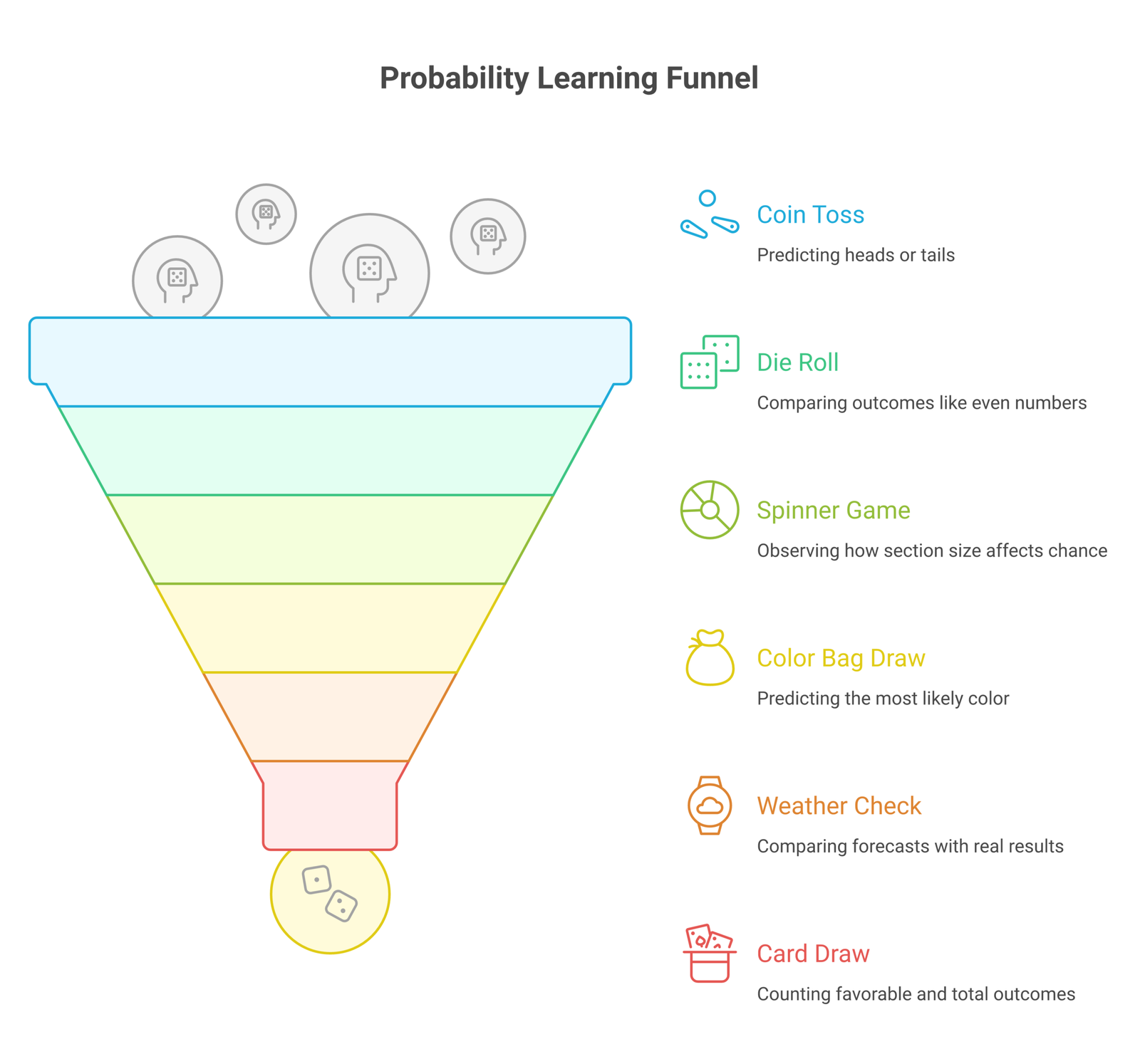
Here is the practical part. These activities do not need expensive materials, and each one gives you a different angle on teaching probability to kids.
1. Toss a coin. Start with heads or tails because there are only two outcomes. Ask which result is more likely and why. Then test the prediction.
2. Roll one die. Ask whether rolling a number greater than four is likely or unlikely. Then compare rolling an even number with rolling a six.
3. Use a homemade spinner. Divide a circle into equal sections with different colors. This is perfect for talking about fair and unfair chances.
4. Grab colored blocks or beads. Put different amounts into a bag and ask your child to predict which color is most likely to be picked.
5. Play card games. Card draws help older children think about total outcomes, matching suits, and comparing chances.
6. Track the weather forecast. Compare the stated chance of rain with what actually happens over several days using forecasts from the National Oceanic and Atmospheric Administration.
7. Use puzzles and games. Probability comes alive when children make choices with uncertain outcomes, which is one reason math puzzles for kids can support this topic so well.
How to connect words, fractions, and percentages
After a child understands words like likely and impossible, you can start showing how math records the same idea. With a coin, the probability of heads is 1 out of 2, or one-half. With a standard die, the probability of rolling a six is 1 out of 6. This is a clean place to revisit fraction meaning, and for older students, it leads naturally into our article on understanding percentages.
It helps to keep the language blunt. Favorable outcomes are the results you want. Total outcomes are all the results that could happen. That is it. The Scholastic Parents site and lesson ideas from Edutopia both show that children remember math better when the wording stays clear and short.
For middle primary grades, you can also compare simple probabilities. Ask whether drawing a red bead from a bag with five red and two blue beads is more likely than rolling a six on a die. Kids do not need advanced notation to reason through that. They just need repeated practice comparing chances and explaining their thinking out loud.
📝 Important Note
Do not rush from vocabulary to formulas. If a child cannot explain why one event is more likely than another, more notation will not fix the problem. Slow down and go back to experiments.
Common mistakes parents make when teaching probability
The first mistake is turning the lesson into a definition contest. Probability is not hard because the word is hard. It is hard when children hear a definition they cannot connect to experience. Start with examples they can test. The second mistake is assuming one trial proves everything. If a child rolls a die once and gets a six, that does not mean six is common. Repeated trials show the bigger picture, which is why the CK-12 Foundation and OpenStax materials keep coming back to examples, tables, and comparisons.
Another mistake is treating wrong predictions like failures. They are not. A wrong prediction gives you a reason to ask, “What made you think that?” and then test the idea. That is useful math talk. If your child gets anxious when they are unsure, keep the conversation light and use very short rounds. A few clear questions will help more than a twenty-minute speech.
Last, be careful with fairness. Children quickly notice when a spinner has larger sections or a bag contains more of one color. Good. That is not a distraction. It is the lesson. An unfair setup gives you a clean way to talk about why some outcomes happen more often than others.
A simple home routine that keeps practice consistent
If you want teaching probability to kids to stick, build a tiny routine instead of waiting for the perfect lesson. Pick one short experiment two or three times per week. Ask for a prediction, run the experiment, record the result, and discuss what happened. That whole sequence can fit into ten minutes. Over time, children start hearing probability language as normal math language, not as a special scary unit.
This is also a good moment to mix topics. Probability can connect to fractions, data, graphing, and reasoning. A few quick follow-up questions on a worksheet can keep the idea fresh without overloading your child. That is exactly where tools like MathSpark help. You can generate practice that matches your child's level and keep the session short, which is often the difference between useful repetition and total pushback.
Parents do not need to sound like textbook writers. Say what is true in plain English: some things are certain, some things are impossible, and some things sit in the middle. Once children trust that framework, the numbers start to make sense.
⚠️ Disclaimer
This article is for general educational guidance as of April 2026. Children learn probability at different speeds depending on age, prior math confidence, and classroom expectations. If your child is consistently overwhelmed, it helps to slow the pace and check with their teacher before increasing the difficulty.
Frequently Asked Questions
What is the best age to start teaching probability to kids?
Most children can start talking about chance in early primary years. Use words like certain, likely, unlikely, and impossible before introducing fractions or percentages.
How do I explain probability without making it too abstract?
Use objects your child can touch and test. Coins, dice, cards, and spinners make probability visible. Ask for predictions before each activity.
Should children learn percentages at the same time as probability?
Not always. Start with words and simple fractions first. Percentages make more sense once children already understand part of a whole.
What if my child keeps guessing instead of reasoning?
That is normal at first. Ask, "Why do you think that?" and run the experiment. The repeated test helps move them from guessing to evidence-based thinking.