Cooking with Kids: Math in the Kitchen
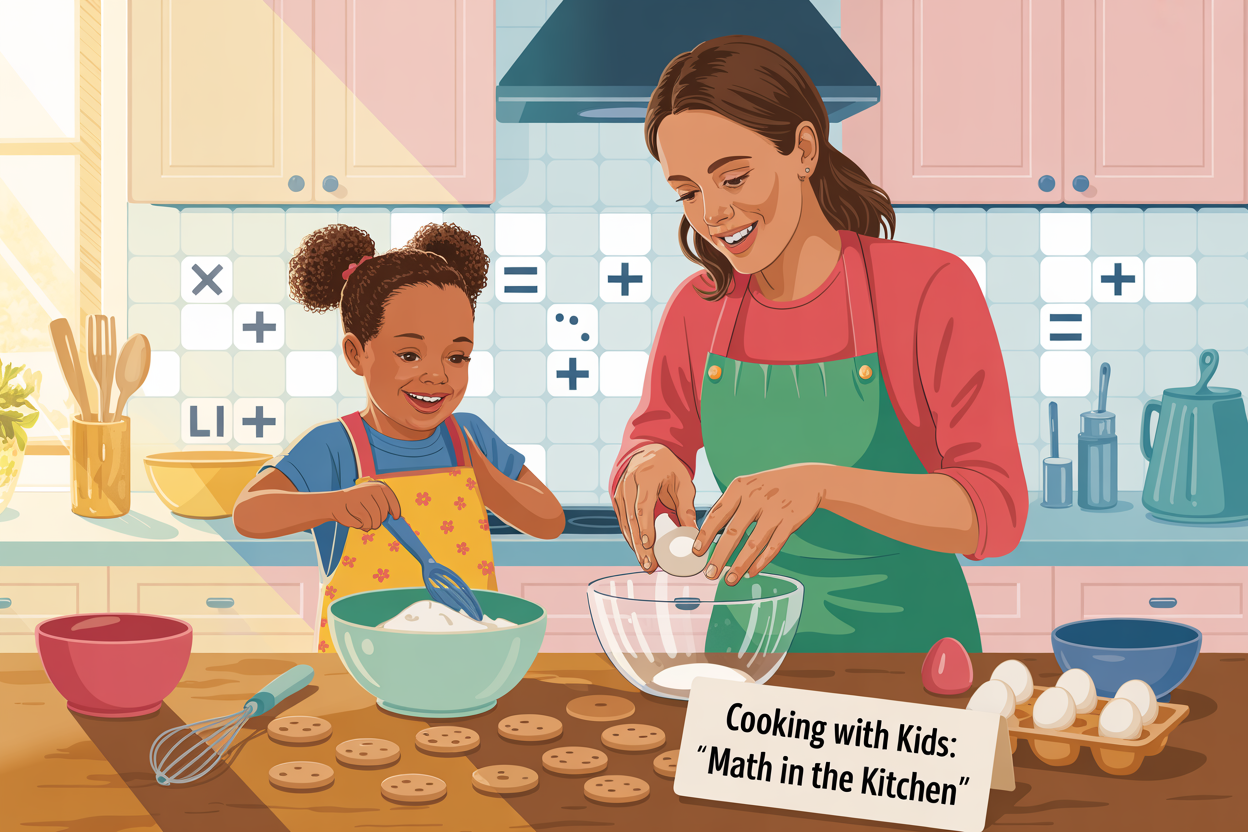
Why the Kitchen Is Your Best Math Classroom
Your child probably groans when you mention math practice. But hand them a mixing bowl and a recipe card? Suddenly they’re measuring flour, counting eggs, and dividing portions without a single complaint. That’s the magic of math in the kitchen: it sneaks learning into something kids already want to do.
Cooking naturally involves almost every math skill taught in elementary and middle school. Fractions show up when you halve a recipe. Multiplication appears when you triple cookie batches for a party. Estimation kicks in when you eyeball “about a cup” of blueberries. And the best part? Kids see why these skills matter, because if you measure wrong, the pancakes taste terrible.
Research from the National Center for Education Statistics shows that children who engage with math in everyday contexts develop stronger number sense than those who only practice through worksheets. The kitchen provides one of the richest environments for this kind of applied learning.
📺 Video Guide
Math Skills Your Child Practices While Cooking
Let’s break down exactly what happens when your child follows a recipe. Each step is loaded with math opportunities you might not even notice.
✓ Math Skills in Every Recipe
- ✓ Measurement – cups, tablespoons, teaspoons, grams, ounces
- ✓ Fractions – half cups, quarter teaspoons, thirds of a recipe
- ✓ Multiplication – doubling or tripling ingredient amounts
- ✓ Division – splitting a batch into equal portions
- ✓ Time – setting timers, calculating total cooking duration
- ✓ Temperature – reading thermometers, converting Celsius to Fahrenheit
- ✓ Estimation – judging quantities by sight
Measurement: Where It All Starts
Measurement is the backbone of cooking and one of the first math concepts kids encounter in school. When your child scoops flour into a measuring cup or pours milk to the 250ml line, they’re building a concrete understanding of units that no textbook can replicate.
Start with simple recipes that use whole measurements. A smoothie recipe calling for “1 cup yogurt, 1 cup frozen berries, 1 banana” is perfect for a 5-year-old learning to count and measure. As your child gets comfortable, introduce recipes with more complex measurements like “3/4 cup” or “2 and 1/2 tablespoons.”
The National Council of Teachers of Mathematics emphasizes that hands-on measurement activities build understanding far better than abstract exercises. Cooking delivers this naturally, because kids can see and feel the difference between a teaspoon and a tablespoon.
💡 Pro Tip
Buy a set of colorful measuring cups and let your child “own” them. When they feel responsible for the tools, they pay more attention to the numbers on each cup. Nesting cups also teach ordering from smallest to largest.
Fractions Come Alive in Recipes
Fractions are one of the biggest stumbling blocks in elementary math. Kids struggle with the concept because it’s abstract. But show a child what “half a cup” looks like next to “a full cup,” and the light bulb switches on.
Try this exercise: pick a recipe and ask your child to cut it in half. If the original calls for 1 cup of sugar, they need to figure out that half is 1/2 cup. If it calls for 3/4 cup of butter, they need to work out that half of 3/4 is 3/8. Suddenly fractions aren’t some weird concept from a worksheet. They’re the difference between cookies that turn out right and cookies that don’t.
A study published in the Journal for Research in Mathematics Education found that students who work with fractions in real-world contexts develop deeper conceptual understanding compared to those learning through procedural methods alone. Cooking is one of the most accessible real-world contexts available.
For extra practice, tools like MathSpark let you generate fraction worksheets that reinforce what your child learned in the kitchen. It takes about 10 seconds to create a custom practice sheet aligned with the Greek school curriculum and Pythagoras Exams methodology, and the basic version is free.
Multiplication and Division at the Dinner Table
“We’re having 8 people for dinner, but this recipe serves 4. What do we need to do?” That single question gives your child a real reason to multiply. And unlike a worksheet problem, the answer actually matters.
Division works the same way. “We made 24 cookies and there are 6 people. How many does everyone get?” Your child is solving division problems without even realizing they’re doing math. According to Understood.org, this kind of contextualized practice is especially helpful for kids who struggle with abstract math concepts.
Here’s a progression you can follow based on your child’s grade level:
- Grades 1-2: Count ingredients, sort by type, practice one-to-one correspondence (one egg per muffin cup)
- Grades 3-4: Double recipes, halve recipes, calculate how many servings you’ll get
- Grades 5-6: Work with mixed numbers, convert between metric and imperial units
- Grades 7-9: Calculate ratios, work with proportions, figure out cost per serving
Time and Temperature: Practical Number Skills
Cooking involves constant time calculations. “If we put the chicken in at 5:15 and it needs 45 minutes, what time will it be done?” This kind of elapsed time problem is notoriously tricky for kids in grades 2-4, but it becomes much easier when they’re actually watching the clock while dinner cooks.
Temperature offers another layer of math. Reading a thermometer requires understanding number lines. Converting between Celsius and Fahrenheit introduces basic algebra: F = (C × 9/5) + 32. And checking whether bread has reached an internal temperature of 190°F practices comparing numbers on a scale.
The UK Department for Education includes telling time and temperature reading as core mathematical skills, and cooking is specifically recommended as a cross-curricular activity to reinforce these areas.
10 Kitchen Math Activities by Age Group
Not sure where to start? Here are specific activities matched to age groups that naturally build math skills while cooking.
Ages 4-6 (Kindergarten to Grade 1)
- Counting ingredients – “Put 5 strawberries in the bowl.” Simple counting with a purpose.
- Sorting by color or size – Separate M&Ms by color before adding to cookie dough. Practice classification.
- Shape recognition – “What shape is the pizza? What shape do we get when we cut it in half?” Connect geometry to food.
Ages 7-9 (Grades 2-4)
- Recipe doubling – “This makes 12 muffins. We need 24. What do we multiply everything by?” Real multiplication practice.
- Fraction measuring – Use 1/4, 1/3, and 1/2 cup measures and ask which is bigger. Hands-on fraction comparison.
- Timer math – “The cake needs 35 minutes. It’s 4:40 now. When do we take it out?” Elapsed time in context.
- Ingredient budgeting – Give them a small budget and have them calculate if you have enough to buy all ingredients. Addition and subtraction with decimals.
Ages 10-14 (Grades 5-9)
- Unit conversion – Convert a recipe from cups to milliliters, or from Fahrenheit to Celsius. Practical ratio work.
- Cost per serving – Calculate total recipe cost and divide by servings. Brings in division with decimals and real money math.
- Scaling for proportions – “This recipe serves 6. We need to serve 15. What’s the scaling factor?” Introduces ratio and proportion.
📝 Important Note
Safety first. Young children should always cook with adult supervision. Keep them away from sharp knives, hot surfaces, and boiling liquids. Assign age-appropriate tasks: stirring, pouring, counting, and measuring are safe for little hands.
Recipes That Pack the Most Math
Some recipes are better than others for math practice. Here are five that naturally involve multiple math skills:
1. Pizza from scratch. Measuring flour and water teaches volume. Kneading dough for a set time practices clock reading. Cutting into equal slices is hands-on fraction work. And dividing toppings evenly among slices brings in fair sharing and division. The Food Network has a straightforward dough recipe that works well with kids.
2. Pancakes. A classic pancake recipe uses fractions heavily: 1 1/2 cups flour, 3/4 cup milk, 1/4 teaspoon salt. Ask your child to make a half batch or a double batch, and they’re doing fraction arithmetic without a pencil in sight.
3. Trail mix. This no-cook recipe is perfect for younger kids. Set up different ingredients (raisins, nuts, chocolate chips, cereal) and have children measure specific amounts of each. You can also introduce ratios: “For every 2 scoops of cereal, add 1 scoop of raisins.”
4. Smoothies. Smoothies involve liquid measurement, which is slightly different from dry measurement. Kids practice reading measurement lines on clear cups, and they can experiment with ratios of fruit to liquid to get the thickness they want. The BBC Good Food collection of kids’ smoothie recipes offers good starting points.
5. Cookies. Baking cookies covers nearly everything: precise measurement, temperature setting, timer calculation, and dividing the batch onto baking sheets. If your child wants to package cookies as gifts, you add grouping and multiplication to the mix.
Turning Cooking into a Math Conversation
The math doesn’t happen automatically. You need to ask the right questions. Here’s a script you can adapt while cooking with your child:
- Before cooking: “How many ingredients do we need? Can you count them on the recipe?”
- While measuring: “This calls for 3/4 cup. Which measuring cup should we use? Is 3/4 more or less than 1/2?”
- While waiting: “The timer says 20 minutes. It’s been 8 minutes. How much longer?”
- While serving: “We made 16 meatballs and there are 4 of us. How many does each person get?”
- After eating: “We used half the bag of pasta. How much is left?”
According to NAEYC (National Association for the Education of Young Children), “math talk” during everyday activities is one of the strongest predictors of early math achievement. The kitchen gives you a natural, low-pressure setting for these conversations.
💡 Pro Tip
Don’t correct mistakes immediately. If your child pours too much or too little, let them see the result. “Hmm, these pancakes are really thin. What do you think happened?” Learning from mistakes is more powerful than getting it right the first time.
Beyond the Recipe: Advanced Kitchen Math
Once your child is comfortable with basic cooking math, you can push into more advanced territory. These extensions work well for kids in grades 5-9 who need to practice concepts like percentages, ratios, and basic algebra.
Nutritional math. Read the nutrition label on ingredients together. “This yogurt has 12 grams of sugar per 100 grams. We’re using 250 grams. How much sugar is that?” This is percentage and proportion work disguised as healthy eating awareness. The FDA’s guide to nutrition labels can help you understand the layout.
Grocery budgeting. Before a shopping trip, sit down with the recipe and estimate the cost. Compare prices per unit at the store. “This 500g bag costs €3.50 and the 1kg bag costs €6.00. Which is a better deal per gram?” You’re teaching unit rate, a concept many middle schoolers find challenging. Resources from Khan Academy on ratios and rates can supplement this practice.
Recipe scaling with awkward numbers. “This recipe serves 4 but we need to serve 7. What’s the multiplier?” The answer (1.75) introduces decimals in multiplication. Working through the ingredients one by one gives sustained practice with a concept that often trips up students on tests.
Common Mistakes Parents Make
Kitchen math works best when it feels natural. Here’s what to avoid:
Don’t turn it into a quiz. Rapid-fire questions like “What’s 3/4 minus 1/2?” while your child is trying to stir batter will kill the fun. Weave questions into conversation instead.
Don’t take over. When your child measures wrong, resist grabbing the cup and doing it yourself. Let them try again. The American Psychological Association notes that autonomy in learning tasks builds both confidence and competence.
Don’t skip the cleanup math. “We used 5 bowls, 3 spoons, and 2 pans. How many items do we need to wash?” Even tidying up can be a counting exercise for younger children.
Don’t forget to connect back to school. After cooking, mention: “You just used fractions today! That’s the same thing your teacher was talking about.” This bridge between kitchen and classroom reinforces the idea that math in the kitchen is real math, not just play. Research from the Institute of Education Sciences supports connecting informal math experiences to formal instruction.
Making It a Weekly Habit
The real benefit comes from consistency. One cooking session won’t transform your child’s math skills. But a weekly “Math Chef” session can make a genuine difference over a school year.
Pick a day that works for your family. Saturday morning pancakes or Sunday evening pizza are popular choices. Let your child choose the recipe (with guidance). Make a shopping list together, calculating quantities. Cook together, asking questions along the way. Over time, you’ll notice your child reaching for the measuring cups with confidence instead of hesitation.
Keep a “recipe math journal” where your child writes down the math they used while cooking. “Today I doubled the pancake recipe. 1 1/2 cups x 2 = 3 cups flour.” This reflection step, recommended by math educators at NCTM, helps cement the learning and gives you a record of progress to share with their teacher.
✓ Quick Start Checklist
- ✓ Choose a simple recipe your child likes
- ✓ Gather measuring cups, spoons, and a timer
- ✓ Read the recipe together before starting
- ✓ Ask 3-5 math questions naturally during cooking
- ✓ Let your child make mistakes and self-correct
- ✓ Connect the experience to school math afterward
⚠️ Disclaimer
This article provides general educational suggestions for parents. Every child learns differently, and these activities should be adapted to your child’s specific age, ability, and comfort level. Always supervise children in the kitchen. Content reviewed March 2026.
Frequently Asked Questions
At what age can kids start doing math in the kitchen?
Children as young as 3-4 can start with simple counting tasks like placing strawberries in a bowl or counting eggs. By age 5-6, they can begin using measuring cups with assistance. More complex math like fractions and multiplication in recipes typically works well from age 7 onward.
Do I need to be good at math myself to teach kitchen math?
Not at all. You just need to follow a recipe and ask questions. The math in cooking is practical and straightforward. If your child asks something you’re not sure about, work through it together. That models problem-solving better than having all the answers.
How is cooking math different from worksheet practice?
Cooking provides context that worksheets can’t. When a child measures 3/4 cup of flour, they see and feel the quantity. They understand that fractions represent real amounts. Worksheets are still valuable for building fluency, but cooking adds the “why” that makes concepts stick. Using both approaches together works best.
What if my child gets frustrated with the math while cooking?
Back off on the questions and let them enjoy the cooking. The goal is to build positive associations with math, not create another stressful learning situation. You can always circle back to math concepts in a later cooking session when they’re more relaxed.
Can kitchen math replace regular math practice?
It shouldn’t replace structured practice entirely, but it’s an excellent supplement. Kitchen math builds conceptual understanding and shows kids why math matters. Pair it with regular practice using tools like MathSpark worksheets to cover both understanding and fluency.