Estimation Skills: Why They Matter for Kids
Estimation skills help children make smart guesses before they calculate, and that habit pays off everywhere, from checking homework answers to adding up snack prices in a shop. When a child can look at 48 + 31 and say “about 80” before solving it exactly, they are building number sense instead of relying on blind procedures. That matters at school, but it also matters at home, where quick mental math can turn ordinary moments into low-pressure practice.
📺 Video Guide
Why estimation matters more than many parents think
A lot of children treat math as a hunt for one exact answer. Estimation changes that. It teaches them to pause, look at the size of the numbers, and decide what would make sense before they start computing. Resources from the National Council of Teachers of Mathematics, Khan Academy, and OpenLearn all treat rounding and estimation as part of strong number sense, not as a filler skill.
That number sense does a few useful jobs. First, it helps children catch silly mistakes. If they estimate 197 + 204 as about 400 but write 611, something feels off immediately. Second, it reduces fear. A hard-looking problem becomes less intimidating when a child can shrink it to a manageable mental picture. Third, it connects school math to real life. Families estimate grocery totals, driving time, ingredients, and discounts all the time, whether they notice it or not.
For many children, estimation also builds confidence faster than exact calculation drills. An estimate does not need to be perfect. It needs to be reasonable. That lower-pressure standard gives hesitant learners a way in, especially when they freeze during timed work or multi-step problems.
✓ Key benefits
- ✓ Children spot unreasonable answers before turning work in.
- ✓ Mental math becomes less stressful because numbers feel more flexible.
- ✓ Everyday situations like shopping and cooking become useful math practice.
What estimation skills actually look like at different ages
In the early years, estimation skills are very concrete. A child looks at a jar of counters and guesses how many are inside. They decide whether one pile has more or fewer blocks than another. They learn that 19 is close to 20 and 51 is close to 50. Sites like BBC Bitesize and Math is Fun explain these early rounding ideas in a simple way that works well for home practice.
By upper primary, estimation starts to support arithmetic. Children round to the nearest 10 or 100 before adding and subtracting. They estimate products like 19 × 6 by thinking 20 × 6. They begin checking whether an answer is in the right ballpark instead of trusting every written step. That habit becomes even more useful when fractions, decimals, and percentages show up.
Older students use estimation to judge reasonableness in more complex work. They estimate the answer to a word problem before solving it. They ask whether 3.8 could really be the cost of 12 notebooks, or whether a percentage result makes sense. According to classroom guidance shared by YouCubed and the Education Endowment Foundation, students grow more confident when they discuss why an estimate is sensible instead of racing straight to procedures.
💡 Pro tip
If your child struggles with exact calculation, start with estimation first. A rough answer lowers the pressure and gives them a target to compare against when they finish the exact work.
Simple ways to teach estimation at home
Parents do not need a long lesson plan to build estimation skills. Small routines work better. Ask for quick guesses before exact answers. When you pour cereal, ask, “How many spoonfuls do you think are left in the box?” At the supermarket, ask, “Do you think these three items together cost closer to 10 euros or 20?” In the car, ask, “How many minutes do you think until we arrive?” These questions teach children to judge size, quantity, and reasonableness without turning the day into school.
Games help too. You can fill a cup with buttons and ask for a guess, then count together. You can show a number like 67 and ask whether it is closer to 60, 70, or 100. You can say a multiplication fact like 49 × 3 and ask for a fast estimate before working it out exactly. Scholastic, GreatSchools, and PBS LearningMedia all suggest using conversation and playful repetition instead of worksheets alone.
Worksheets still have a place, especially when a child needs structured practice with rounding, compatible numbers, or checking answers. If you want fast, grade-level practice without spending half an hour searching, MathSpark is a practical option. It creates math worksheets for grades 1 to 9 in about 10 seconds, follows the Greek curriculum, and fits nicely into a short home routine when you want one focused page instead of a pile of random exercises.
⚠️ Disclaimer
Advice in this article is for general home support in April 2026. If your child has persistent difficulty with number sense or anxiety around math, it is worth speaking with their classroom teacher for more targeted guidance.
A step by step routine that builds strong estimation habits
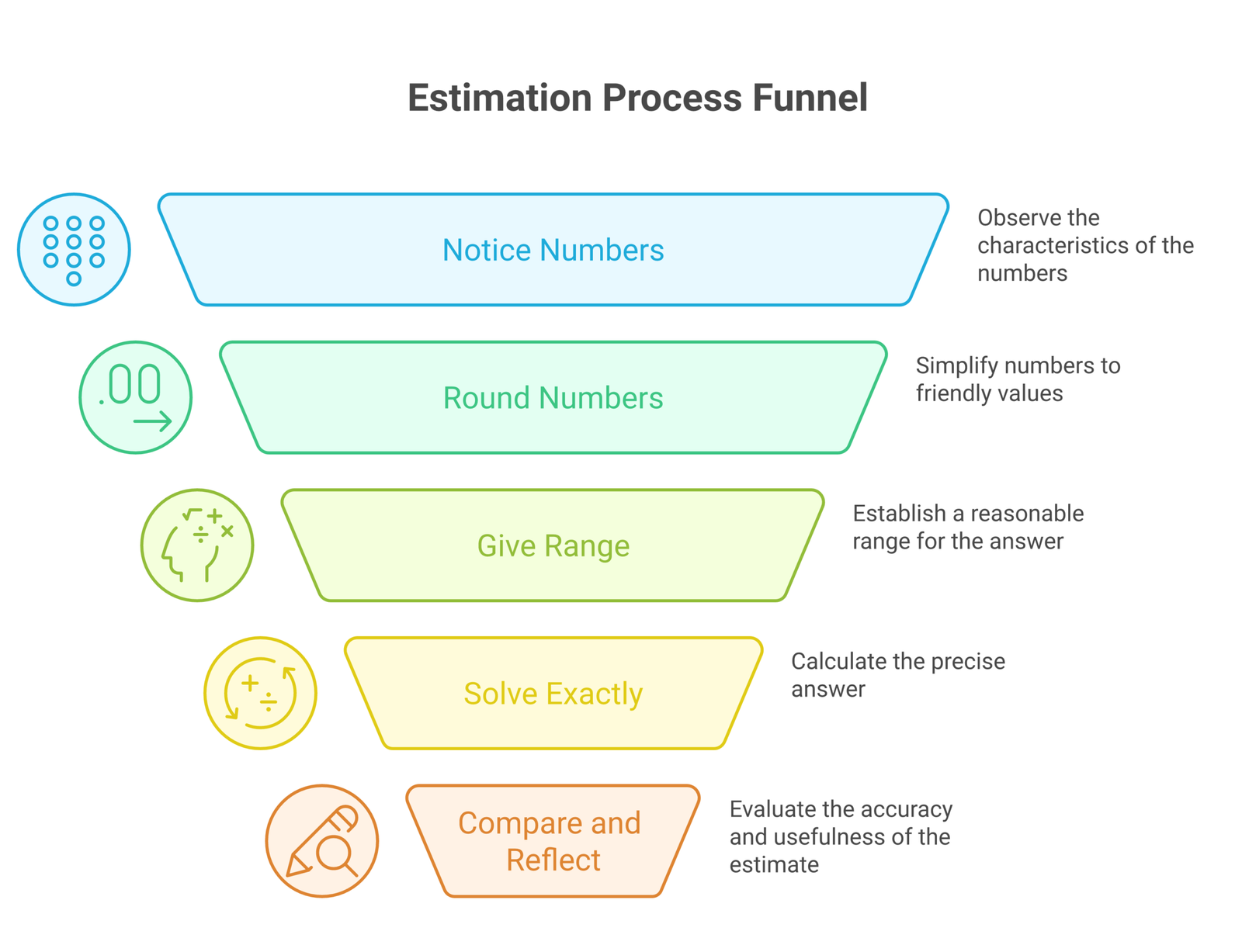
The best home routine is short, predictable, and repeated often. Here is one that works well for primary and lower secondary students.
1. Look at the numbers first. Ask your child what they notice. Are the numbers small or large? Close together or far apart? This slows down impulsive guessing and gets them thinking about magnitude.
2. Round or simplify. Change the numbers into friendly numbers. A child might turn 198 into 200 or 4.9 into 5. This is where many estimation skills become automatic with practice.
3. Give a reasonable answer range. Instead of one magic estimate, ask for a range. “Would the answer be between 300 and 400?” That builds flexible thinking and stops children from treating estimation like exact calculation.
4. Solve the exact problem. After the estimate, work out the exact answer. This matters because the real learning comes from comparing the rough answer to the precise one.
5. Reflect briefly. Ask, “Was your estimate close enough to be useful?” That final question teaches judgment, not perfection.
📝 Important note
If your child gives a weak estimate, do not jump in with the right answer immediately. Ask what number they rounded, why they chose it, and what a more reasonable guess might look like. That short conversation does more than correcting them on the spot.
Common mistakes that weaken estimation skills
One common mistake is teaching rounding as a rule to memorize and then leaving it there. Children may learn that 5 rounds up and 4 rounds down, but still have no feel for whether 298 is close to 300 or why that matters in a real problem. Estimation skills improve when rounding is connected to actual decisions, such as checking a bill or judging the size of an answer.
Another mistake is correcting every estimate too aggressively. If a child guesses 73 when the answer is around 80, that is not a disaster. It is useful thinking in progress. The goal is not perfect prediction. The goal is a rough answer that supports better reasoning. Parents who expect exactness too early can accidentally make estimation feel like another place to fail.
A third mistake is separating estimation from the rest of math. It should show up in addition, subtraction, multiplication, division, fractions, time, money, and measurement. If your child already enjoys articles on mental math tricks, place value, and math facts fluency, estimation fits right alongside them because all four skills help children judge numbers quickly and sensibly.
The best tools and activities for extra practice
If you want extra support, keep it simple. Use dice for quick sums and estimates. Use a receipt and ask your child to estimate the total before checking it. Use measuring cups in the kitchen and ask whether a bowl holds closer to 250 ml or 500 ml. If your child likes digital tools, Edutopia, Understood, and Parents.com all recommend mixing visual models, spoken reasoning, and short bursts of practice rather than repeating one format until everyone is annoyed.
On the MathSpark blog, families can also pair estimation practice with related topics like problem solving strategies and how to use math worksheets well. That combination works because estimation is strongest when children meet it in different contexts, not as an isolated chapter they forget a week later.
If you need one rule to remember, make it this: estimate first, calculate second, compare last. That tiny sequence turns passive math work into active thinking. It also gives children a better shot at staying calm when a problem looks messy. And frankly, that is half the battle.
Frequently Asked Questions
At what age should children start learning estimation skills?
Children can start very young with simple guesses about quantity, size, and time. Formal rounding usually comes later, but early estimation begins with everyday comparison and counting.
Why are estimation skills important if calculators exist?
Calculators give answers, but they do not tell children whether those answers make sense. Estimation helps students catch errors, check reasonableness, and understand the size of numbers.
How can I improve my child’s estimation skills without extra homework battles?
Use short verbal questions during daily routines, such as shopping, cooking, or travel. A few relaxed guesses each day usually work better than a long forced session.
What is the difference between rounding and estimation?
Rounding is one tool used to estimate. Estimation is the broader skill of finding a reasonable approximate answer, while rounding changes a number to a nearby simpler value.
Are estimation skills useful for older children too?
Yes. Older children use estimation with decimals, percentages, ratios, graphs, and word problems. It stays useful long after basic rounding lessons are over.