Math at the Grocery Store for Kids
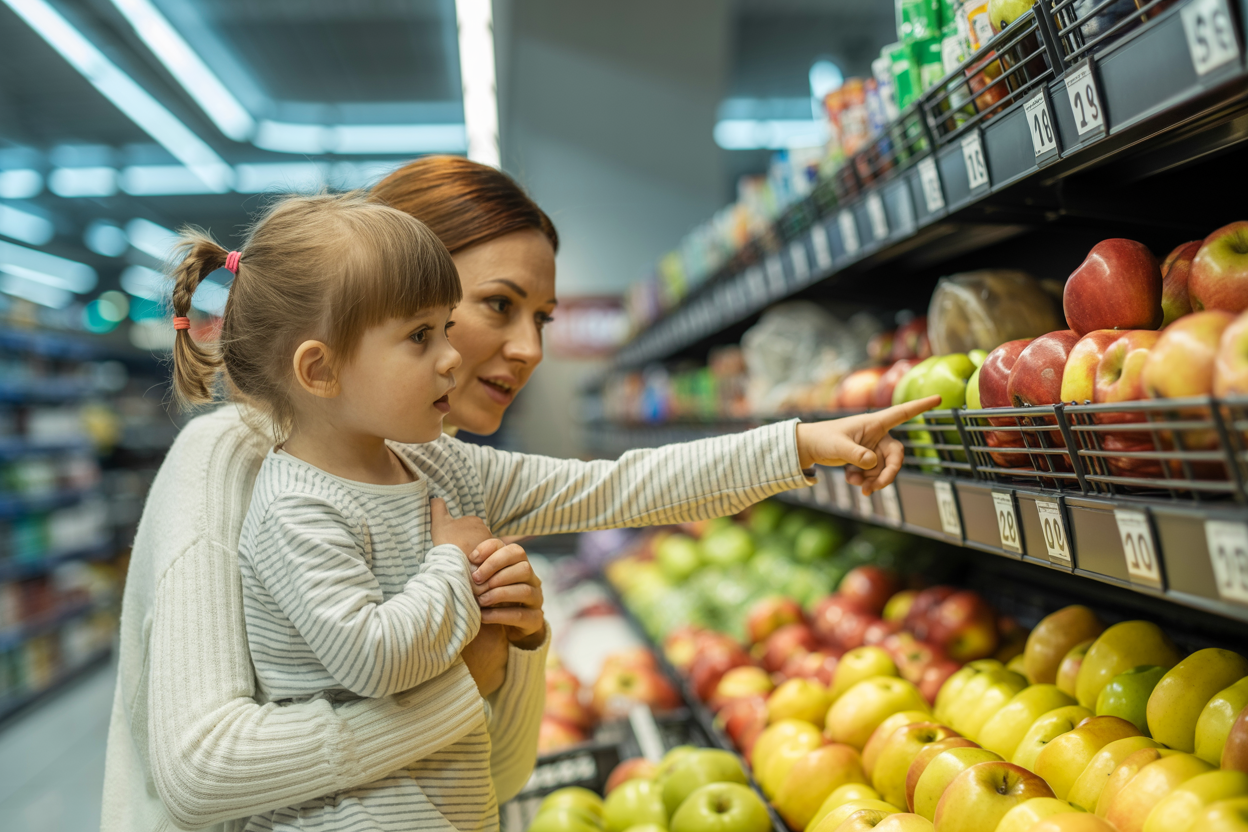
Math at the grocery store gives kids a reason to use numbers that actually matter. Instead of filling in another worksheet just to finish homework, they count apples, compare prices, estimate totals, and notice how math helps a family make decisions. For many children, that shift changes everything. The grocery store feels real, fast, and a little unpredictable, which makes it a surprisingly good place to build number sense.
Parents do not need to turn every shopping trip into a lesson. That usually backfires. A better approach is to pick one small job and let your child own it. The National Council of Teachers of Mathematics has long emphasized connecting math to problem solving, reasoning, and daily life, and a normal supermarket trip does exactly that when kids get to make choices with numbers.
If your child still needs extra practice at home, pair these real-world moments with a few short custom sheets from MathSpark. It creates grade-appropriate worksheets in about 10 seconds, follows the Pythagoras Exams methodology, and works well when you want grocery-store learning to carry over into calm practice later in the week.
📺 Video Guide
Why grocery shopping is a strong math lesson
A grocery store is packed with useful math. Kids see numbers on price tags, package sizes, receipts, scales, and special offers. They compare two brands, count how many yogurts fit a weekly plan, and decide whether a family-size box is worth the extra cost. Those are not fake word problems. They are the exact kinds of choices adults make every week.
This matters because children often learn faster when they can connect an idea to a visible result. Early childhood organizations such as NAEYC encourage everyday math talk, especially when children can sort, compare, count, and explain their thinking. A store trip naturally creates those chances. “Which cereal costs less?” is already a math question. “How many oranges do we need if everyone eats two?” is another one.
You also get built-in variety. Younger kids can count and match. Older children can work with estimation, unit prices, percentages, and budgeting. That makes this kind of practice easy to adapt whether your child is in early primary school or already moving into more advanced arithmetic.
✓ Key benefits
- ✓ Kids see why numbers matter outside school
- ✓ Parents can adjust tasks by age in seconds
- ✓ Practice includes money, measurement, and reasoning together
- ✓ Short store moments often feel easier than formal homework
What kids can learn in each aisle
Produce is great for counting, grouping, and weighing. Ask a younger child to put six bananas in a bag, then remove two and tell you how many are left. Ask an older child to estimate the weight of apples before checking the scale. The USDA produce standards and scale labels also give you a natural way to talk about pounds, kilograms, and quality differences.
The dairy aisle is useful for multiplication and planning. If each family member eats one yogurt a day, how many do you need for five days? Is a pack of four enough, or do you need two packs? You can even connect this to math facts fluency if your child is working on faster recall.
Packaged foods introduce label reading. The FDA nutrition facts label guide helps explain serving sizes, calories, and daily values, but for children the first win is simpler. They can compare serving sizes, count grams, and notice how package size changes value.
Frozen foods and pantry aisles are good for unit-price thinking. Many stores display price per kilogram, ounce, or liter. That is an excellent step up for older kids who are ready to ask whether the bigger package is actually cheaper per unit. If your child already enjoys problem-solving strategies, this kind of comparison feels like a real puzzle instead of a school task.
💡 Pro tip
Pick one aisle and one skill. If you try to teach counting, budgeting, fractions, nutrition labels, and subtraction in the same trip, everyone will be tired before you reach checkout.
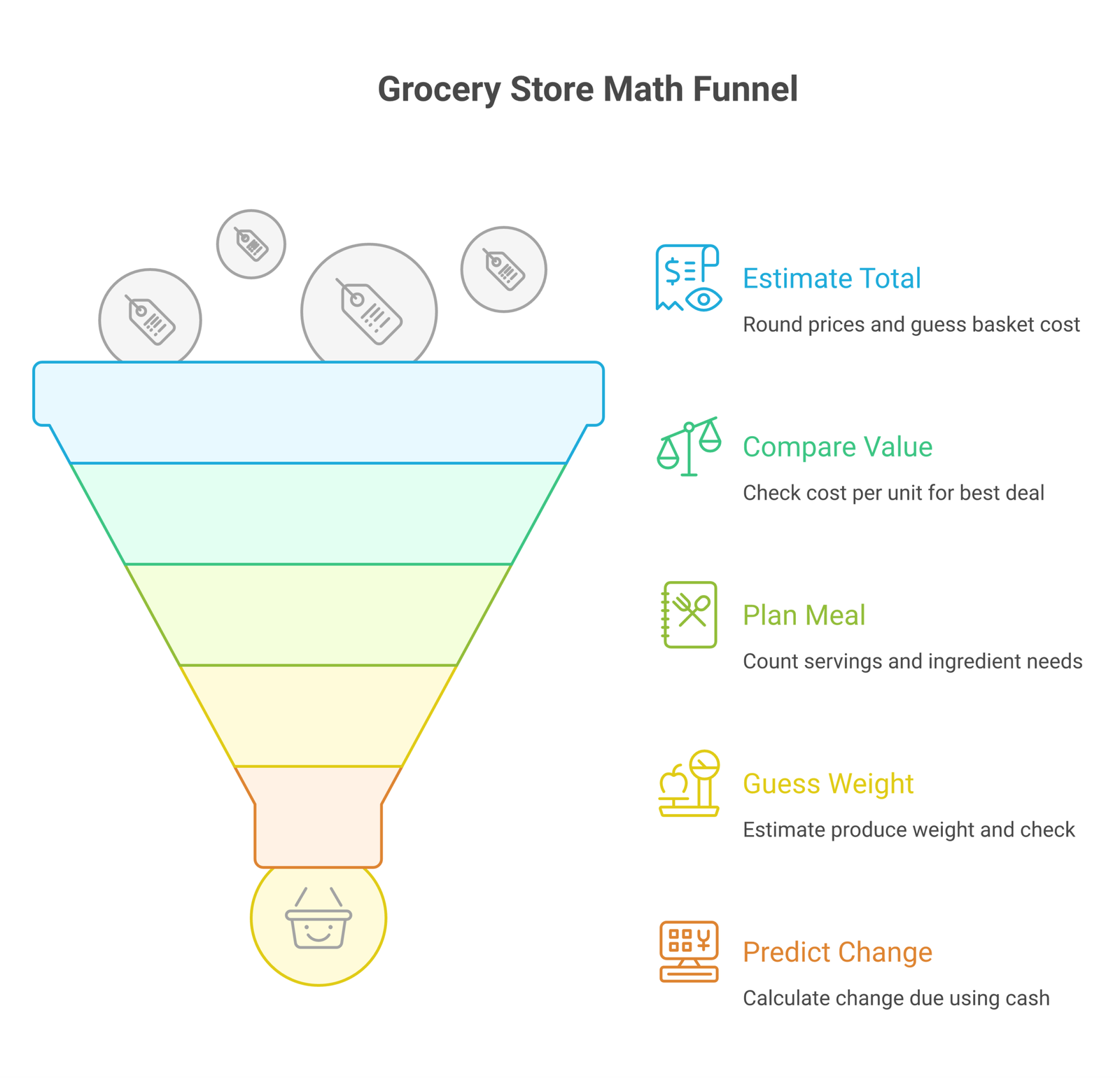
Five easy grocery store math activities
These activities work because they are short and concrete. You can finish one in under two minutes, then move on.
1. Price estimate challenge. Before checkout, ask your child to round each item to the nearest euro or half euro and guess the total. The Consumer.gov budget guide is written for adults, but the core habit is the same for kids: know your limit and track what you spend.
2. Best buy comparison. Put two similar products side by side and ask which one gives more for the price. Use the shelf unit price if the store shows it. This is a natural extension of measurement activities because children see that numbers on packaging have a purpose.
3. Meal plan math. Choose ingredients for one dinner. Have your child count how many people will eat, how many portions are needed, and whether one package is enough. The MyPlate healthy eating budget guide is useful here because it connects planning with spending choices.
4. Weight guess and check. Ask your child to guess how heavy a bag of potatoes or a watermelon is, then compare the guess with the scale. If your child is learning estimation, that quick check is gold.
5. Change detective. If you ever pay with cash, let your child predict the change. Even if your family mostly uses cards, you can still do this with pretend amounts while waiting in line. For kids who need more support with money language, the MoneyHelper budgeting guide offers simple terminology you can adapt.
How to match grocery store math to your child's age
For ages 4 to 6, keep it visual and physical. Count apples, sort vegetables by color, find the larger box, or name shapes on packaging. These small jobs build early number sense without pressure. If your child enjoys playful tasks, this can work nicely alongside math puzzles at home.
For ages 7 to 9, move into addition, subtraction, and simple multiplication. Ask for the total cost of two or three items, or have your child figure out how many pieces of fruit your family needs for a few days. This age group can usually handle receipt checks too, especially when prices are rounded first.
For ages 10 and up, the store becomes a practical lab for ratios, percentages, decimals, and budgeting. They can compare prices by weight, work out discounts, and decide whether a promotion is actually useful. The Education Endowment Foundation points to the value of planning and monitoring thinking, and grocery tasks naturally push kids to explain how they got an answer.
If a task feels too easy, increase the number of steps. If it feels too hard, remove one layer. The goal is not to impress anyone. The goal is to keep your child thinking without frustration.
📝 Important note
If your child already feels anxious about math, avoid quizzes disguised as shopping. Give one helpful task, praise the thinking, and move on. A calm five-minute win beats a long store lesson that turns into a fight.
How grocery store practice supports school math
School math often asks children to move between concrete examples and abstract ideas. Grocery shopping helps with that bridge. A child who compares two package sizes is starting to think about measurement and ratio. A child who predicts the total cost of four items is rehearsing addition, estimation, and number sense. A child who checks a receipt is learning accuracy and self-correction.
This is also where parents can quietly support the Pythagoras-style focus on understanding, not just memorizing. You are not asking for a fast answer only. You are asking, “How did you decide that?” That simple question turns shopping into reasoning practice.
If you want to extend the lesson after the trip, save the receipt. Ask your child to circle prices under 2 euros, add all the fruit costs, or identify which item cost the most per unit. You can also connect the experience to online math resources or short targeted sheets from MathSpark so the real-world example turns into deliberate practice.
The nice part is that none of this requires a perfect parent, a big budget, or a special teaching background. You are already shopping. The math is already there.
Mistakes to avoid when teaching math in the store
The most common mistake is doing too much. One question in the produce aisle is enough for many kids. Another mistake is correcting too quickly. If your child says the total is 12 euros when it is really 14, give them a second look instead of jumping in. That pause matters.
It also helps to avoid vague praise like “good job.” Be specific. “You noticed the larger pack was cheaper per kilogram” tells your child what worked. Researchers at the U.S. What Works Clearinghouse consistently emphasize clear guidance and deliberate practice, and that principle fits everyday math too.
Finally, do not force grocery store math when the moment is wrong. If the store is crowded, your child is hungry, or you are rushing, skip it. A stressed adult and a tired child are not a magical learning duo. Try again next trip.
Done well, grocery store math feels practical and oddly satisfying. It gives children proof that numbers are not just something adults hand them on a worksheet. Numbers help them make sense of the world, one shopping basket at a time.
⚠️ Disclaimer
This article is for educational purposes as of April 2026. Product prices, promotions, nutrition labels, and store layouts can change, so check current information in your local supermarket before turning examples into fixed rules.
Frequently Asked Questions
What age is best for grocery store math?
Kids as young as four can count items and compare sizes. Older children can estimate totals, compare unit prices, and work with percentages or discounts.
How long should a grocery store math activity take?
Usually one to five minutes. Short activities work better because they fit naturally into shopping and do not overwhelm children.
Can grocery shopping help with math anxiety?
Yes, it can help because the math feels useful and less formal. Keep tasks small, avoid pressure, and focus on thinking rather than speed.
What if my child gets the answer wrong?
Treat it as a chance to rethink, not a failure. Ask how they got the answer, then help them check one step at a time.
How can I continue the lesson at home?
Use the receipt for follow-up questions, repeat the same skill on the next trip, or generate a few matching practice pages with MathSpark so the idea sticks.