LEGO Math Activities: 12 Fun Building Ideas for Kids
Your kid probably has a bucket of LEGO bricks somewhere in the house right now. What if those colorful blocks could do double duty, turning playtime into a hands-on math lesson without anyone noticing? LEGO math activities work because kids are already motivated to build. You are just sneaking in counting, fractions, geometry, and problem-solving while they stack and sort.
Research from the National Association for the Education of Young Children (NAEYC) confirms that manipulative-based learning helps children develop stronger number sense. LEGO bricks are one of the most accessible manipulatives you already own. No special kits needed, no apps to download. Just bricks and a few good ideas.
Why LEGO bricks work for math
LEGO bricks aren’t random toys. They come in consistent sizes with a fixed number of studs, which makes them surprisingly precise for teaching math concepts. A 2×4 brick always has 8 studs. A 2×2 always has 4. This consistency means kids can use them to model addition, multiplication, and fractions with real objects they can touch and rearrange.
According to a study published by the Cambridge Mathematics initiative, children who use physical manipulatives alongside abstract instruction show better retention and transfer of math skills. The National Center for Education Statistics also reports that hands-on learning correlates with higher math achievement scores in elementary grades.
The key advantage? Mistakes are cheap. A kid who gets an answer wrong can pull apart their bricks and try again without erasing, crossing out, or feeling like they failed. That kind of low-stakes practice builds confidence faster than worksheets alone.
✓ Why parents love LEGO math
- ✓ Uses materials you already have at home
- ✓ Works for ages 4 through 12 with different activities
- ✓ Kids stay engaged because it feels like play
- ✓ Covers counting, addition, multiplication, fractions, and geometry
- ✓ Mistakes are easy to fix, which reduces frustration
LEGO math activities for counting and number sense
Stud counting towers: Give your child a number card (say, 7) and ask them to build a tower using bricks that add up to exactly 7 studs. They might use a 2×2 brick (4 studs) and a 1×3 brick (3 studs). This teaches both counting and the concept that numbers can be composed in different ways, a skill the National Council of Teachers of Mathematics (NCTM) identifies as foundational.
Number line builder: Lay LEGO baseplates end to end and have your child place bricks at intervals to create a physical number line. They can label positions with small paper tags. This works well for kids in grades 1 and 2 who need to visualize where numbers sit in relation to each other.
Color sorting and grouping: Pour out a pile of mixed LEGO bricks and ask your child to sort by color, then count how many of each. This introduces the basics of data collection and categorization. You can even have them build a simple bar graph using stacked bricks to show which color they have the most of.
Building addition and subtraction skills
Brick equations: Write a simple equation on paper (3 + 5 = ?) and have your child build each number using LEGO bricks, then combine them to find the total. The physical act of snapping bricks together makes addition concrete. For subtraction, start with the larger number built and remove bricks. Research from the American Psychological Association supports that this concrete-to-abstract progression helps kids internalize operations faster.
Mystery bag challenge: Put a set number of bricks in a bag. Your child pulls some out and counts them, then figures out how many remain inside. This is subtraction in disguise, and kids love the suspense element. Once they guess, they dump the bag to check.
Race to 20: Two players take turns rolling a die and adding that many studs worth of bricks to their tower. First to reach exactly 20 studs wins. If you overshoot, you have to remove the excess. It practices addition under a constraint, which is trickier than it sounds.
💡 Pro tip
Pair these LEGO activities with printed worksheets for extra reinforcement. Tools like MathSpark generate custom math worksheets in about 10 seconds, covering the Greek school curriculum for grades 1 through 9. After a hands-on LEGO session, a quick worksheet round helps kids transfer what they built to paper.
LEGO multiplication and division activities
Array builder: Multiplication is repeated addition, and arrays make it visible. Ask your child to build a 3×4 array using single-stud LEGO bricks on a baseplate. They can count the total (12) and see that 3 rows of 4 equals 4 columns of 3. The Khan Academy multiplication curriculum uses this same array concept in its third-grade modules.
Equal sharing challenge: Give your child 12 LEGO bricks and ask them to divide equally among 3 minifigures. Then try dividing 12 among 4, then 5 (which doesn’t work evenly, introducing remainders). This physical division activity helps kids understand why some numbers divide cleanly and others don’t.
Skip counting towers: Build towers of identical bricks (all 2×2, for example) and count by fours. Each tower represents one group. Line up five towers and your child sees that 5 groups of 4 equals 20. According to the UK National Curriculum, skip counting is a precursor skill for multiplication fluency, typically expected by Year 2.
Teaching fractions with LEGO bricks
Fractions are where many kids start to struggle, and where LEGO bricks really shine. The trick is using a large brick as the “whole” and smaller bricks as parts.
Fraction wall: Take a 2×8 brick (16 studs) as your whole. Show that two 2×4 bricks (8 studs each) make up the same length, so each is 1/2. Four 2×2 bricks give you quarters. Eight 2×1 bricks give you eighths. Line them up side by side and your child can physically see that 2/4 equals 1/2, a concept that stumps many kids when it’s just numbers on paper.
Pizza party fractions: Build a flat “pizza” from LEGO bricks on a baseplate, then ask your child to divide it into equal slices for different numbers of guests. This connects fractions to everyday situations, following recommendations from the NCTM Standards for contextual math learning.
Equivalent fraction matching: Give your child two different brick combinations and ask if they represent the same fraction of a whole. For example, does one 2×4 brick cover the same area as two 2×2 bricks on a 2×8 baseplate? Both equal 1/2. This builds fraction equivalence understanding through comparison.
Geometry and spatial reasoning with LEGO
Symmetry builder: Draw a vertical line down the center of a baseplate. Build a design on one side and challenge your child to mirror it exactly on the other side. This teaches symmetry while training spatial awareness. You can increase difficulty by using more complex patterns or switching to diagonal symmetry.
Perimeter and area: Build a flat rectangle on a baseplate and have your child count the studs around the outside edge (perimeter) and the total studs inside (area). Then challenge them to build a different shape with the same area but a different perimeter. This is the kind of hands-on geometry practice that makes abstract formulas click.
3D shape explorer: Use LEGO to build cubes, rectangular prisms, and L-shapes. Count faces, edges, and vertices. Then ask: “If I added one more layer, how many more bricks would I need?” This introduces volume concepts naturally, building skills that become relevant in upper elementary grades according to Common Core 5th grade standards.
📝 Important note
LEGO activities work best when you let children explore and make mistakes before correcting them. If your child builds an incorrect fraction model, ask them to compare it against a known correct one rather than just telling them the answer. The self-correction process builds deeper understanding.
Pattern recognition and early algebra
Color patterns: Start a repeating pattern (red, blue, red, blue) and ask your child to continue it. Then try more complex patterns (red, red, blue, green, red, red, blue, green). Pattern recognition is one of the earliest algebraic thinking skills, and the NCTM algebra standards recommend introducing it in kindergarten.
Growing patterns: Build a staircase where each step adds one more brick. Step 1 has 1 brick, step 2 has 2, step 3 has 3. Ask: “How many bricks will step 10 have?” Then: “How many bricks total in the whole staircase up to step 5?” This introduces sequences and series in a concrete way that older kids (grades 4 and 5) can handle.
Missing brick puzzles: Build a pattern with one brick missing and ask your child to figure out what goes there. This is algebraic thinking: solving for an unknown. It is the same mental muscle they will need when they encounter x + 3 = 7 in a few years.
How to run a LEGO math session at home
You don’t need a structured curriculum or a teaching degree. Here’s what works:
Keep sessions short. 15 to 20 minutes is the sweet spot for most kids under 10. If they want to keep going, great. If they lose interest at 12 minutes, that’s fine too. The Understood.org research on attention spans suggests that a child’s focused attention in minutes roughly equals their age plus one.
Start easy and build up. Begin with an activity your child can succeed at, then add a twist. If they mastered building a 3×4 array, try 3×5 next. Small progressions keep the challenge level right.
Let them teach you. Once your child understands an activity, ask them to explain it to you (or a younger sibling). Teaching solidifies learning, a principle backed by decades of research that educators call the protege effect.
Mix LEGO play with printed practice. After a hands-on session, give your child a worksheet that covers the same skill. The combination of physical manipulation and paper practice reinforces learning through multiple channels.
Age-appropriate LEGO math activities by grade
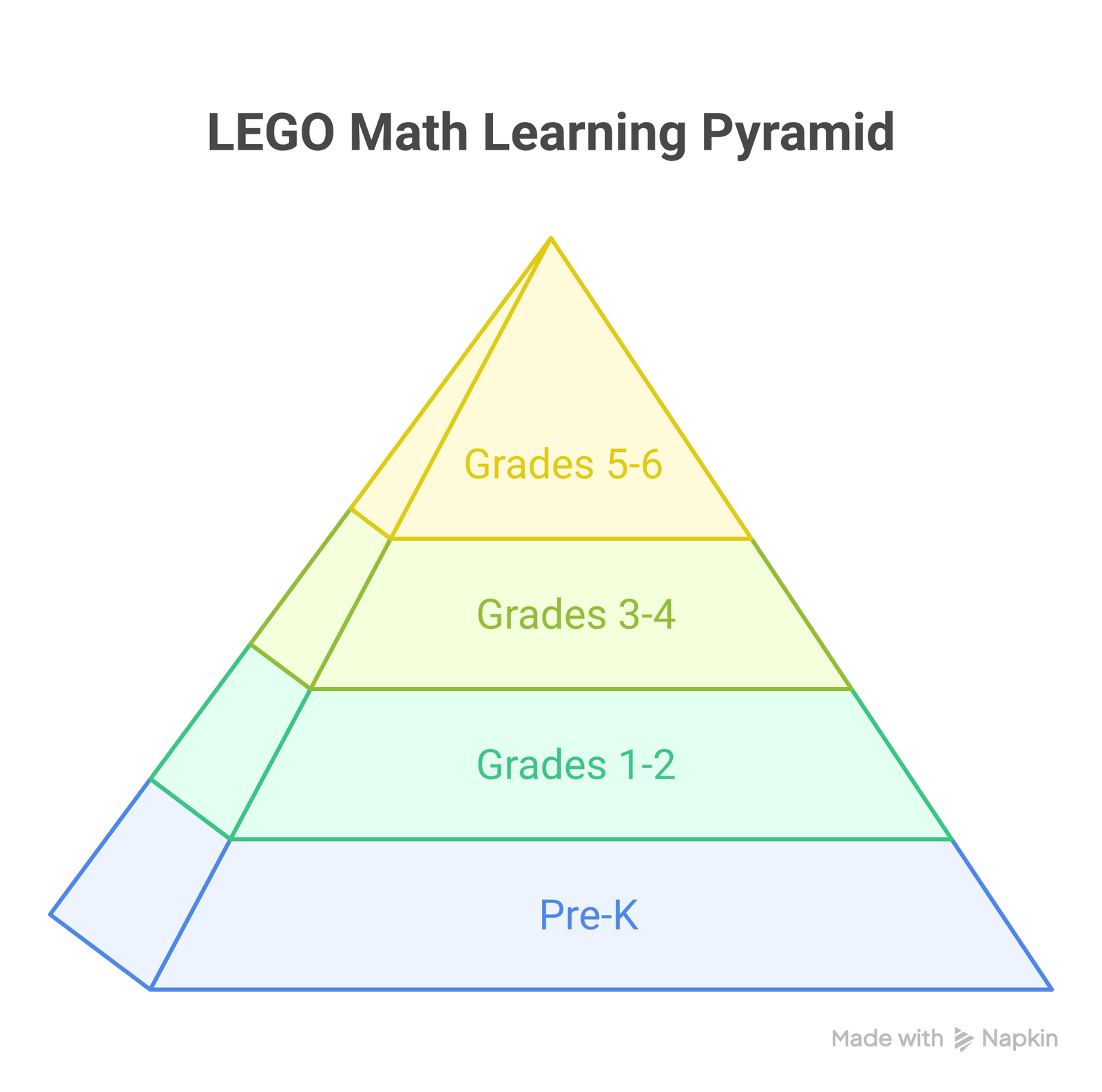
Pre-K and Kindergarten (ages 4 to 5): Color sorting, stud counting (up to 10), simple patterns (AB, AB), and comparing “more” vs. “fewer.”
Grades 1 and 2 (ages 6 to 7): Addition and subtraction with bricks, number line building, bar graphs, skip counting by 2s and 5s.
Grades 3 and 4 (ages 8 to 9): Multiplication arrays, fraction walls, perimeter and area, symmetry challenges, equal sharing (division).
Grades 5 and 6 (ages 10 to 12): Equivalent fractions, growing patterns and sequences, volume calculations, coordinate grids using baseplates.
⚠️ Disclaimer
LEGO is a registered trademark of the LEGO Group. This article is not sponsored by or affiliated with the LEGO Group. Activity suggestions are general guidelines based on common math education practices as of March 2026. Individual results may vary based on your child’s specific needs and learning style.
Frequently asked questions
What age should I start LEGO math activities?
Children as young as 4 can start with DUPLO-sized bricks for basic counting and sorting. By age 5 or 6, most kids can handle standard LEGO bricks for addition and pattern activities. Adjust the complexity to your child’s level rather than strictly following age guidelines.
Do I need special LEGO math kits?
No. Any standard LEGO collection works. You need a variety of brick sizes (1×1, 1×2, 2×2, 2×4) and ideally a baseplate or two. LEGO does sell education-specific sets, but they are not necessary for the activities described in this article.
How long should a LEGO math session last?
About 15 to 20 minutes is a good target for children under 10. Younger kids may lose focus sooner, and older kids might happily spend 30 minutes if the activity is engaging. Follow your child’s lead. Shorter, frequent sessions beat long, forced ones.
Can LEGO activities replace regular math practice?
They are a supplement, not a replacement. LEGO activities build conceptual understanding and make math tangible, but children also need practice with written problems to develop fluency. Combining hands-on LEGO sessions with worksheet practice gives the best results.
What if my child just wants to free-build instead of following the activity?
Let them. Free building still involves math: counting bricks, estimating quantities, spatial planning, and symmetry. You can weave in questions naturally (“How many blue bricks did you use?”) without turning it into a formal lesson. The math happens either way.