Math Board Games for Family Game Night
📺 Video Guide
Why board games are one of the best ways to practice math
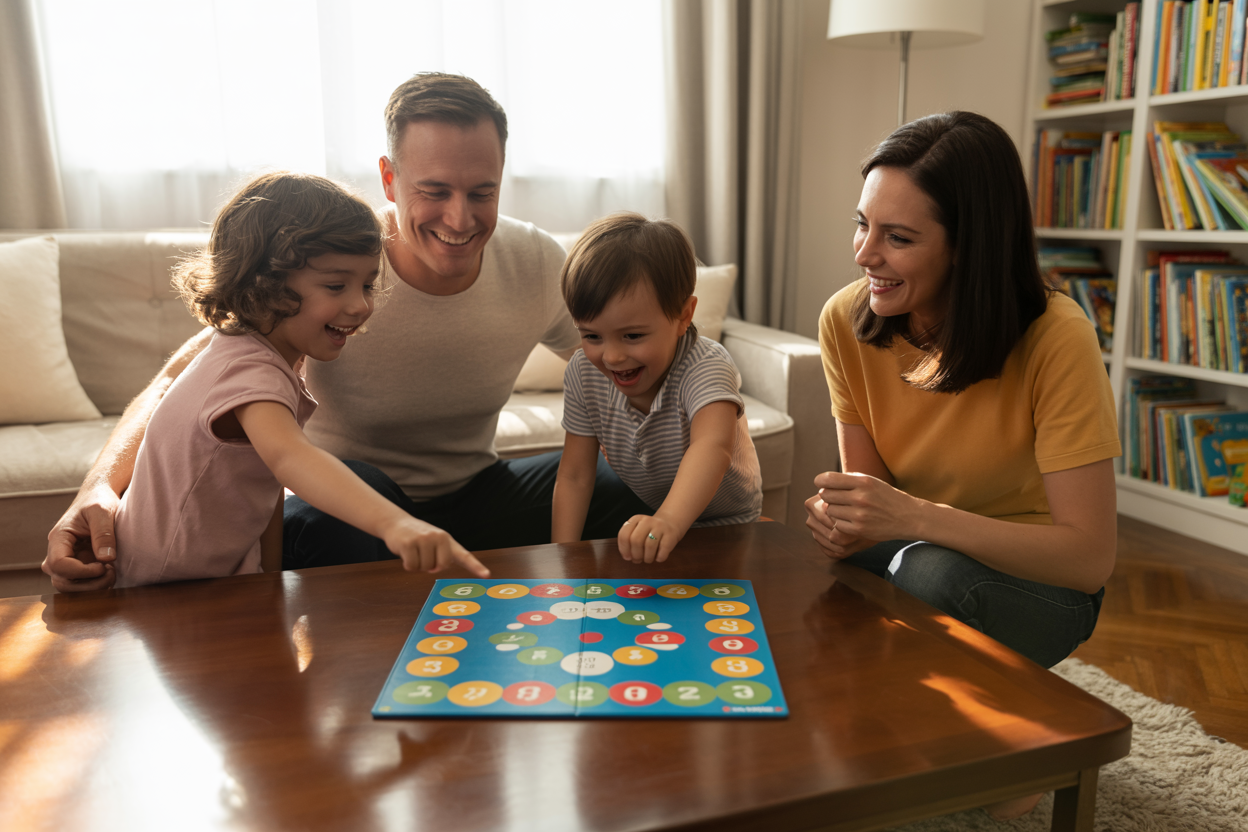
Here’s the thing about math board games: kids don’t realize they’re learning. They’re too busy trying to win. That competitive drive, the rolling of dice, the counting of spaces, the mental calculations to figure out if they can afford that property or beat that score… it’s all math. And it sticks because they actually want to do it.
Research from the National Institutes of Health has shown that game-based learning improves mathematical reasoning in children ages 5 to 12. A separate study published in Early Childhood Research Quarterly found that children who played number-based board games regularly scored significantly higher on number line estimation tasks.
The beauty of family game night is that it takes the pressure off. There’s no worksheet to complete, no grade to worry about. Just a shared experience that happens to build math skills along the way.
✓ Why math board games work
- ✓ Kids practice arithmetic without even noticing
- ✓ Turn-taking builds patience and social skills alongside math
- ✓ Losing and trying again teaches persistence
- ✓ Family bonding time doubles as learning time
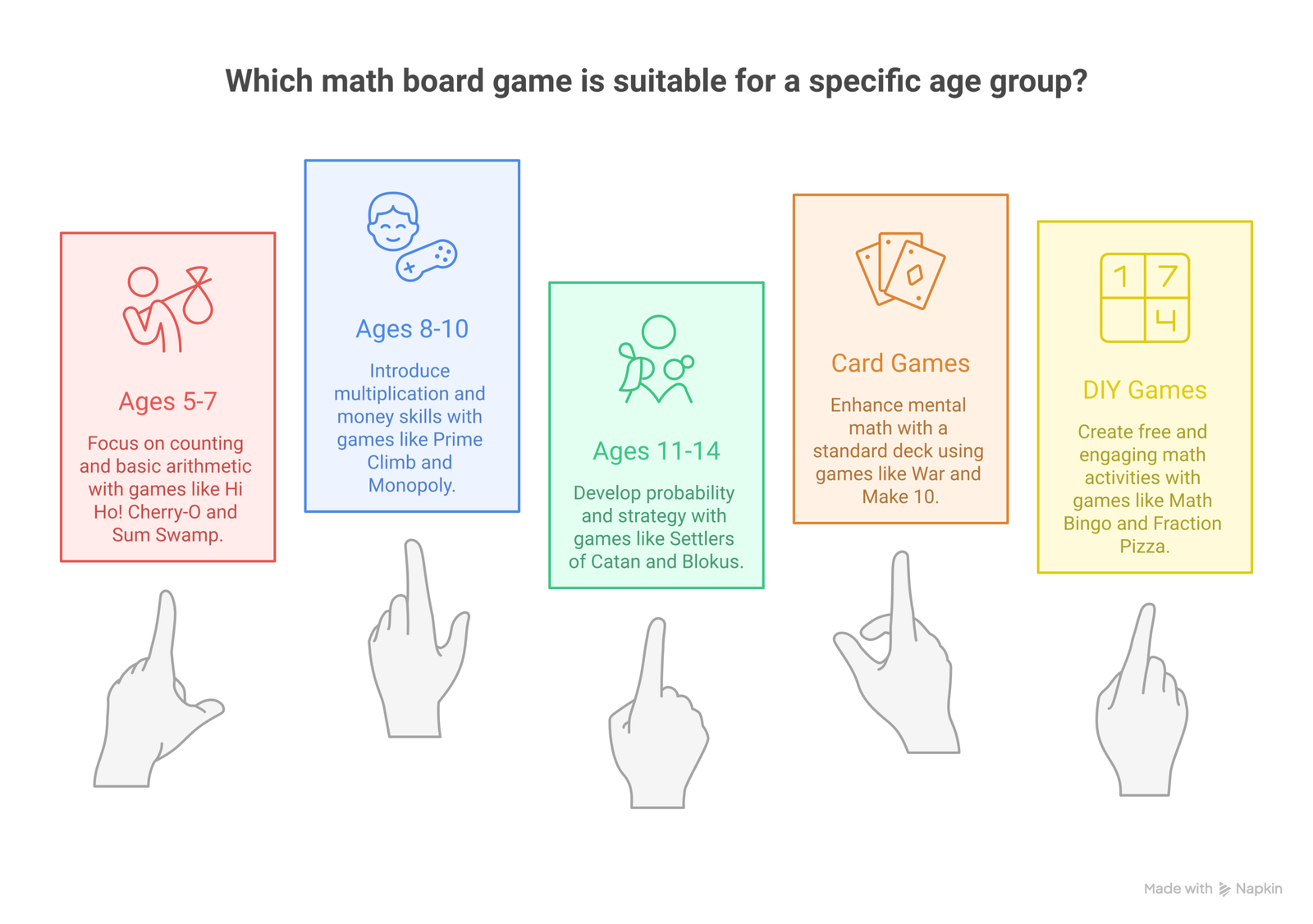
Best math board games for ages 5-7
Younger kids need games where the math feels invisible. Too much calculation and they’ll lose interest. Too little and you’re just playing Candy Land (which, let’s be honest, teaches absolutely nothing). Here are the games that hit the right balance.
Hi Ho! Cherry-O is a classic for a reason. Kids pick cherries (addition), put them back (subtraction), and count their collection. It’s simple arithmetic disguised as fruit picking. The National Association for the Education of Young Children recommends game-based math play for this age group because it matches how young brains actually learn.
Sum Swamp takes kids through a swamp using addition and subtraction dice. Every move requires a quick calculation: roll a 3 and a 2 with the plus die, and you move 5 spaces. It’s repetitive enough to build fluency without feeling like drill work.
Chutes and Ladders gets overlooked, but it’s genuinely useful for number recognition and counting. Kids learn the number line from 1 to 100, which is a foundation skill that the National Council of Teachers of Mathematics identifies as critical for early math development.
Math board games for ages 8-10
This is the age where kids can handle more strategy. They’re past basic counting and ready for multiplication, fractions, and logical thinking. The games get more interesting here, and parents actually start enjoying them too.
Prime Climb is probably the most beautifully designed math board game out there. Every number on the board is color-coded by its prime factorization. Players use arithmetic (addition, subtraction, multiplication, and division) to land on their opponents and send them back to start. It’s competitive, colorful, and quietly teaches number theory. The game was created by a mathematician and has been used in classrooms across the US, according to Edutopia.
Zeus on the Loose is a card game where players add numbers to a running total, trying to reach exact multiples of 10 to capture Zeus. It drills mental addition in a way that feels genuinely fun. My kids got into heated debates about strategy within the first game.
Monopoly might seem obvious, but it works. Kids handle money, make change, calculate rent, and manage budgets. A study from the American Psychological Association suggests that games involving currency and transactions help children develop financial numeracy alongside basic arithmetic skills.
💡 Quick tip
Let your child be the banker in Monopoly. It’s extra math practice and kids love the responsibility. They’ll be doing addition, subtraction, and making change for every transaction in the game.
Challenge-level games for ages 11-14
Older kids and tweens need games that challenge their thinking without feeling childish. The good news is that some of the best board games for this age group are ones adults genuinely enjoy playing too.
Settlers of Catan involves probability, resource management, and strategic planning. Every dice roll is a probability lesson: players quickly learn that 6 and 8 are rolled more often than 2 and 12. Kids start thinking about expected value without even knowing the term. The game has sold over 40 million copies worldwide, according to BBC News.
Blokus is a spatial reasoning game where players take turns placing Tetris-like pieces on a grid. Each new piece must touch a corner of a previously placed piece, but not share an edge. It’s pure geometry and spatial thinking, which are skills that the UK Department for Education considers foundational for STEM readiness.
Ticket to Ride requires players to plan routes, count train cards, and calculate the most efficient paths between cities. It builds strategic thinking, planning ahead, and basic optimization, all skills that connect directly to mathematical reasoning.
Card games that double as math practice
You don’t always need a fancy board game. A standard deck of cards can do serious math work. Here are a few games you can play with cards you probably already have at home.
War (with a twist): Instead of comparing single cards, flip two cards and multiply them. Highest product wins the round. This turns a mindless game into multiplication practice. You can also add both cards together for younger kids working on addition.
Make 10: Lay out cards in a grid. Players find pairs that add up to 10 and remove them. It builds number bonds, which are the building blocks of mental math. The Khan Academy curriculum emphasizes number bonds as one of the first skills for mathematical fluency.
24 Game: Deal four cards. Players race to combine all four numbers using addition, subtraction, multiplication, and division to reach exactly 24. This one gets intense. Adults struggle with it too, which makes it perfect for family play because everyone’s on a more level playing field.
How to make game night actually work
Buying the game is the easy part. Getting the family around the table consistently is where most people fall off. Here are some things that have worked for families who actually maintain a game night habit.
Pick a regular time. Friday after dinner, Sunday afternoon, whatever fits your family. The American Psychological Association notes that predictable family routines reduce stress and increase children’s sense of security.
Let the kids choose. If they picked the game, they’re more invested in playing. Rotate who gets to choose each week so everyone gets a turn.
Keep it short. Younger kids can’t sit through a 2-hour game. Start with 20-minute sessions and build from there. If someone’s getting frustrated, it’s okay to stop and switch to something else.
Don’t turn it into a lesson. The moment you say “see, that’s fractions!” you’ve killed the vibe. Let the math happen naturally. They’ll absorb more than you think. Research published by the Journal of the Learning Sciences confirms that informal learning environments produce stronger conceptual understanding than forced instruction.
📝 Worth knowing
According to a 2023 survey by The Genius Brand, families who play board games together at least once a week report stronger family bonds and better communication. The math benefits are a bonus on top of the relationship benefits.
Pairing board games with daily math practice
Board games are great for weekly practice, but math skills grow with daily repetition. The key is finding something quick that doesn’t feel like a chore. Even 10 minutes a day of targeted practice can make a real difference.
Tools like MathSpark let you generate a math worksheet in about 10 seconds, tailored to your child’s grade level and the specific skill they need to work on. It covers grades 1 through 9 and follows the Greek school curriculum (with Pythagoras Exams methodology), so the worksheets actually match what kids are learning in class. You can use it for free to create quick daily exercises that reinforce what they’re picking up from game night.
The combination works well: game night builds positive associations with math, and short daily practice builds fluency. Neither one is enough on its own, but together they cover both the motivation side and the skill-building side.
DIY math games you can make at home
Not every math game needs to come from a store. Some of the most effective games can be made with stuff you already have.
Math Bingo: Create bingo cards with answers. Call out equations instead of numbers. “What’s 7 times 8?” Kids scan their cards for 56. You can generate fresh cards each time, and the Understood.org team recommends this game specifically for kids who struggle with timed drills.
Fraction Pizza: Cut circular paper into different-sized slices. Kids trade slices to build whole pizzas, learning fraction equivalence along the way. Three sixths equals one half? They figure it out by fitting the pieces together.
Number Scavenger Hunt: Write math problems on cards and hide them around the house. Each answer leads to the next clue. The final clue leads to a small prize. It gets kids moving while they calculate, which is something the CDC recommends for brain development in children.
💡 Make it yours
Customize DIY games to your child’s current curriculum. If they’re working on multiplication at school, make a multiplication-focused game. If they’re learning fractions, use fraction activities. Matching the game to what they’re studying in class doubles the reinforcement.
What to avoid when choosing math board games
Not all “educational” games are created equal. Some are barely disguised worksheets with cardboard, and kids see right through them. A game needs to be fun first and educational second, or it ends up collecting dust in the closet.
Watch out for games that are too easy. If there’s no challenge, kids get bored within 5 minutes. The NCTM’s Teaching Children Mathematics journal recommends games that sit just above a child’s current level, in what educators call the “zone of proximal development.”
Also avoid games where the math component feels bolted on. If removing the math part wouldn’t change the gameplay at all, the math isn’t really integrated into the game’s core mechanics. Good math games make the numbers part of winning, not a speed bump on the way to winning.
Finally, consider your child’s frustration threshold. Some games involve a lot of luck (dice-based), while others are more skill-based (strategy games). If your child gets upset when they lose, start with luck-heavy games where no one feels personally responsible for losing. As they develop resilience, gradually introduce more skill-based options.
Frequently Asked Questions
What age should kids start playing math board games?
Kids can start with simple counting games like Hi Ho! Cherry-O and Chutes and Ladders around age 4 or 5. These games build number recognition and basic counting skills. More complex games with arithmetic can be introduced around age 7 or 8.
How often should we have family game night?
Once a week is a good target. Consistency matters more than frequency. Even 30 minutes every Saturday creates a routine your kids will look forward to. You can supplement with quick card games on weeknights if your family enjoys them.
Should I let my child win at math games?
Not always. Losing teaches resilience and problem-solving. That said, if a child is consistently losing and getting discouraged, it’s okay to adjust the difficulty. For example, give younger players a head start or use simpler arithmetic rules. The goal is to keep them engaged and willing to play again.
Can board games replace math tutoring?
Board games are a supplement, not a replacement. They build number sense, mental math speed, and positive attitudes toward math. But if your child has specific learning gaps or needs structured intervention, a tutor or targeted practice (like MathSpark worksheets) can address those directly.
What if my child says board games are boring?
Start with the games they choose, even if they’re not the most math-heavy options. Any game with numbers, scoring, or strategy involves some math. Once they’re in the habit of playing, you can introduce games with more mathematical depth. Peer pressure helps too, so invite friends over for game night to make it social.
⚠️ Disclaimer
This article reflects recommendations as of March 2026. Game availability and prices may vary by region. Always check age recommendations on game packaging and supervise younger children with small game pieces. The external links in this article lead to independent sources and do not constitute endorsements.