Math Centers: Creating Learning Stations
Math centers can turn practice time from a tug-of-war into something far more useful. Instead of one long worksheet block, kids move through short learning stations with a clear task, a small goal, and just enough challenge to stay engaged. When the setup is simple, math centers give children repetition without boredom and give adults room to support the students who actually need help.
Parents often think learning stations are only for classrooms, but the same structure works at home, in tutoring sessions, and in homeschool routines. The main idea is not fancy decor. It is a predictable system. A child knows where to start, what to do, how to check the work, and what comes next. That kind of clarity matters, especially for children who get overwhelmed by long assignments or lose focus when every task looks the same.
Research on effective math instruction from the National Council of Teachers of Mathematics, the What Works Clearinghouse, and the Education Endowment Foundation keeps pointing to the same thing: students learn more when practice is structured, feedback is timely, and activities are matched to what they are ready to do. A good center routine gives you all three.
📺 Video Guide
What math centers really do
A math center is just a place, physical or digital, where one focused task happens. That task might be practicing number facts, solving word problems, building shapes, or using manipulatives to model a new idea. The power comes from breaking practice into smaller pieces. Kids do not need to hold the whole lesson in their head at once. They only need to handle the next step.
That matters because working memory is limited. The Institute of Education Sciences practice guide recommends visual representations, deliberate problem solving, and regular review. Centers make that easier to deliver. One station can review old skills. Another can focus on today’s target. A third can ask students to explain their thinking out loud, which lines up with guidance from NCTM’s Principles and Standards.
If you are teaching more than one child, math centers also buy you time. One child can work independently at a matching-level task while you sit with another for ten minutes of direct support. If you are a parent working at the kitchen table, that can be the difference between a decent afternoon and total chaos.
✓ Why centers work so well
- ✓ Short tasks lower resistance for kids who freeze when work feels too big.
- ✓ Rotations make it easier to mix review, new learning, and hands-on practice.
- ✓ Independent stations free up adult attention for small-group teaching.
- ✓ Repeated routines help children build confidence instead of guessing what to do each time.
A simple station plan you can copy
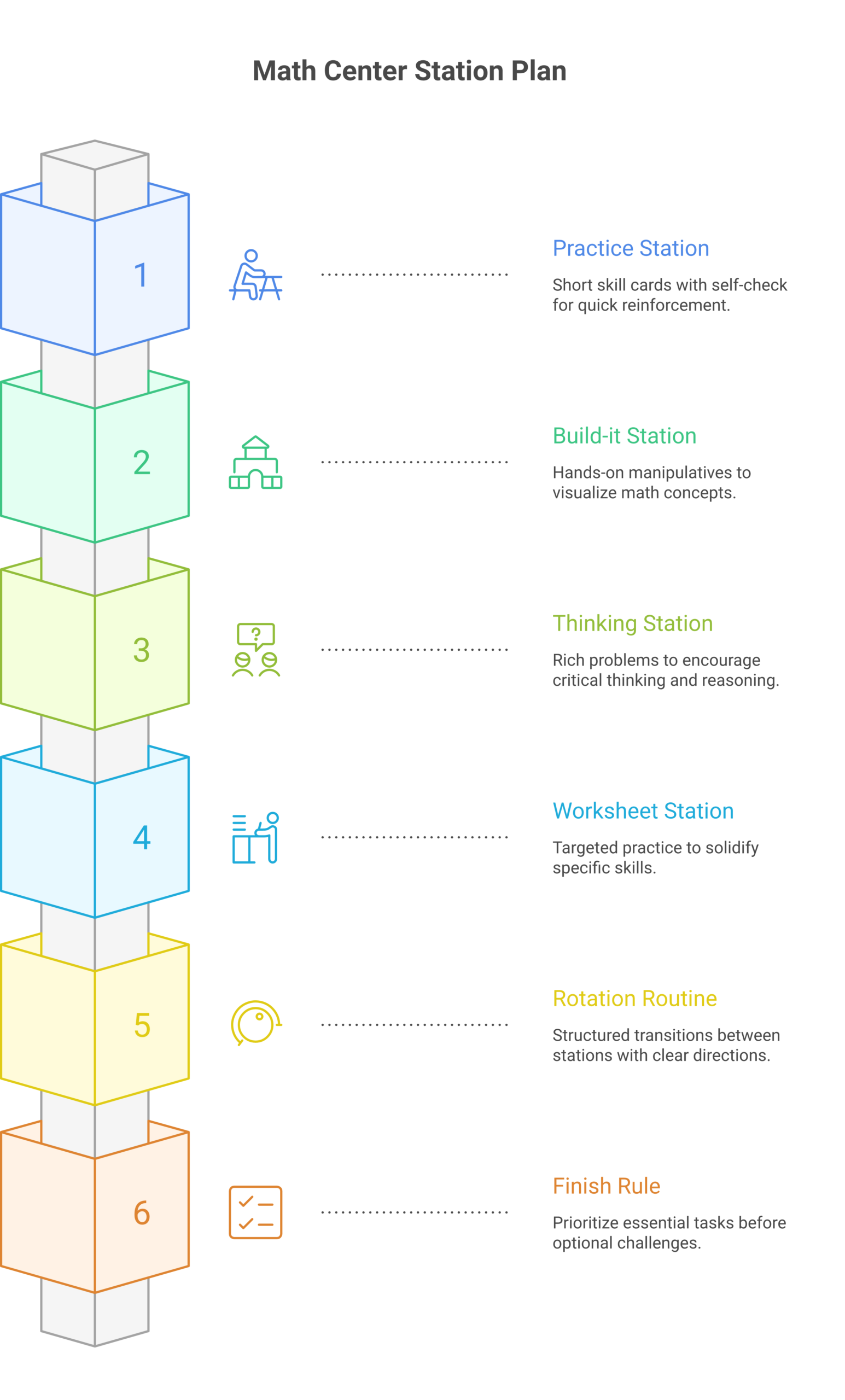
You do not need eight stations. Start with four. That is enough variety without turning setup into a part-time job. My favorite starter mix is direct practice, hands-on modeling, problem solving, and independent digital work. It covers the basics and it is flexible across grade levels.
Station 1 is the practice station. This is where you place task cards, short worksheets, or fluency games. The work should be familiar enough that children can start without you. Station 2 is the build-it station. Use counters, fraction strips, pattern blocks, base ten blocks, or even coins from a drawer. The Khan Academy math library and the PBS Parents math activities are useful if you want examples of concrete representations before you make your own version.
Station 3 is the thinking station. Here, students solve one rich problem, compare methods, or explain why an answer makes sense. This is where you can borrow ideas from our articles on pattern recognition and graphing for kids, because both topics train children to notice structure instead of memorizing random rules.
Station 4 is the independent tech or worksheet station. This is where a tool like MathSpark fits naturally. If you need targeted practice in a hurry, MathSpark generates grade-appropriate worksheets in about 10 seconds and follows the Greek curriculum plus the Pythagoras Exams approach. That is genuinely useful when you want one child practicing regrouping while another reviews fractions, and you do not feel like hunting through twelve PDFs to make that happen.
💡 Pro Tip
If a center needs a five-minute explanation every day, it is not really independent practice. Strip it down until a child can read the card, grab the materials, and begin.
What to put in each learning station
The best math centers feel repetitive in a good way. Children know the format even when the numbers change. For a fluency station, use quick tasks: fact triangles, number bonds, dice games, flash cards with self-checking answers, or mini whiteboard prompts. For a concept station, use manipulatives that make the math visible. The Understood guide to manipulatives explains why concrete models help students who are still connecting symbols to meaning.
For your problem-solving station, keep the task count low. One well-chosen problem beats ten shallow ones. The OECD PISA framework and the NAEP mathematics framework both emphasize reasoning, representation, and communication. In real life, children need to decide what operation makes sense, not just complete a page full of identical sums.
A reflection station is worth adding once the basic routine works. This can be as simple as, “Explain how you solved one problem” or “Circle the question that felt tricky and tell me why.” That kind of reflection often shows more than a score does. Kids will tell you exactly where they got stuck if the prompt is short enough. If your child likes movement, borrow ideas from our post on math for kinesthetic learners and turn one station into a stand-up activity with cards around the room.
Digital stations should stay purposeful. A game or worksheet generator is useful if it matches the skill target and gives feedback. It is less useful if it turns into endless clicking. The Common Sense Media advice on learning apps is a good reminder to choose tools based on learning quality, not just bright graphics.
📝 Important Note
Do not rotate children through centers just for the sake of movement. Rotate when the task has a purpose. A weak station wastes time, even if it looks busy.
How to manage rotations without losing the room
This is the part that scares people. The good news is that management usually fails for boring reasons, not mysterious ones. Kids get off track when instructions are vague, materials are missing, tasks are too hard, or the timing is unrealistic. Fix those first. A visible rotation chart helps. So does a timer. So does keeping every station in the same place for at least two weeks before you change anything.
Teach the routine before you expect independence. Model how to enter a station, where to place finished work, how to ask for help, and what to do if you finish early. The Edutopia guidance on learning stations and resources from the National Association for the Education of Young Children both underline the same point: routines have to be taught, not announced once and hoped for.
Keep sessions short at the start. For younger kids, 8 to 12 minutes per station is enough. Older children can often handle 12 to 15 minutes if the task has some variety. If you are doing this at home, do not feel obligated to run a full classroom-style block. Two stations done well is better than four done badly.
I also like a “must do, may do” rule. Every child completes the main task first. If time remains, they move to a bonus challenge, puzzle, or review game. That prevents the fast kids from drifting and keeps the slower kids from feeling constantly behind.
Grade-by-grade math center ideas
In kindergarten and Grade 1, keep centers tactile. Counting collections, ten frames, shape sorting, simple measurement, and compare-the-number games work well. Children this age need touchable math. Worksheets alone are rarely enough.
In Grades 2 to 4, center work can expand into place value, regrouping, time, money, multiplication facts, fractions, and word problems. This is also the sweet spot for printable practice. If you need quick review sets, our post on online math resources pairs well with a MathSpark worksheet station because it helps you mix digital support with paper practice instead of relying on one format.
In Grades 5 to 6, use stations for decimals, percentages, graphing, ratios, and multi-step problem solving. Children in this age range often benefit from one station that asks them to justify an answer in writing. It slows them down in a productive way. For students who like a visual route into harder topics, our guide to percentages is a good model for how to connect diagrams, number sense, and practical examples.
For mixed-age families, run the same station format with different task cards. One child might use base ten blocks to model 43 plus 28 while another solves decimal comparisons. Same routine, different level. That is the trick that keeps prep reasonable.
Common mistakes that make centers fall flat
The first mistake is making every station new. Novelty looks fun on Pinterest and becomes exhausting by Thursday. Reuse the same structures and swap the content. The second mistake is mixing teaching and independent work in the same station. If a child needs new instruction, that belongs in your small-group table or a guided station with you nearby.
Another common problem is giving children too much work at one stop. A station should feel finishable. If a child sees a thick stack of cards, motivation drops immediately. Cut it down. You can always add challenge later. The Harvard Graduate School of Education has written well about balancing procedural fluency with conceptual understanding, and centers are one of the easiest places to get that balance right if the tasks stay tight.
Finally, do not forget answer keys, examples, or self-check systems. Independence depends on feedback. A child who cannot tell whether the work is right will either guess, wait for you, or check out. None of those is helpful.
Good math centers are not complicated. They are clear. That is why they work. Once the routine clicks, you can reuse it all year and simply change the skill focus as your child moves from basic facts to fractions, graphs, and more advanced problem solving.
⚠️ Disclaimer
This article offers general educational ideas for parents and teachers as of April 2026. Curriculum pacing, terminology, and classroom routines vary by school and country, so adapt any station plan to your child’s grade level and teacher expectations.
Frequently Asked Questions
How many math centers should I start with?
Start with two to four. That gives enough variety without creating a setup headache. Add more only when the routine already works.
Can I use math centers at home with one child?
Yes. At home, a center can simply be one tray, one digital task, and one hands-on activity. The structure still helps because it breaks practice into manageable chunks.
What if my child rushes through every station?
Use shorter task sets with a built-in check step, then add one extension challenge. Speed is less of a problem when children must explain or prove one answer before moving on.
Do math centers need expensive materials?
Not at all. Dice, cards, coins, sticky notes, printable worksheets, and simple counters can cover a surprising amount of math.
How often should I change center activities?
Keep the format the same for at least one to two weeks. Swap numbers, problem types, or skill focus before you redesign the whole station.