Math Competition Prep: How to Help Your Child Succeed
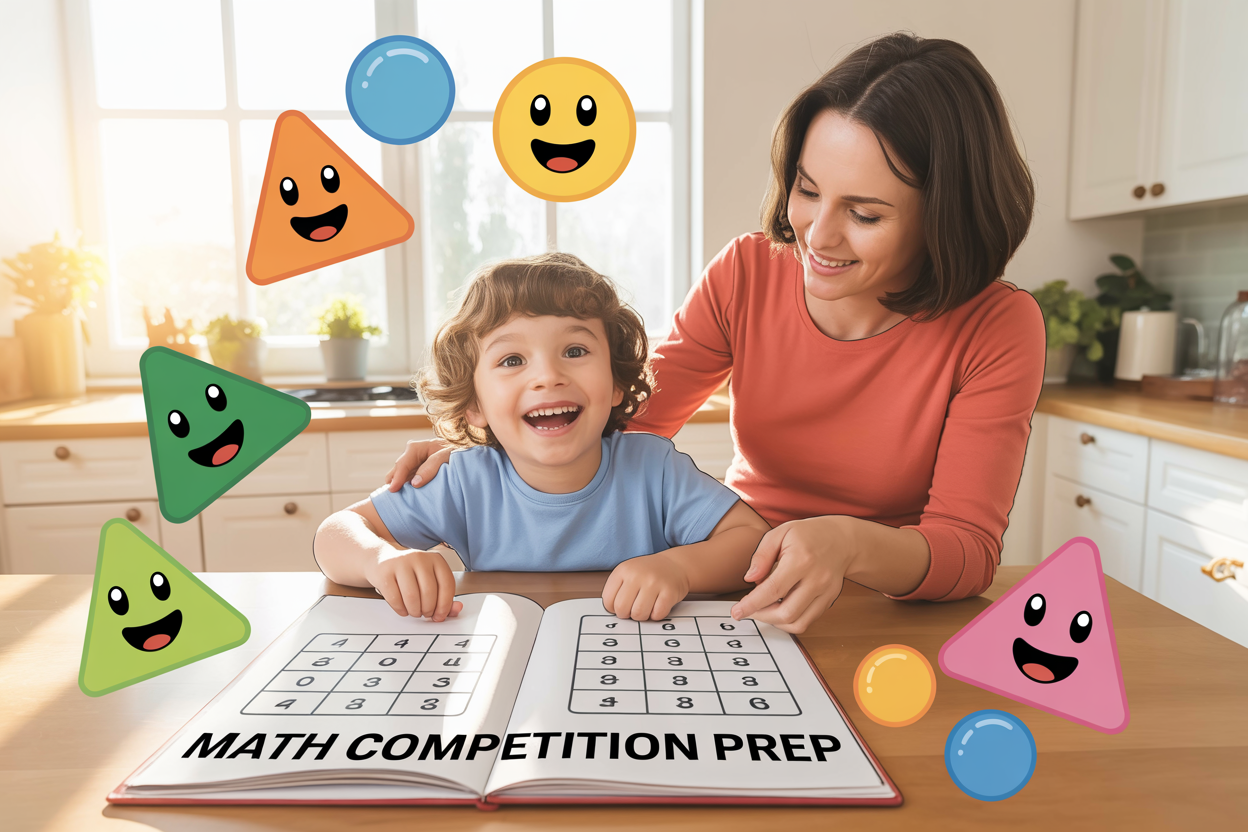
Your child just told you they want to enter a math competition. Maybe it’s the school’s annual math contest, maybe it’s something bigger like the AMC, Mathkangaroo, or a national olympiad. Either way, you’re probably wondering: how do we actually prepare for this? Math competition prep looks different from regular homework, and most parents aren’t sure where to start. This guide walks you through what works, based on how real families and coaches approach it.
📺 Video Guide
What makes math competitions different from school math
School math tests whether your child can follow a procedure. Math competitions test whether they can figure out which procedure to use when nobody tells them. The problems are designed to be tricky, with multiple steps and unexpected connections between topics. A child who gets straight A’s in math class might still struggle with competition problems, and that’s completely normal.
Competition math draws on problem-solving standards outlined by the National Council of Teachers of Mathematics (NCTM), but pushes them further. Kids need to think creatively, manage their time under pressure, and stay calm when a problem seems impossible at first glance.
The Mathematical Association of America (MAA), which runs the AMC series, designs problems specifically to test mathematical reasoning rather than computation. Understanding this distinction is the first step in preparing your child.
Start with the right foundation
Before diving into competition-specific material, make sure your child has a solid grip on grade-level math. Gaps in basic skills like fractions, divisibility rules, or order of operations will slow them down on every problem. This isn’t about rushing ahead to algebra or geometry. It’s about making sure the fundamentals are automatic so your child can focus on the actual puzzle.
According to research published through the National Assessment of Educational Progress (NAEP), students who demonstrate strong procedural fluency also score higher on problem-solving tasks. That connection matters for competitions, where speed and accuracy work together.
Tools like MathSpark can help here. It generates AI-powered worksheets aligned with the Greek school curriculum (and useful for any curriculum) in about 10 seconds, so you can target specific weak spots without spending hours searching for the right practice sheets. The worksheets follow the Pythagoras Exams methodology, which is particularly useful for kids preparing for Greek math competitions.
✓ Foundation skills to lock in first
- ✓ Mental arithmetic (addition, subtraction, multiplication, division without a calculator)
- ✓ Fractions, decimals, and percentages (converting between them quickly)
- ✓ Divisibility rules and prime factorization
- ✓ Basic geometry (area, perimeter, angles)
- ✓ Logical reasoning and pattern recognition
Build a practice routine that works
Cramming the night before a math competition doesn’t work. These aren’t vocabulary tests where memorization helps. Math competition prep works best as a steady habit, even just 20-30 minutes a day, three to four days a week. Consistency beats intensity here.
A study by the American Psychological Association found that distributed practice (spreading study sessions out over time) produces stronger retention than massed practice (cramming). For competition math, this means doing a few problems every day is far more effective than doing 50 problems on a Sunday afternoon.
Here’s a sample weekly schedule that works for most families:
💡 Sample weekly practice schedule
Monday: 20 min of warm-up problems (easy to medium difficulty)
Wednesday: 30 min working through 2-3 competition-style problems with full solutions
Friday: 20 min of timed practice (simulating competition conditions)
Weekend (optional): Review mistakes from the week and try one challenge problem
Where to find good practice problems
One of the biggest challenges in math competition prep is finding problems at the right level. Too easy, and your child gets bored. Too hard, and they get frustrated and want to quit. The sweet spot is problems where they can solve about 60-70% on their own and need hints or guidance for the rest.
The Art of Problem Solving (AoPS) community is one of the best free resources for competition math. Their forums have thousands of past problems from competitions worldwide, organized by difficulty. The Math Kangaroo website also publishes past papers, which are great for younger students (grades 1-6) because the problems use pictures and real-world scenarios.
For Greek families, the Hellenic Mathematical Society organizes the Pythagoras competition and publishes past exams. Working through these old papers is the single best way to prepare for Greek math competitions specifically.
Brilliant.org offers interactive problem sets that build mathematical thinking skills step by step. Their approach works well for kids who learn better through guided exploration than through reading textbooks.
Teaching your child to read problems carefully
This sounds basic, but it’s where most kids lose points. Competition problems are deliberately worded to be tricky. A single word like “at least” versus “at most” or “different” versus “distinct” can completely change the answer. Kids rush through the problem statement, assume they know what’s being asked, and solve the wrong thing.
Train your child to read each problem twice before picking up a pencil. On the first read, they should understand the story. On the second read, they should identify exactly what the question is asking for. Research from NCTM consistently shows that reading comprehension is one of the strongest predictors of math problem-solving ability.
A useful trick: have your child underline the question being asked and circle any constraints or conditions. This forces them to slow down and notice details they might otherwise miss.
📝 Common reading mistakes in competitions
Kids often confuse “how many ways” (asking for a count) with “what is the probability” (asking for a fraction). They also miss words like “positive” or “integer” that limit which answers are valid. Catching these small details is worth more than learning any advanced technique.
Problem-solving strategies that actually help
Most competition math books teach strategies like “draw a diagram” or “work backwards.” These are fine, but they’re only useful if your child has practiced applying them enough that they become instinctive. Here are the strategies that matter most, ranked by how often they come up:
Try small cases first. If a problem asks about a pattern with 100 elements, try it with 2, 3, and 4 elements first. Most patterns become obvious with small numbers. This strategy alone will solve about 30% of competition problems, according to experienced AMC coaches.
Draw a picture. Even for problems that seem purely numerical, a diagram often reveals the structure. Geometry problems obviously need diagrams, but so do many counting and probability problems.
Work backwards from the answer. In multiple-choice competitions, plugging answer choices back into the problem can save time. Start with the middle value and adjust up or down based on whether it’s too big or too small.
Look for what’s invariant. Some competitions (especially International Mathematical Olympiad-style problems) have quantities that stay the same throughout a process. Finding that invariant often cracks the problem open.
George Polya’s classic book “How to Solve It” (Princeton University Press) remains one of the best resources for teaching problem-solving thinking. It was written in 1945 and is still relevant because the principles of mathematical reasoning don’t change.
Managing competition-day nerves
Even well-prepared kids can freeze on competition day. The clock is ticking, the room is quiet, and suddenly every problem looks harder than anything they’ve practiced. This is normal. According to research published in the Journal of Experimental Child Psychology, math anxiety affects performance through working memory, meaning anxious kids literally have less mental bandwidth available for solving problems.
The best antidote is simulated practice. Run timed practice sessions at home using real past papers. Set a timer, enforce the same rules (no calculator, no talking), and let your child experience the time pressure in a low-stakes environment. After a few of these sessions, the real competition feels much less scary.
Also: teach your child to skip hard problems. Seriously. In most competitions, every problem is worth the same number of points. Spending 15 minutes stuck on problem 5 while leaving three easy problems unanswered at the end is a common mistake. The Centre for Education in Mathematics and Computing (CEMC) at the University of Waterloo recommends doing a first pass through all problems, solving the ones you can do quickly, then going back to the harder ones.
The role of mistakes in learning
Here’s something that surprised me when I first looked into competition math: the kids who improve the fastest aren’t the ones who solve the most problems. They’re the ones who spend the most time analyzing problems they got wrong.
After each practice session, review every mistake. Not just “oh, I made a calculation error.” Go deeper. Was it a reading mistake? Did they not know a technique? Did they know the technique but couldn’t recognize where to apply it? Did they run out of time? Each type of mistake requires a different fix.
Professor Jo Boaler at Stanford’s YouCubed has published extensive research showing that mistakes cause the brain to grow new synaptic connections. Framing mistakes as learning opportunities rather than failures changes how kids feel about getting problems wrong, and that attitude shift makes a real difference in how they approach challenging material.
Key math topics for competitions by age group
Different competitions emphasize different topics, but here’s a general guide based on what shows up most frequently:
Ages 6-8 (grades 1-3): Number patterns, basic geometry (shapes, symmetry), simple logic puzzles, counting, and mental arithmetic. At this level, competitions like Math Kangaroo focus on visual reasoning and creative thinking more than calculation.
Ages 9-11 (grades 4-6): Number theory (divisibility, primes, factors), fractions and ratios, area and perimeter, combinatorics (counting arrangements), and introductory algebra. The Pythagoras competition in Greece targets this range, and past papers from the Hellenic Mathematical Society are excellent practice material.
Ages 12-14 (grades 7-9): Algebra (equations, inequalities), coordinate geometry, probability, modular arithmetic, and proof techniques. At this level, the AMC 8 is a widely recognized benchmark. Problems start requiring multi-step reasoning and connections between different areas of math.
What parents can (and can’t) do to help
You don’t need to be a math expert to support your child’s competition prep. In fact, sometimes knowing less math can be an advantage because you’ll ask genuine questions instead of jumping straight to the answer.
What helps: sitting with your child while they work, asking them to explain their thinking out loud, and keeping the atmosphere positive. Research from the U.S. Department of Education consistently shows that parental involvement in learning activities correlates with better academic outcomes, regardless of the parent’s own skill level.
What hurts: putting pressure on results, comparing your child to other kids, or making competition participation feel like an obligation rather than a choice. The moment math stops being fun, your child will start dreading practice sessions and the whole exercise becomes counterproductive.
If your child needs more structured guidance, consider a math circle or competition prep group. Many schools and community centers run these. Working alongside peers who share the same interest makes practice more engaging than working alone at the kitchen table.
✓ Parent do’s and don’ts
- ✓ Do celebrate effort and improvement, not just scores
- ✓ Do let your child choose which competitions to enter
- ✓ Do create a regular, low-pressure practice routine
- ✓ Don’t compare your child’s scores to other children’s
- ✓ Don’t punish poor performance or set unrealistic goals
Recommended books and resources
You don’t need to buy a whole library. Start with one or two books matched to your child’s level:
For younger kids (grades 2-5), the “Competition Math for Middle School” by Jason Batterson covers the basics well and includes practice problems with full solutions. The Mathematical Circles Library from the American Mathematical Society has approachable titles for this age group too.
For older kids (grades 6-9), the Art of Problem Solving series by Richard Rusczyk is widely considered the gold standard. Their “Introduction to Counting and Probability” and “Introduction to Number Theory” books cover the topics that come up most frequently in competitions.
Online, Khan Academy offers free courses that cover foundational topics. While Khan Academy isn’t competition-specific, it’s excellent for filling skill gaps quickly.
Frequently Asked Questions
At what age should my child start math competition prep?
Most kids can start with low-pressure competitions like Math Kangaroo in grade 1 or 2 (ages 6-7). Formal preparation with structured problem-solving typically begins around grades 3-4 (ages 8-9). The key is to follow your child’s interest rather than forcing it too early.
How much time should we spend on competition prep each week?
For most kids, 60-90 minutes per week split across 3-4 short sessions is enough. Quality matters more than quantity. A focused 20-minute session where your child works through two problems carefully is worth more than an hour of unfocused practice.
My child is good at math but doesn’t want to compete. Should I push them?
No. Competition math isn’t for everyone, and that’s fine. If your child enjoys solving puzzles and challenges but doesn’t like the competitive pressure, you can still use competition-style problems as enrichment without entering actual contests. The problem-solving skills transfer regardless.
Do math competitions help with school grades?
Generally yes. The problem-solving skills developed through competition prep improve mathematical reasoning across the board. Many parents report that their children find school math easier after working on competition problems, because school problems seem straightforward by comparison.
What if my child scores poorly in their first competition?
This is completely expected. First competitions are learning experiences, not tests of ability. Focus on what they learned, which problems they found interesting, and what they want to try differently next time. Most successful competition math students started with mediocre scores and improved over months of consistent practice.
⚠️ Disclaimer
This article provides general guidance on math competition preparation as of March 2026. Competition formats, dates, and rules vary by organization and region. Always check the official website of the specific competition your child is entering for the most current information. Links to external resources are provided for reference and do not imply endorsement.