Math Vocabulary for Kids: Key Terms Every Child Should Know
Why Math Vocabulary Matters More Than You Think
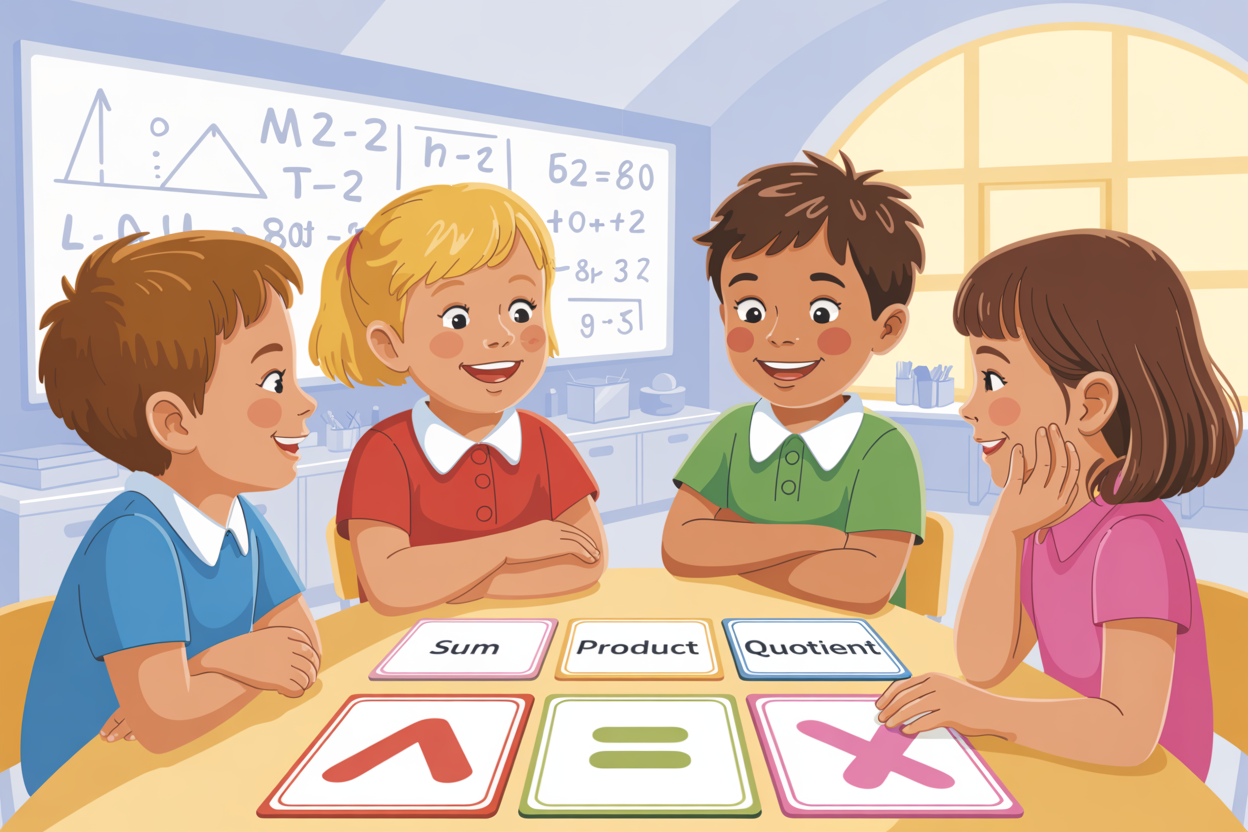
Here’s something that trips up a lot of kids: they can do the math, but they can’t understand what’s being asked. A child might know how to add 7 + 5, but freeze when a test says “find the sum of 7 and 5.” The problem isn’t arithmetic. It’s vocabulary. Math vocabulary for kids is one of those overlooked building blocks that can make or break their confidence in the classroom.
Research from the National Council of Teachers of Mathematics (NCTM) consistently shows that students who understand math terminology perform better on assessments. Not because the words are magic, but because understanding the language of math removes a layer of confusion. When your child knows that “difference” means the result of subtraction, word problems stop feeling like puzzles wrapped in riddles.
This guide breaks down the terms your child actually needs, organized by topic and grade level. No jargon about jargon. Just practical definitions parents can use at the kitchen table tonight.
📺 Video Guide
Addition and subtraction terms your child needs first
These are the foundation. Most kids encounter them in first and second grade, but plenty of older students still mix them up. The IXL math vocabulary resources confirm that mastering basic operation terms early prevents confusion later on.
Addend: Any number being added. In 3 + 5 = 8, both 3 and 5 are addends. Kids often learn “plus” first, but “addend” shows up on tests and worksheets starting around grade 2.
Sum: The result you get when you add numbers together. This one gets confused with “total” all the time, but they mean the same thing in math. If your child sees “find the sum,” that means add.
Difference: The result of subtraction. This word catches kids off guard because in everyday English, “difference” means something else entirely. In math, 10 – 4 = 6, and 6 is the difference.
Minuend and subtrahend: Less common, but they pop up. The minuend is the number you start with (the bigger one in basic subtraction). The subtrahend is the number being taken away. In 10 – 4, 10 is the minuend and 4 is the subtrahend.
💡 Quick activity
Write a simple equation on paper: 8 + 3 = 11. Ask your child to point to the addends and the sum. Then flip it: 11 – 3 = 8. Ask them to identify the difference. Takes two minutes and locks in the vocabulary.
Multiplication and division vocabulary
Once your child moves past addition and subtraction, a whole new set of words arrives. These typically show up in grades 3 and 4, and according to Understood.org, this is where vocabulary gaps start causing real trouble.
Factor: A number that divides evenly into another number. In 4 x 6 = 24, both 4 and 6 are factors. Kids sometimes confuse factors with addends because the position looks similar in an equation.
Product: The result of multiplication. This is the multiplication equivalent of “sum.” If a worksheet says “find the product of 7 and 8,” your child needs to multiply, not add.
Dividend: The number being divided. In 20 ÷ 4 = 5, the dividend is 20.
Divisor: The number you’re dividing by. In that same example, 4 is the divisor.
Quotient: The answer to a division problem. 20 ÷ 4 = 5, and 5 is the quotient. This is probably the most forgotten math term. Kids who learn it early have a real edge on word problems.
Remainder: The amount left over when a number doesn’t divide evenly. 13 ÷ 4 = 3 with a remainder of 1. The Khan Academy multiplication and division section has free practice problems that use these terms in context.
Fractions and decimals: where vocabulary gets tricky
Fractions introduce some of the most confusing math vocabulary. A study published by Edutopia found that many students struggle with fractions not because the math is hard, but because the terminology creates barriers.
Numerator: The top number in a fraction. It tells you how many parts you have. In 3/4, the numerator is 3.
Denominator: The bottom number. It tells you how many equal parts the whole is divided into. In 3/4, the denominator is 4. A helpful trick: “denominator” and “down” both start with “d.”
Equivalent fractions: Fractions that look different but represent the same amount. 1/2 and 2/4 are equivalent. This concept usually clicks when you show kids a pizza cut into different numbers of slices.
Improper fraction: A fraction where the numerator is bigger than the denominator, like 7/4. It means you have more than one whole.
Mixed number: A whole number combined with a fraction, like 1 3/4. This is just another way to write an improper fraction.
Decimal: A number expressed using a decimal point to show parts of a whole. 0.5 is the same as 1/2. The Math Is Fun definition page has interactive examples kids can play with.
✓ Memory shortcuts that stick
- ✓ Denominator starts with D = Down (bottom of fraction)
- ✓ Numerator = Number of pieces you have (top)
- ✓ Product = what a factory produces (multiplication makes things)
- ✓ Quotient sounds like “quota” (how much each person gets when you divide)
Geometry terms kids encounter early
Geometry vocabulary starts in kindergarten with basic shapes, but it expands rapidly by grade 3. The Common Core State Standards expect students to use proper geometric terms by grade 4.
Vertex: The point where two lines or edges meet. A triangle has three vertices. Kids often call these “corners,” which is fine at home, but tests use “vertex.”
Edge: A line segment where two faces of a 3D shape meet. A cube has 12 edges.
Face: A flat surface on a 3D shape. A cube has 6 faces.
Perimeter: The total distance around the outside of a shape. Add up all the sides. Kids confuse this with area constantly, so it’s worth drilling the distinction.
Area: The space inside a shape, measured in square units. Perimeter goes around the outside, area fills the inside. The Math Playground has interactive games that help kids visualize the difference.
Parallel: Lines that run in the same direction and never cross, like train tracks.
Perpendicular: Lines that cross at a right angle (90 degrees), like the corner of a book.
Comparison and number sense words
These terms come up in almost every math topic. The National Association for the Education of Young Children (NAEYC) recommends introducing comparison vocabulary as early as preschool.
Greater than / Less than: Comparing two numbers. The alligator mouth (the > or < symbol) always opens toward the bigger number. This simple visual has saved countless kids from confusion.
Equal: The same value. The = sign means both sides have the same amount. Sounds obvious, but many kids don’t realize the equals sign means “is the same as” rather than “here comes the answer.”
Estimate: An educated guess about a number or measurement. Rounding to the nearest ten and then calculating is a common estimation strategy.
Round: Adjusting a number to the nearest ten, hundred, or other place value. 47 rounds to 50. 43 rounds to 40.
Equation: A math sentence with an equals sign. 3 + 5 = 8 is an equation. 3 + 5 by itself is an expression (no equals sign). The Splash Learn math vocabulary section helps kids practice telling the difference.
Expression: A combination of numbers and operations without an equals sign. 4 x 3 + 2 is an expression. Once you write = 14, it becomes an equation.
Data and measurement vocabulary
By grades 3-5, kids start working with data and measurement more formally. These terms show up in science class too, so learning them in math gives your child a head start.
Mean (average): Add all the numbers, then divide by how many numbers there are. For the set {4, 6, 8}, the mean is (4 + 6 + 8) ÷ 3 = 6.
Median: The middle number when you line them up in order. For {3, 5, 9}, the median is 5. If there’s an even amount of numbers, average the two middle ones.
Mode: The number that appears most often. In {2, 3, 3, 5, 7}, the mode is 3.
Range: The difference between the highest and lowest numbers. For {2, 5, 9}, the range is 9 – 2 = 7. The National Center for Education Statistics has a free tool where kids can create graphs and explore data concepts hands-on.
Unit: A standard measurement (inches, centimeters, liters, grams). Kids need to know that the number alone doesn’t mean anything without the unit. “5” doesn’t tell you much. “5 centimeters” does.
📝 A note about word problems
The number one reason kids struggle with word problems isn’t math skills. It’s vocabulary. When a problem says “how many more,” it means subtract. “How many altogether” means add. “Share equally” means divide. Practice translating these phrases at home, and word problems become much less intimidating. The Reading Rockets math vocabulary guide has more phrase translations parents can use.
How to practice math vocabulary at home
Flashcards work. They’re not glamorous, but research from the American Psychological Association confirms that spaced repetition (reviewing information at increasing intervals) is one of the most effective ways to commit new vocabulary to long-term memory.
Beyond flashcards, here are some strategies that actually work:
Use the words in conversation. Instead of saying “what’s 6 plus 4,” try “what’s the sum of 6 and 4?” Casual exposure builds familiarity faster than drilling definitions.
Create a math word wall. Tape index cards with terms and definitions on a wall near where your child does homework. Visual reminders work. The Education.com math vocabulary worksheets are a good starting point for printable word lists.
Play “math detective.” When doing everyday math (grocery shopping, cooking, driving), point out vocabulary in action. “The recipe says we need 3/4 cup of flour. What’s the numerator?”
Use worksheets with vocabulary built in. Tools like MathSpark generate AI-powered math worksheets for kids in grades 1-9 in about 10 seconds. The worksheets follow the Pythagoras Exams methodology and include problems that naturally use proper math terminology, so your child practices both computation and vocabulary at the same time. It’s free in its basic form.
Quiz backwards. Give your child the definition and have them guess the term. “I’m the answer you get when you divide two numbers. What am I?” (Quotient.) This is harder than matching terms to definitions, and it builds deeper understanding.
Grade-by-grade vocabulary checklist
Not every term needs to be learned at once. Here’s a rough guide for what kids should know by grade level, based on Common Core standards and typical Greek school curriculum expectations:
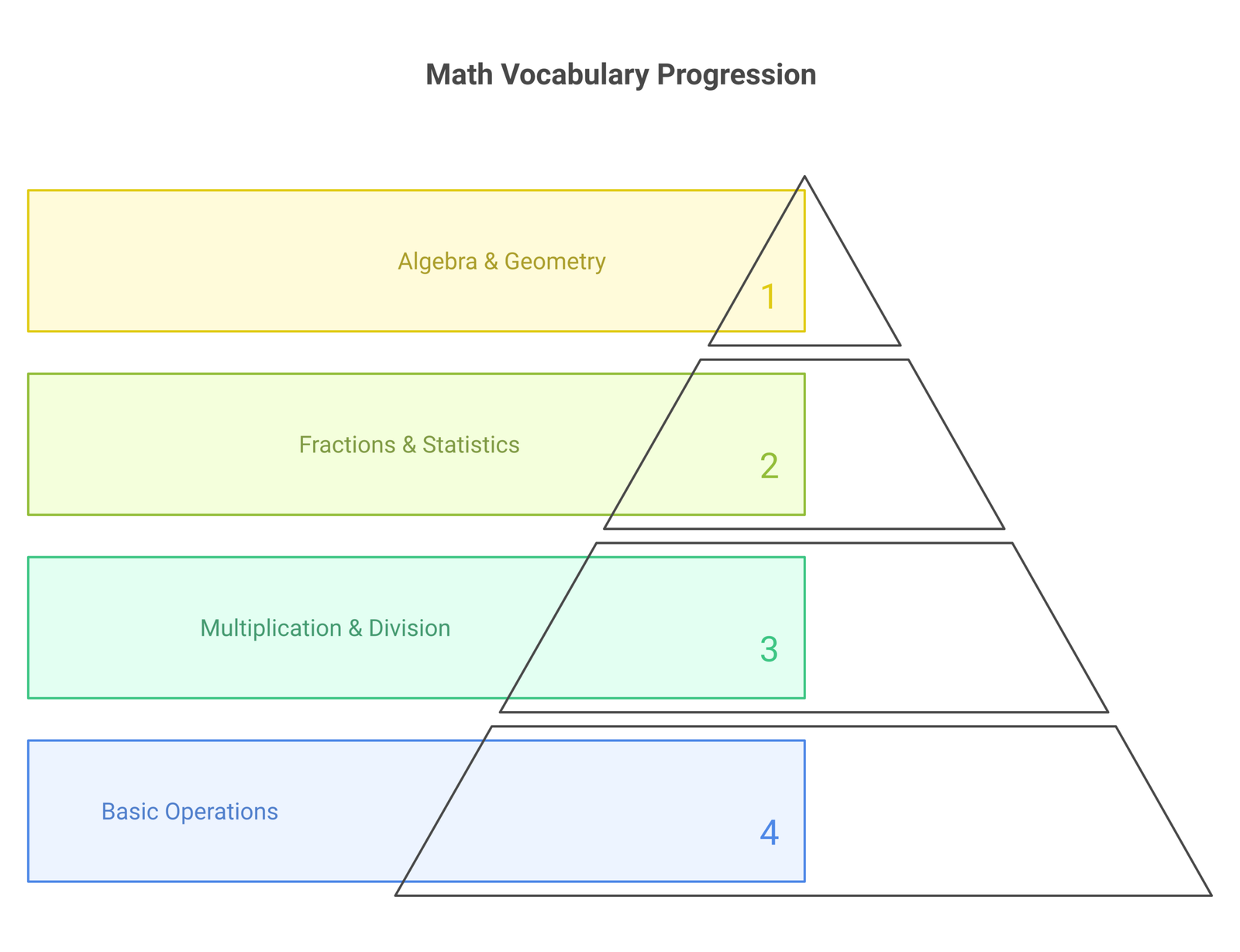
Grades 1-2: Addend, sum, difference, greater than, less than, equal, equation, estimate, even, odd
Grades 3-4: Factor, product, dividend, divisor, quotient, remainder, fraction, numerator, denominator, array, perimeter, area
Grades 5-6: Equivalent fractions, improper fraction, mixed number, decimal, percent, mean, median, mode, range, ratio, volume
Grades 7-9: Variable, coefficient, exponent, integer, rational number, expression, inequality, slope, coordinate, probability
Don’t worry about memorizing everything at once. Focus on the terms that match your child’s current grade, and revisit previous ones if gaps come up. The Massachusetts Department of Education math framework is one of the most detailed public resources for grade-level expectations.
✓ Signs your child needs vocabulary support
- ✓ They can solve problems shown with numbers but struggle with word problems
- ✓ They confuse “sum” with “difference” or “product” with “quotient”
- ✓ They don’t know what a test question is asking even though they know how to do the math
- ✓ They avoid reading math textbook explanations
Frequently Asked Questions
At what age should kids start learning math vocabulary?
Kids can start learning basic math terms like “more,” “less,” “equal,” and “add” as early as age 4-5. Formal math vocabulary instruction typically begins in first grade, but casual use at home before that gives children a meaningful advantage.
How many math vocabulary words should my child know per grade?
There’s no fixed number, but roughly 10-15 new terms per grade is typical. By the end of elementary school (grade 5-6), most students should comfortably use around 50-60 math terms. Quality of understanding matters more than quantity.
What’s the difference between an equation and an expression?
An expression is a combination of numbers and operations (like 4 + 3 or 2 x 5 – 1) without an equals sign. An equation includes an equals sign and shows that two things are equal (like 4 + 3 = 7). Think of it this way: an equation makes a statement, an expression is just a phrase.
My child speaks Greek at school. Are math terms different in Greek?
Many math terms share Latin or Greek roots, which can actually help bilingual children. “Perimeter” comes from the Greek “perimetros” (περίμετρος). “Geometry” comes from “geometria” (γεωμετρία). Knowing both languages often makes math vocabulary easier, not harder.
How can I tell if my child’s math struggles are vocabulary-related?
Try this test: give your child a problem in plain numbers (like 15 – 8) and then the same problem as a word problem (“find the difference between 15 and 8”). If they solve the first one easily but hesitate on the second, vocabulary is likely the issue, not math ability.
⚠️ Disclaimer
This article is for informational purposes and reflects general math education guidance as of March 2026. Curriculum expectations vary by school, district, and country. Consult your child’s teacher for grade-specific requirements.