Pattern Recognition: Early Math Skills for Kids
Your child sorts LEGO bricks by color without being asked. They notice the sidewalk tiles alternate between gray and white. They predict what song comes next on their favorite playlist. That’s pattern recognition math at work, and it’s one of the most important early math skills your child can develop.
Pattern recognition is how kids learn to spot repeating sequences, predict what comes next, and make sense of the world around them. According to the National Council of Teachers of Mathematics (NCTM), recognizing and extending patterns is a foundational algebra skill that children should begin developing in kindergarten. And research published in the Journal of Educational Psychology has found that early pattern skills predict later math achievement more strongly than counting or number knowledge.
The good news? You don’t need flashcards or expensive programs. Pattern recognition grows naturally through play, conversation, and everyday routines. This guide walks you through what pattern recognition looks like at different ages, practical activities you can try at home, and how to tell if your child needs more support.
📺 Video Guide
What is pattern recognition in math?
Pattern recognition is the ability to identify repeating elements and use that information to predict what comes next. In math, this means spotting sequences in numbers, shapes, colors, or objects and understanding the rule that governs them.
Think about it from your child’s perspective. When they see “red, blue, red, blue, red, ___” and know the answer is blue, they’ve just done something mathematically significant. They identified a repeating unit (red-blue), recognized it repeats, and used that understanding to make a prediction.
This skill shows up everywhere in later math. Khan Academy’s algebra curriculum builds directly on pattern skills when teaching sequences and functions. The Common Core State Standards include pattern work starting in kindergarten because it forms the bridge between arithmetic and algebraic thinking.
✓ Why pattern recognition matters
- ✓ Builds the foundation for algebraic thinking and equations
- ✓ Strengthens logical reasoning and problem-solving abilities
- ✓ Helps children make predictions based on observed data
- ✓ Develops attention to detail and careful observation
- ✓ Connects math to real-world situations children already understand
Pattern recognition by age: what to expect
Children develop pattern skills gradually. Knowing where your child should be helps you meet them at the right level without pushing too hard or holding back.
Ages 3 to 4 (Preschool): Children begin recognizing simple AB patterns, like “clap-stomp, clap-stomp.” They can copy a pattern you create with blocks or beads, and they start noticing patterns in their environment (striped shirts, tiled floors). At this age, most kids need the pattern physically in front of them to work with it.
Ages 5 to 6 (Kindergarten to Grade 1): Children can identify, copy, and extend AB and ABC patterns using colors, shapes, and sounds. They begin creating their own patterns and can describe the rule (“it goes circle, square, circle, square”). Research from the Institute of Education Sciences shows that children who receive structured pattern instruction at this age show measurable gains in both pattern skills and general math ability.
Ages 7 to 9 (Grades 2 to 4): Students work with growing patterns (2, 4, 6, 8…) and number sequences. They can fill in missing elements and describe patterns using mathematical language. This is when pattern work shifts from visual/physical to numerical, and children start connecting patterns to skip counting and multiplication.
Ages 10 to 12 (Grades 5 to 7): Pattern recognition becomes more abstract. Students analyze number patterns to find rules (like “multiply by 2 then add 1”), work with decimals and fraction patterns, and begin expressing patterns as simple equations. This directly prepares them for formal algebra.
Types of patterns your child should know
Not all patterns are the same. Each type builds a different thinking muscle, and kids benefit from exposure to all of them.
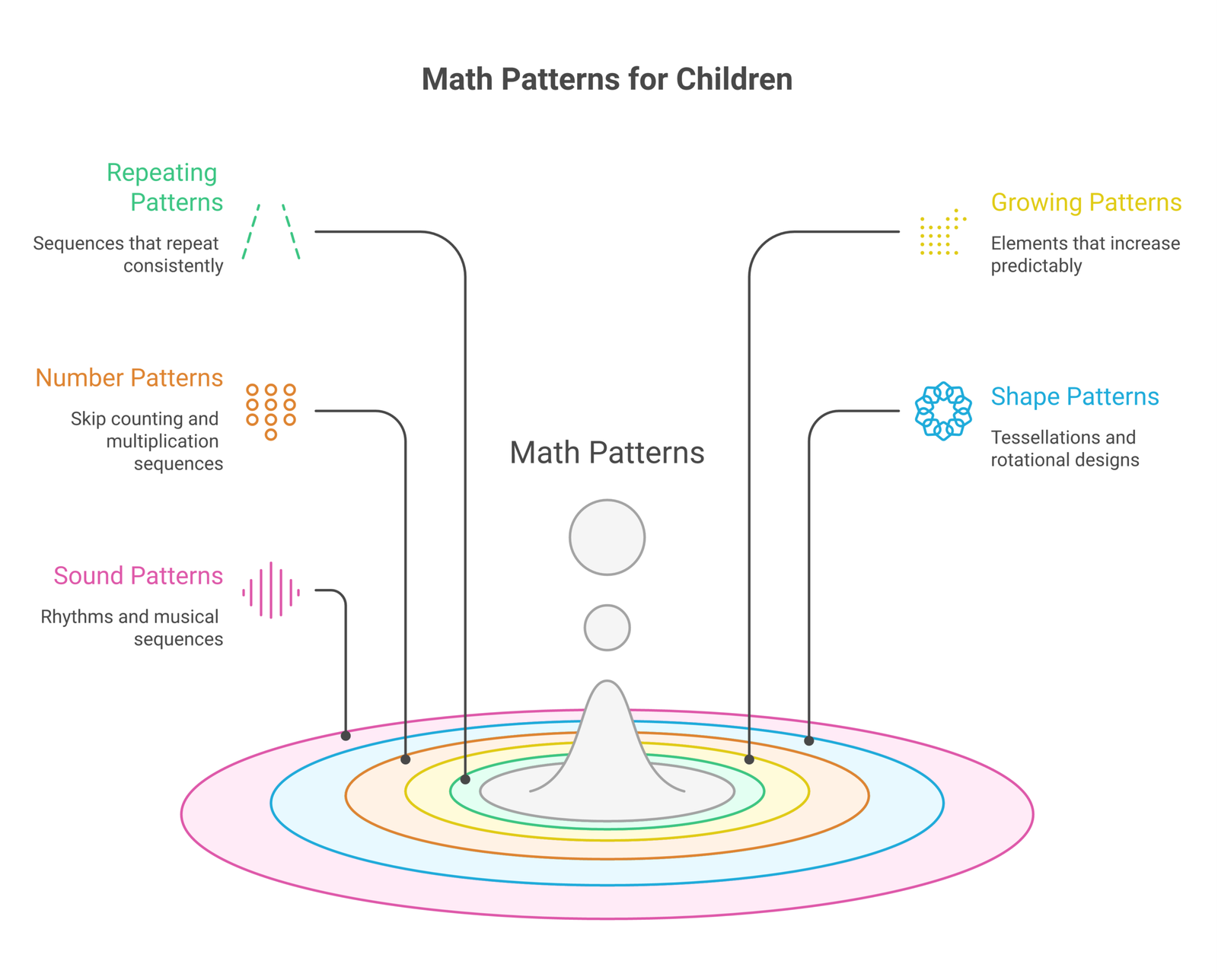
Repeating patterns are the simplest. An element or group of elements repeats over and over: ABABAB, ABCABC, AABAABAAB. These are usually where kids start. You can practice them with colored blocks, clapping rhythms, or even arranging fruit on a plate.
Growing patterns change in a predictable way. The sequence 1, 3, 5, 7, 9 grows by 2 each time. Building staircases with blocks (1 block, 2 blocks, 3 blocks) is a hands-on way to explore these. According to Teaching Children Mathematics, growing patterns are particularly effective for developing early algebraic reasoning because children must figure out the rule, not just copy a repeating unit.
Number patterns include skip counting (5, 10, 15, 20…), multiplication tables, even/odd sequences, and more complex rules like Fibonacci-style patterns where each number is the sum of the two before it. These connect directly to arithmetic fluency.
Shape and spatial patterns involve geometric relationships. Think of tessellations (how tiles fit together), symmetry patterns, and rotational patterns. The National Assessment of Educational Progress (NAEP) regularly includes spatial pattern questions, and students who practice these tend to score higher on geometry sections.
💡 Quick tip
When your child spots a pattern, ask “How do you know?” and “What would come next if we kept going?” These two questions push them from passive observation to active mathematical thinking.
10 activities to build pattern recognition at home
These activities work for different ages and don’t require any special materials. Start with whichever matches your child’s current level.
1. Pattern walks. Go for a walk and challenge your child to spot patterns: brick arrangements, fence posts, flower petals, house numbers. Take photos and discuss them later. This works for ages 3 and up.
2. Bead or pasta stringing. Give your child colored beads (or painted pasta) and ask them to create a pattern necklace. Start with AB patterns for younger kids and challenge older ones to make AABB or ABC patterns. Then have them describe their rule.
3. Clapping and rhythm games. Create a clapping pattern (clap-clap-snap, clap-clap-snap) and ask your child to join in. Then let them create their own rhythm for you to follow. This adds a physical, auditory dimension to pattern work that helps kinesthetic learners connect with the concept.
4. Snack patterns. Use Cheerios, grapes, crackers, and other small foods to create edible patterns. Kids arrange them, identify the repeating unit, extend the pattern, and then eat their creation. The National Association for the Education of Young Children (NAEYC) recommends food-based math activities for preschoolers because they combine sensory experience with abstract thinking.
5. Block staircases. Build a staircase where each step is one block taller than the last. Then ask: “How many blocks will the 10th step have?” This introduces growing patterns and lays groundwork for understanding sequences.
6. Number chart detective. Print a hundreds chart (1 to 100) and have your child color in skip-counting patterns. Count by 2s in one color, 5s in another, 10s in another. The visual patterns that emerge are genuinely surprising and help kids see the structure inside numbers. MathSpark can generate custom pattern worksheets for any grade level in about 10 seconds, which is handy when you want fresh practice material without searching through workbooks.
7. Pattern cards. Draw a pattern on a card but leave the last two elements blank. Make a set of 10 to 15 cards with increasing difficulty. Your child fills in the missing pieces. Great for car rides or waiting rooms.
8. Music patterns. Listen to a song and identify the repeating verse-chorus structure. Or play simple melodies on a xylophone and ask what note comes next. Music and math share deep structural connections, and research from Cambridge Brain Sciences confirms that musical training strengthens pattern recognition abilities.
9. Story patterns. Many children’s books follow patterns. “Brown Bear, Brown Bear” and “If You Give a Mouse a Cookie” both have predictable, repeating structures. Read these books and pause before the pattern completes so your child can predict what happens next.
10. Calendar patterns. Use a monthly calendar to explore day-of-week patterns, number patterns (all Mondays go up by 7), and date sequences. Ask questions like “What date will it be two Thursdays from now?” This is real-world math in daily life.
Common mistakes parents make with pattern practice
Even well-meaning parents can accidentally make pattern practice less effective. Here’s what to watch for.
Jumping to numbers too quickly. Many parents skip physical and visual patterns and go straight to number sequences. But children need concrete experience first. A child who has never sorted buttons by color will struggle with numerical skip counting. The ERIC database contains dozens of studies showing that hands-on pattern experience before age 7 leads to stronger abstract reasoning later.
Only using visual patterns. Patterns exist in sounds, movements, time, and language too. If your child only encounters color-shape patterns on worksheets, they may not transfer the skill to other areas. Mix it up with clapping games, music, and verbal patterns.
Giving the answer too fast. When your child gets stuck, resist the urge to say “it’s blue!” Instead, try: “Let’s look at the beginning again. What do you see repeating?” The struggle is where learning happens. A study from the American Psychological Association found that productive struggle, where children work through difficulty with gentle guidance, produces deeper understanding than simply being told the answer.
Making it feel like a test. “What comes next?” is fine occasionally. But if every pattern interaction becomes a quiz, your child will start avoiding them. Weave patterns into play naturally. Build a pattern fence for toy animals. Arrange stickers in a pattern on a card. Keep it fun and pressure-free.
📝 Important
If your child consistently struggles with simple AB patterns after several weeks of practice, consider discussing it with their teacher. Difficulty with patterns can sometimes signal broader processing challenges that benefit from early intervention.
How pattern recognition connects to other math skills
Pattern recognition isn’t an isolated skill. It threads through almost every area of math your child will encounter.
Counting and number sense. Skip counting (2, 4, 6, 8) is a number pattern. When kids build number sense, they’re recognizing that numbers follow predictable patterns on a number line. Even/odd recognition is pattern work.
Multiplication. The times tables are patterns. The 9 times table has a beautiful pattern where the digits always add up to 9 (18, 27, 36, 45…). Kids who see multiplication through the lens of patterns memorize facts faster and understand the underlying structure, not just the individual answers.
Geometry. Geometry for kids involves recognizing patterns in shapes: symmetry, tessellation, rotational patterns, and fractal structures in nature. The Math is Fun tessellation page shows how repeating patterns of shapes can fill an entire plane, which is the same concept as simple AB patterns applied to 2D space.
Algebra. Algebra is, at its core, the study of patterns expressed with symbols. When your child writes “the rule is: add 3 each time,” they’re doing pre-algebra. The Massachusetts Mathematics Framework explicitly links pattern work in early grades to algebraic reasoning in later grades.
Problem solving. Many math problem-solving strategies rely on finding patterns. When faced with a complex word problem, experienced math thinkers look for the pattern first. This habit starts in preschool with simple repeating sequences.
Using worksheets and digital tools for pattern practice
Hands-on activities are the best starting point, but worksheets and apps have their place too, especially for kids who enjoy structured practice or need repetition to build fluency.
Platforms like MathSpark generate AI-powered pattern worksheets tailored to your child’s grade level. You type in what you need, and it creates practice sheets in seconds. This is especially useful when your child has mastered one pattern type and needs fresh challenges at the next level, because searching through workbooks for the right difficulty is time-consuming.
The NCTM Illuminations website offers free interactive pattern activities. CoolMath Games has pattern-based games that kids actually enjoy playing. And Education.com provides printable pattern worksheets organized by grade.
That said, a worksheet should supplement hands-on experience, not replace it. The ideal balance for younger children (ages 4 to 7) is about 70% hands-on activities and 30% paper or digital practice. For older children (ages 8 and up), that ratio can shift toward 50/50 as they become more comfortable with abstract representations.
💡 Practice idea
Try “pattern of the day” at breakfast. Arrange cereal pieces in a pattern and let your child figure out the rule. It takes 30 seconds and builds the habit of looking for patterns everywhere.
Signs your child is developing strong pattern skills
You don’t need a formal assessment to know your child is progressing. Look for these everyday signs:
They spontaneously point out patterns they notice, whether it’s the pattern on a dress, the rhythm of windshield wipers, or the way house numbers increase. They can describe a pattern rule using words like “it goes… then… then… and starts over.” They create their own patterns during play without being prompted. They predict what comes next in a story, song, or sequence. And they start noticing when something breaks a pattern (“that one doesn’t belong!”).
If your child is doing most of these things, their pattern recognition is developing well. Encourage it by celebrating their observations (“Good catch! I didn’t even notice that pattern”) rather than only praising correct answers on worksheets.
⚠️ Disclaimer
This article provides general guidance on supporting your child’s math development. Every child learns differently and at their own pace. If you have concerns about your child’s progress, consult with their teacher or a learning specialist. Information current as of March 2026.
Frequently Asked Questions
At what age should my child start learning patterns?
Most children begin noticing simple patterns around age 3, though they may not be able to describe them verbally. By age 4 to 5, they can typically copy and extend basic AB patterns. Formal pattern instruction usually begins in kindergarten, but casual pattern play can start much earlier.
My child can do color patterns but struggles with number patterns. Is this normal?
Yes, completely normal. Color and shape patterns are concrete and visual, while number patterns require abstract thinking. There’s often a gap of one to two years between mastering visual patterns and being comfortable with number sequences. Keep offering both types and let your child progress naturally.
How much time should we spend on pattern practice each day?
For young children (ages 3 to 6), 5 to 10 minutes of intentional pattern play is plenty. The real learning happens during natural moments throughout the day when you point out patterns together. Older children (ages 7 and up) can handle 15 to 20 minutes of structured pattern work alongside their regular math practice.
Are pattern worksheets effective for young children?
Worksheets work best when combined with hands-on activities. For children under 6, physical manipulation of objects (blocks, beads, food) is more effective than paper-based practice. From age 6 onward, worksheets can reinforce skills that were first learned through play. Tools like MathSpark generate grade-appropriate pattern worksheets quickly if you want targeted practice material.
How does pattern recognition help with standardized tests?
Pattern questions appear on virtually every standardized math assessment, from state tests to college entrance exams. More importantly, pattern recognition helps children approach unfamiliar problems by looking for structure. Kids who are comfortable with patterns tend to perform better on non-routine problems because they instinctively look for the underlying rule.