10 Fun Ways to Prevent the Summer Math Slide
The summer math slide sounds dramatic, but for many families it shows up in tiny August moments: a child who knew multiplication facts in May suddenly pauses, fractions feel foggy, and homework confidence drops before school even starts. The good news is that preventing the summer math slide does not require a strict vacation classroom. It works best when math becomes short, playful, visible, and connected to real life.
Research summaries from NWEA and education researchers consistently show that summer can affect math more than reading because math facts and procedures fade when children stop using them. A widely cited AERA report found that many students lose ground across repeated summers, while Brookings notes that the pattern is real but not identical for every child. That nuance matters: your goal is not panic, it is gentle maintenance.
📺 Video Guide
Summer Math Slide Prevention Starts Small
The best summer plan is the one you can actually keep. Ten to fifteen minutes most days beats one heroic two-hour worksheet session followed by a week of resistance. The What Works Clearinghouse math intervention guide supports explicit, systematic practice, but parents can translate that into simple routines: one tiny skill, one clear example, one playful repeat, and one quick celebration.
For MathSpark families, I recommend a “small spark” routine: choose a grade-appropriate worksheet, solve only the first few questions together, then stop while the child still feels successful. Tools like MathSpark make this easier because you can generate AI-powered worksheets in seconds, align practice with the Greek school curriculum and Pythagoras-style reasoning, and avoid the endless search for the right printable. Keep it practical, not performative.
✓ A Low-Stress Weekly Rhythm
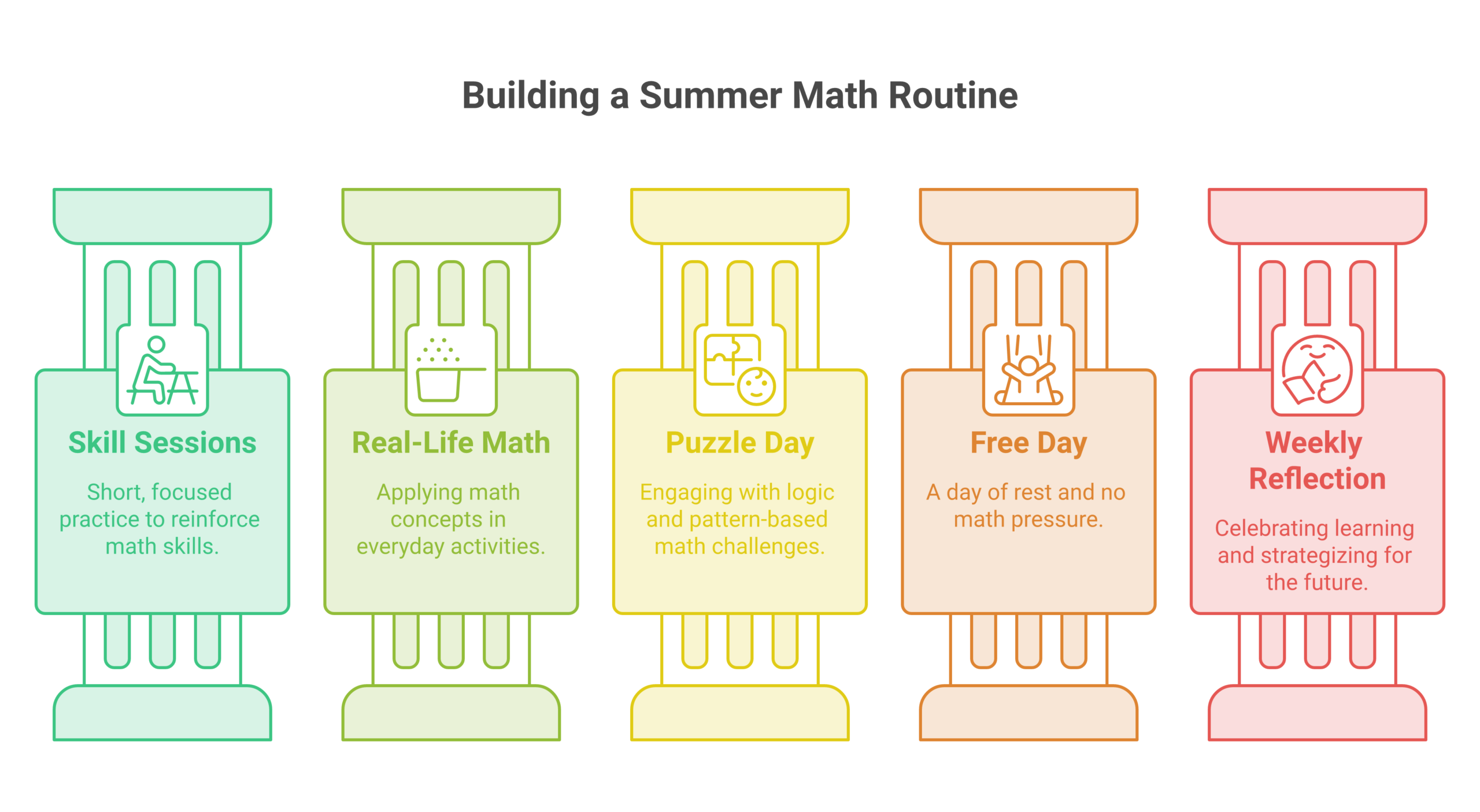
- ✓ 3 days of 10-minute fact or worksheet practice
- ✓ 2 days of real-life math through cooking, shopping, or games
- ✓ 1 day for puzzles, logic, or Pythagoras-style challenges
- ✓ 1 fully free day with no math pressure
Turn Everyday Errands into Math Practice
Real life is the most underrated math workbook. At the grocery store, ask your child to compare prices, estimate the total, round numbers, or calculate change. For younger children, count apples, sort items by shape, or hunt for numbers on labels. For older children, build a tiny budget: “We have €15 for snacks. What combination works?” These moments strengthen number sense without announcing a lesson.
Cooking is another summer gift. Recipes naturally create fractions, multiplication, division, measurement, time, and estimation. Ask, “If we double this recipe, what happens to 3/4 cup?” or “The muffins bake for 18 minutes and went in at 16:20. When do we check them?” The NAEYC emphasizes that children notice mathematics in everyday routines, and summer gives parents hundreds of low-stakes chances to point it out.
If your child likes movement, use sports. Track basketball shots, calculate batting averages, measure long jumps, compare swim lap times, or graph daily steps. You can even connect this with existing MathSpark posts on math and sports and math at the grocery store for more examples.
💡 Pro Tip
Use the phrase “I wonder” instead of “What is the answer?” “I wonder which beach snack is the best value” feels like curiosity. “Calculate the unit price” feels like homework wearing sunglasses.
Use Games to Keep Facts Fresh
Games protect fluency because children repeat facts many times without feeling drilled. A deck of cards can become addition war, multiplication war, place-value battle, or fraction comparison. Dice can become probability experiments, mental addition races, or build-a-number challenges. Board games build counting, planning, money sense, and strategic thinking. NCTM has long emphasized reasoning, communication, and problem solving as central parts of mathematics, and games naturally invite all three.
For a five-minute game, remove face cards, flip two cards, and ask your child to add, subtract, multiply, or compare them depending on grade level. For a challenge version, flip three cards and create the largest possible number, smallest possible number, or closest number to 100. This keeps the summer math slide away from basic facts and place value while still feeling like play.
Families who enjoyed earlier activities may also like math board games for family game night and math games for car rides, especially during travel days when formal practice is unrealistic.
Build a 15-Minute Summer Math Routine
A short routine gives children predictability, and predictability reduces negotiation. Try this structure: two minutes of warm-up facts, five minutes of a worksheet or app, five minutes of a puzzle or real-world problem, and three minutes for checking one mistake together. The point is not to finish a page. The point is to keep math language, attention, and confidence active.
Use official and respected free resources wisely. Khan Academy is useful for short explanations and independent practice. IXL offers targeted skill practice. Education.com has printable ideas. Coolmath Games can be motivating when used selectively. For parents who want custom Greek-curriculum practice without hunting through dozens of pages, MathSpark is the fastest route.
One warning: avoid turning the routine into a scoreboard. If a child gets eight out of ten correct, celebrate the thinking, then choose one mistake to examine. This mirrors the Pythagoras Exams spirit: the best learning comes from strategy, not speed alone.
📝 Important Note
June 2026 is a smart time to begin. If you wait until the final week before school, review feels like rescue. If you start now with tiny sessions, it feels like normal family rhythm.
Try Pythagoras-Style Problem Solving
The Greek Pythagoras competition approach is useful far beyond competition preparation because it teaches children to read carefully, test ideas, draw diagrams, and explain reasoning. Instead of ten nearly identical calculation problems, give one interesting problem and ask, “How could we start?” That single question builds metacognition.
A simple summer challenge: “A family buys 3 ice creams and 2 juices for €13. The ice creams cost €3 each. How much is each juice?” Younger children can draw pictures. Older children can write an equation. The same problem supports multiple representations, exactly the habit encouraged by OECD PISA style mathematical literacy and by modern classroom practice.
Keep a “strategy wall” on paper: draw a picture, make a table, try smaller numbers, work backwards, estimate first, check with the opposite operation. When your child is stuck, point to the wall instead of giving the answer. This turns struggle into a menu of choices.
Protect Confidence More Than Coverage
The summer math slide is partly about memory, but it is also about identity. Children who return to school thinking “I forgot everything” often avoid practice, rush through problems, or shut down when challenged. Your summer job is to protect the belief that math is learnable. Short success loops matter: “I tried, I noticed, I corrected, I improved.”
The American Psychological Association highlights motivation and supportive learning conditions as key ingredients in academic growth. In practical parent language: keep the emotional temperature low. Do not argue over every error. Do not compare siblings. Do not make math the price of screen time every single day. Make it a normal, small, shared habit.
If your child struggles, revisit foundational topics before pushing ahead. Place value, multiplication facts, fractions, and word-problem language are common summer weak spots. Related guides on place value, math facts fluency, and word problems can help you choose the right starting point.
A 10-Idea Menu for Busy Families
Here is the practical menu. Pick three ideas, not all ten. First, play card fact games after breakfast. Second, cook one recipe each week and talk through fractions. Third, ask your child to estimate grocery totals. Fourth, use a 10-minute worksheet twice a week. Fifth, graph the weather, steps, reading minutes, or swim laps. Sixth, create a travel budget for a day trip. Seventh, solve one puzzle on Sunday. Eighth, measure a room, balcony, or garden area. Ninth, use a trusted math app for short practice. Tenth, let your child teach you one strategy they remember from school.
This menu works because it mixes fluency, reasoning, measurement, data, and confidence. The RAND summer learning research suggests that well-designed summer learning can help, but families do not need a formal program to make progress. Consistency is the multiplier. A little math, often, in a calm tone, is enough to keep skills alive.
⚠️ Disclaimer
This article reflects general educational guidance for June 2026. Children with diagnosed learning differences, significant math anxiety, or persistent skill gaps may need individualized support from a qualified teacher, psychologist, or specialist.
Frequently Asked Questions
How much summer math practice does my child need?
For most children, 10–15 minutes on several days each week is enough to maintain skills. Children with major gaps may need more structured support, but short consistent practice still works better than occasional marathon sessions.
Should summer math be worksheets or games?
Use both. Games keep motivation high and facts fresh. Worksheets provide focused practice and a visible record of progress. The best routine combines playful review with a small amount of targeted written work.
What skills are most likely to fade over summer?
Math facts, computation steps, fractions, word-problem language, and multi-step attention often fade first because they depend on regular use.
What if my child refuses math in summer?
Lower the demand. Start with real-life math, card games, cooking, or one problem together. End before frustration peaks. Rebuild trust first, then add structured practice.
Is an app enough to prevent the summer math slide?
An app can help, but it should not be the whole plan. Children also need conversation, real-world problems, mistakes explained calmly, and occasional paper-and-pencil work.