Printable Summer Math Worksheets for Grades K–8
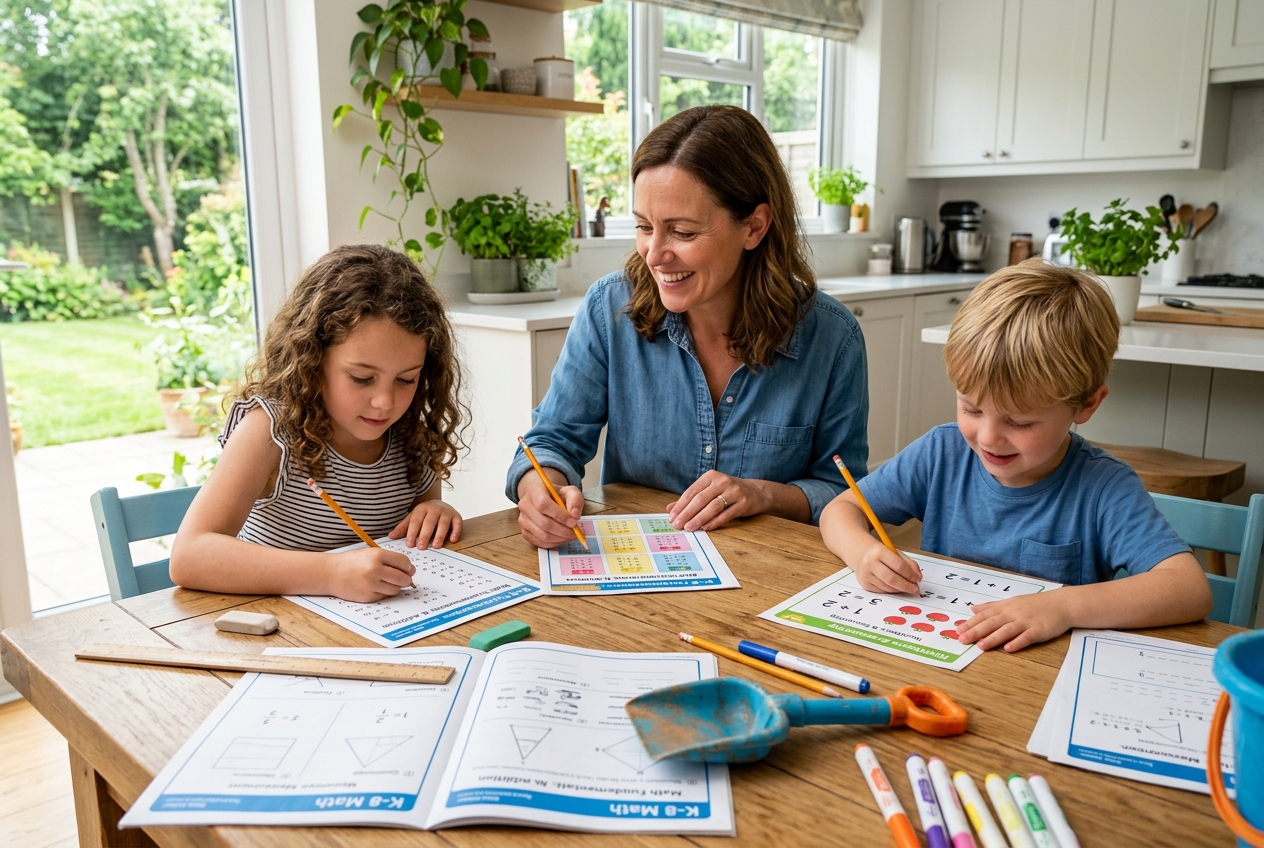
Printable summer math worksheets can be the difference between a calm September and a painful “I forgot everything” restart. The trick is not to bury children in pages. The trick is to use short, targeted practice that keeps facts, problem solving, fractions, measurement, and confidence alive while summer still feels like summer.
Research on summer learning is nuanced, but the direction is clear: math skills often fade when children stop using them. NWEA’s 2026 review reports that summer scores tend to flatten or drop, especially in math. A widely cited AERA summary found that many students lose ground across repeated summers, while Brookings notes that summer loss varies by child and context. So the parent goal is not panic. It is a practical rhythm: a little math, often, with feedback and encouragement.
📺 Video Guide
Printable Summer Math Worksheets Need a Purpose
A printable packet works best when every page has a job. Some pages build fluency. Some review a topic from spring. Some stretch reasoning with word problems. Some give children an easy win. If every page looks the same, motivation drops and mistakes repeat. The What Works Clearinghouse elementary math guide emphasizes systematic instruction, representations, mathematical language, and practice. Parents can borrow that logic without becoming teachers: choose one skill, show one example, give a few problems, check one mistake, then stop.
That is why MathSpark fits naturally into summer review. It creates AI-powered math worksheets for grades 1 to 9 in seconds, follows the Greek school curriculum, and supports Pythagoras-style reasoning. Instead of hunting through generic pages, you can create a worksheet for the exact skill your child needs today. Pair that with a simple folder or clipboard and you have a summer system that does not eat your vacation.
For grades K–2, the purpose is number sense: counting, comparing, addition, subtraction, shapes, and early measurement. For grades 3–5, the purpose expands to multiplication, division, place value, fractions, decimals, and word problems. For grades 6–8, the purpose shifts toward ratios, percentages, integers, expressions, equations, geometry, and data. A mixed packet is fine, but the sequence should feel intentional.
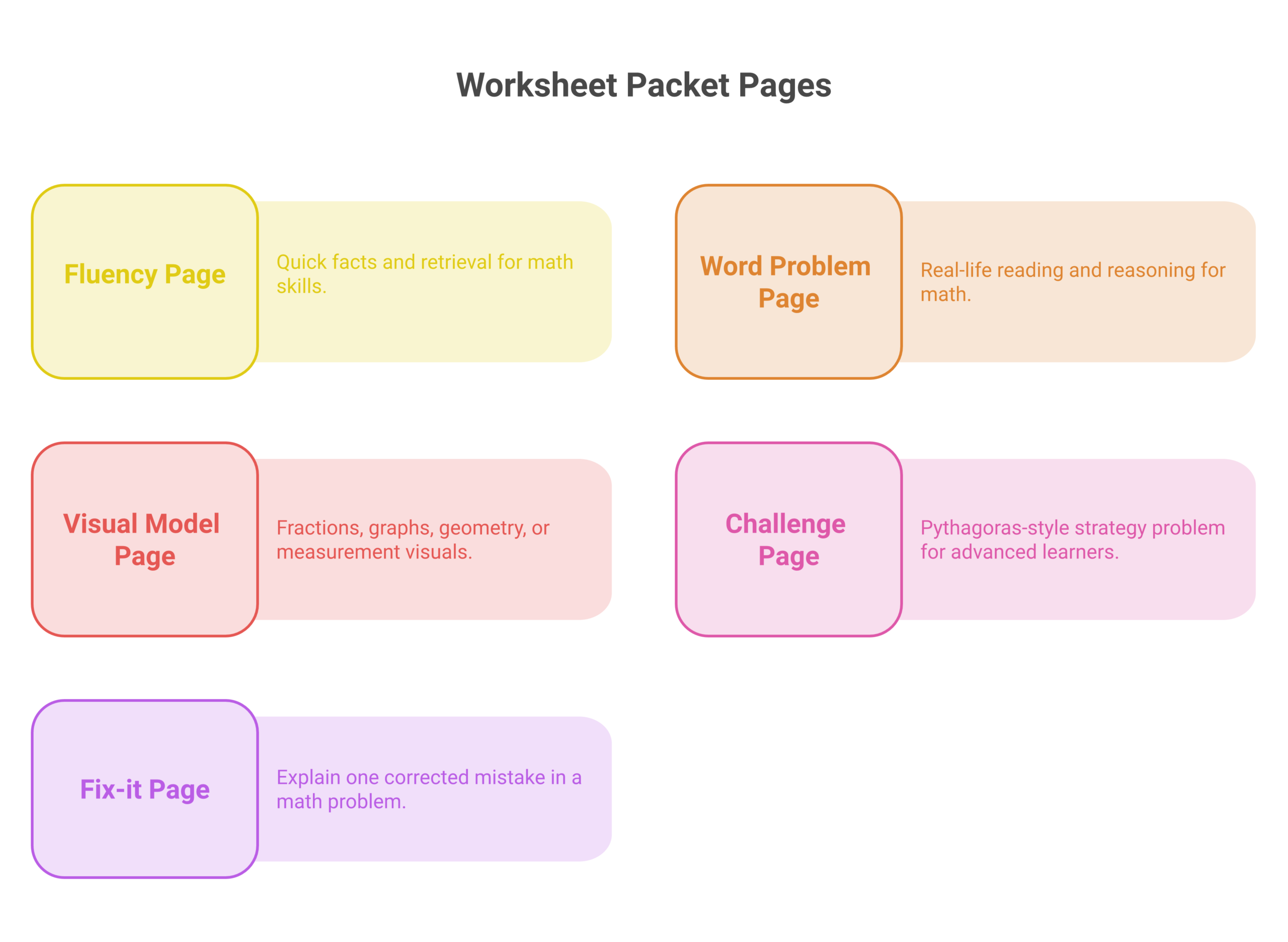
✓ What a Strong Summer Worksheet Packet Includes
- ✓ One page of fluency practice each week
- ✓ One real-life word problem set
- ✓ One visual topic such as fractions, graphs, or geometry
- ✓ One challenge problem for reasoning
- ✓ One correction page where the child explains a fixed mistake
A Grade-by-Grade Worksheet Map for K–8
Kindergarten and Grade 1 worksheets should stay visual and short. Use counting pictures, number tracing, ten frames, simple addition stories, shape hunts, and comparison language such as more, fewer, longer, shorter, before, and after. NAEYC family math guidance reminds parents that early math grows through everyday routines, so printable pages should connect to objects children can touch.
Grade 2 and Grade 3 worksheets can add two-digit addition and subtraction, arrays, skip counting, early multiplication, time, money, and picture-based word problems. Keep the writing load reasonable. A child should not fail a math worksheet because the instructions are too crowded. Use wide spacing, clear examples, and a predictable structure.
Grades 4 and 5 need review that mixes computation with meaning: multi-digit multiplication, division, equivalent fractions, adding and subtracting fractions, decimals, area, perimeter, and multi-step word problems. This is a key age for confidence. If summer work becomes a wall of calculations, children may rush. Include visual models, number lines, and “explain your strategy” prompts.
Grades 6–8 need fewer pages and deeper thinking. Use ratio tables, percentages, integer operations, coordinate planes, expressions, equations, geometry, probability, and data. Middle school students often resist babyish worksheets, so design pages that feel like puzzles, investigations, or real-world challenges. Connect to sports stats, travel budgets, recipes, shopping, gardening, and screen-time data.
💡 Pro Tip
For a mixed-age family, print one shared theme and change the math. Everyone can work on “beach day math”: a 6-year-old counts shells, a 9-year-old graphs colors, and a 13-year-old calculates percentages or ratios.
Use Worksheets in a 15-Minute Routine
A realistic routine beats an ambitious one. Start with two minutes of mental warm-up, then eight minutes on the worksheet, then three minutes checking, then two minutes choosing tomorrow’s topic. This structure mirrors the idea of guided practice from the older WWC response-to-intervention guide: model, practice, feedback, cumulative review. At home, that can be warm, simple, and quick.
If your family already follows a summer math routine, worksheets become one small tool rather than the whole plan. Monday might be facts. Tuesday might be cooking math. Wednesday might be one printable word-problem page. Thursday might be a game. Friday might be a challenge problem. That variety protects motivation.
Do not grade every page like a test. Choose one mistake and ask, “What was your plan here?” or “Where did the problem change direction?” If the child can explain the thinking, you have something to build on. If the child cannot, reduce the difficulty and model the first problem together. The purpose is retrieval and confidence, not proof that summer is still school.
📝 Important Note
For June 2026, start with review from the grade just completed. Preview next year only after your child has had several easy wins. Summer worksheets should rebuild confidence before they stretch.
Balance Printables with Real-Life Math
Worksheets are useful, but they should not be the only math children see. Stanford DREME shows how families can find meaningful math in normal routines like cooking, shopping, and play. Use the printable page to name the skill, then go find the skill in the real world. A measurement worksheet can lead to baking. A money worksheet can lead to grocery planning. A graphing worksheet can lead to tracking swim laps or daily temperature.
This also helps children understand why math matters. A fractions page feels abstract until your child cuts a sandwich into fourths. A percentage problem feels dry until it explains a sale price. A data table feels flat until it tracks a favorite football team. The National Council of Teachers of Mathematics emphasizes reasoning and problem solving, and real life gives those ideas oxygen.
Try connecting this post with existing MathSpark guides on math worksheets for kids, word problems, and how to prevent the summer math slide. The more children see the same skill in different settings, the less brittle their learning becomes.
How to Choose the Right Difficulty
The right worksheet should feel slightly easy at the start and slightly challenging by the end. If your child misses the first three problems, the page is not “rigorous.” It is misleveled. Start lower. A confident review page often does more good than a difficult page that creates another argument.
Use the 80 percent rule. If your child can solve about eight out of ten with reasonable effort, the level is right. If they solve everything instantly, add a challenge problem. If they miss half, return to a smaller skill. For example, before adding unlike fractions, review equivalent fractions. Before long division, review multiplication facts and place value. Before equations, review inverse operations.
Free resources can help when used selectively. Khan Academy gives explanations and practice by topic. Education.com math worksheets offers printable ideas. A video such as this Excel worksheet generator walkthrough can inspire parents who want custom pages. But curated beats endless. Pick the next useful page, not fifty possible pages.
Make Corrections Part of the Learning
Many children experience corrections as failure. Change the ritual. Use a “fix-it box” where the child chooses one problem to repair. Ask for a sentence: “I changed my answer because…” This builds mathematical language, and APA guidance on motivation supports the broader point that children learn better in supportive conditions.
For younger children, corrections can be oral. “Show me with blocks.” “Draw it another way.” “Can you count it again?” For older children, corrections should include reasoning: underline the question, mark known information, choose an operation, estimate first, solve, and check. This turns worksheets from answer sheets into thinking records.
Pythagoras-style practice fits beautifully here. Instead of racing through twenty examples, give one problem that asks for careful reading and strategy. The OECD PISA emphasis on mathematical literacy points in the same direction: students need to interpret, model, reason, and explain, not only compute.
A Simple Four-Week Summer Worksheet Plan
Week 1 should be easy review. Pick topics your child mostly knows: addition facts, multiplication facts, place value, simple fractions, or integer basics. Week 2 should mix fluency with word problems. Week 3 should add measurement, geometry, data, or ratios. Week 4 should revisit the hardest skill from the first three weeks and add one challenge page.
The RAND summer learning research suggests that structured summer learning can help when it is intentional and consistent. At home, intentional does not mean complicated. It means you know why today’s page exists. Write the weekly skill on the folder: “fractions,” “multiplication,” “percentages,” “word problems.” Children like knowing the target.
At the end of the month, keep three pages: one easy win, one corrected mistake, and one challenge problem. This tiny portfolio is more useful than a stack of unfinished printables. It shows progress, effort, and the skills that need another pass before September.
⚠️ Disclaimer
This article reflects general educational guidance for June 2026. Children with diagnosed learning differences, significant math anxiety, or persistent skill gaps may need individualized support from a qualified teacher, psychologist, or specialist.
Frequently Asked Questions
How many printable summer math worksheets should my child do each week?
For most children, two to four short worksheets per week is enough when combined with games and real-life math. Consistency matters more than volume.
Should I print one big summer packet?
A small packet is fine, but avoid handing over a huge stack. Children do better when parents choose the next page based on current needs.
What if the worksheet is too easy?
Use it as a confidence warm-up, then add one challenge problem. Easy review is valuable in summer because it rebuilds automaticity.
What if my child hates worksheets?
Start with games, cooking, shopping, or one problem together. Then use a tiny printable page as a follow-up, not the main event.
Are online worksheets as good as printed ones?
Both can work. Printed pages are useful for showing work, drawing models, and correcting mistakes. Online practice can add feedback and variety.