Summer Math: How to Prevent Learning Loss in Kids
Every parent has seen it happen. Your child finishes the school year confident with multiplication and long division, then September rolls around and they’re staring at their new textbook like it’s written in a foreign language. This isn’t a mystery or a fluke. Researchers call it summer learning loss, and it hits math harder than any other subject.
Studies from the Brookings Institution show that students lose an average of two to three months of math skills over summer break. That means your child could start the new school year behind where they left off. The good news? It’s entirely preventable with the right approach, and you don’t need to turn your kitchen into a classroom to make it work.
What exactly is summer learning loss?
Summer learning loss (sometimes called “the summer slide”) refers to the decline in academic skills that happens when kids go weeks without structured practice. Reading loss tends to vary by family. Some kids read all summer and come back stronger. Math is different. According to research published in the American Educational Research Journal, math loss is more universal because kids rarely practice computation or problem-solving outside of school.
Think about it this way: your child practices math five days a week for ten months. Then they stop cold for two or three months. Their brains don’t forget everything, but the fluency fades. A child who could rattle off 7 x 8 = 56 in May might hesitate or guess in September. The concepts are still in there somewhere, but the recall speed and confidence take a real hit.
The National Center for Education Statistics has tracked this pattern across decades. And the effect compounds. A child who loses ground every summer and then spends the first six weeks of school reviewing old material falls further behind each year. By middle school, the gap between students who practiced over summer and those who didn’t can be significant.
Why math gets hit the hardest
Reading is everywhere. Kids see words on signs, menus, text messages, video game instructions. Even reluctant readers absorb written language throughout the summer. Math doesn’t work the same way. Unless a child is actively solving problems, measuring ingredients, or counting money, their computational skills sit idle.
There’s also a confidence factor. Many children already feel shaky about math, and a long break reinforces the idea that math is something that only happens in school. When they return and struggle with material they previously understood, it can feel like proof that they’re “just not a math person.” This is where the real damage happens, because that belief sticks around far longer than any gap in fractions knowledge.
Research from the RAND Corporation also points out that summer learning loss disproportionately affects lower-income families, who may have less access to enrichment programs, tutoring, or educational materials during the break.
✓ What the research says
- ✓ Students lose 2-3 months of math skills over summer on average
- ✓ Math loss is more consistent across demographics than reading loss
- ✓ The effect is cumulative and widens achievement gaps over time
- ✓ Even 15-20 minutes of daily practice can prevent most of the slide
Daily practice without the daily battle
Here’s the part where most advice articles tell you to “make a schedule and stick to it.” That’s technically correct and practically useless for families who are also trying to enjoy their summer. Instead, think about building math into routines your family already has.
The target is 15 to 20 minutes a day. That’s it. Not an hour. Not a formal lesson at the dining table. Just enough consistent practice to keep those neural pathways active. The National Council of Teachers of Mathematics recommends short, frequent sessions over longer sporadic ones, especially for younger children whose attention spans have natural limits.
One approach that works well is pairing math with something your child already looks forward to. If they play on the iPad after lunch, the worksheet comes first. Not as punishment, but as a quick warm-up. When the association is “do a few math problems, then enjoy your screen time,” resistance tends to drop off within a week or two.
Tools like MathSpark make this particularly easy, because you can generate a grade-appropriate worksheet in about 10 seconds. No searching Pinterest for printables, no wondering whether the difficulty level matches your child’s grade. Just pick the topic, print or open on a tablet, and let them work through it. The worksheets follow the Pythagoras Exams methodology, so they’re aligned with the Greek curriculum but also useful for anyone who wants structured math practice.
Turn everyday moments into math practice
The best summer math doesn’t feel like school. It feels like life. And honestly, once you start noticing opportunities, they’re everywhere.
At the grocery store: Ask your child to estimate the total cost of items in the cart. Can they figure out how much change you’ll get from a 20 euro note? For older kids, introduce percentages: “This yogurt is 15% off. What’s the actual price?” This is real math in a real context, and it’s the kind of practice that sticks.
Cooking together: Recipes are full of fractions. Doubling a recipe, halving it, converting between units. If you’re making a cake and need 3/4 cup of sugar but want to double the batch, your child has to work with fractions whether they realize it or not. The American Academy of Pediatrics has noted that hands-on activities like cooking support mathematical thinking in younger children.
Road trips: “How many kilometers until we get there? If we’re going 90 km/h, how long will it take?” For younger kids, simpler versions work: “Count all the red cars in the next five minutes.” Even license plate math (add the digits together, find the biggest number) turns downtime into mental math practice.
Board games and card games: Games like Monopoly, Yahtzee, and card games involving scoring naturally exercise arithmetic skills. Even Uno involves pattern recognition and strategic thinking. A weekly family game night does more for math retention than you might expect.
💡 Quick tip
Keep a small whiteboard or notebook in the kitchen. Write a “math question of the day” each morning. It could be as simple as “What’s 56 ÷ 7?” or as open-ended as “How many minutes until dinner?” Your child can answer whenever they walk by. Low pressure, consistent exposure.
Structured worksheets and online resources
Everyday math is great for maintaining general number sense, but some skills need structured repetition. Long division, multi-digit multiplication, fraction operations: these are procedural skills that fade without practice. That’s where worksheets and apps fill the gap.
A few well-regarded options for summer math practice:
Khan Academy offers free, structured math courses organized by grade level. Their summer review tools let you set a pace and track progress. It’s thorough and well-designed, though some kids find the video-heavy format less engaging for independent work.
IXL Math provides adaptive practice that adjusts difficulty based on your child’s performance. The immediate feedback loop is helpful, but it does require a subscription.
For families in Greece or anyone following the Greek curriculum, MathSpark generates AI-powered worksheets tailored to specific grade levels and topics. You can create a worksheet on fractions for a 4th grader or word problems for a 6th grader in seconds. It’s free for basic use and especially handy for parents who want targeted practice without spending time searching for the right difficulty level.
Prodigy Math wraps math practice in a game format that appeals to younger kids (grades 1-8). The gamification keeps engagement high, though the free version includes ads and promotional elements.
Setting up a summer math plan that actually works
The mistake most parents make is going in with too much ambition. “We’ll do math every day for 45 minutes!” sounds great in June and falls apart by the second week of July. Start small. Here’s what a realistic summer math plan looks like:
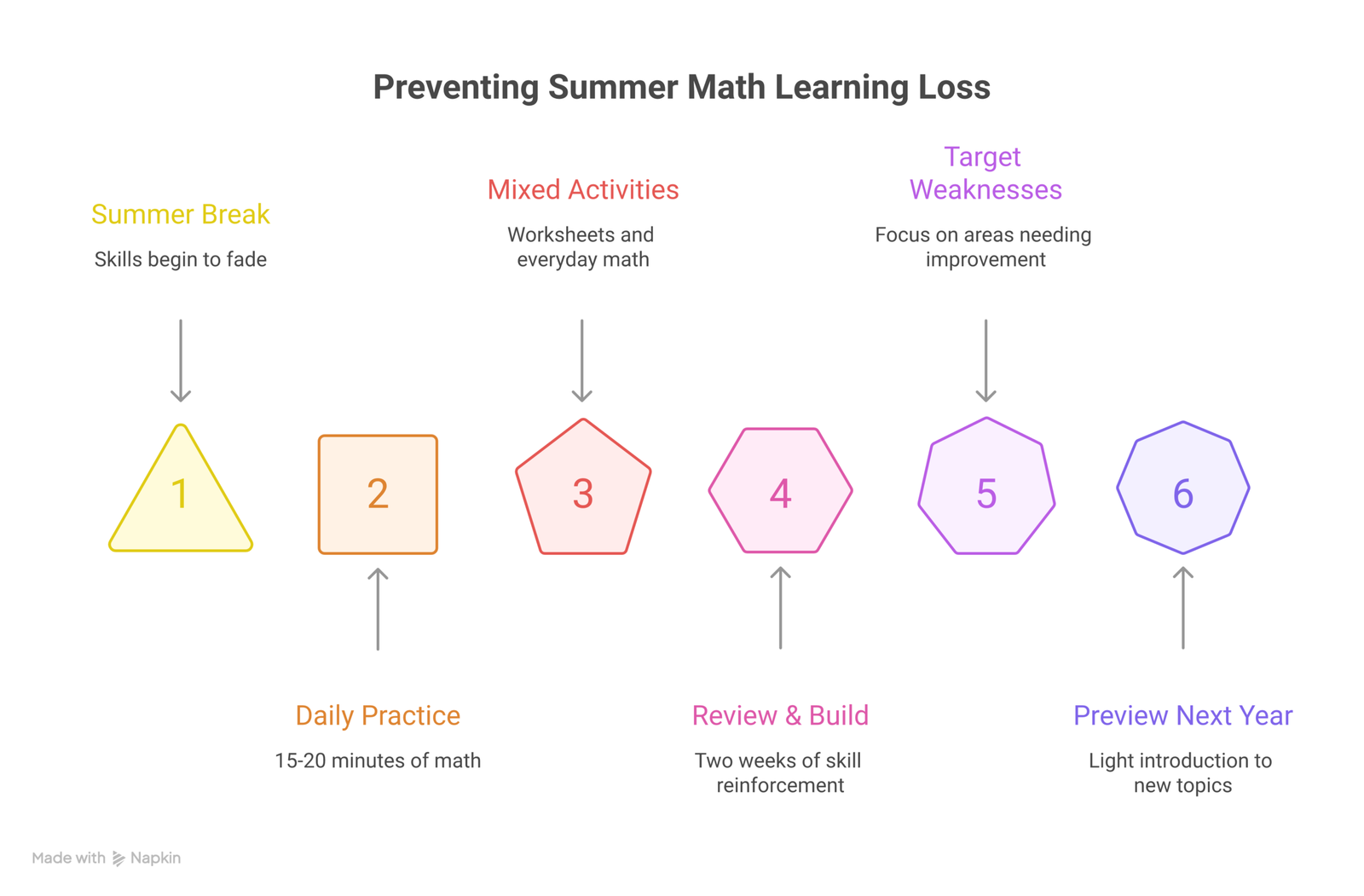
Week 1-2: Warm-up. Focus on review. Go back to topics from earlier in the school year that your child felt comfortable with. The goal isn’t to push forward; it’s to rebuild confidence and establish the routine. Fifteen minutes a day, four or five days a week. Weekends off.
Week 3-6: Targeted practice. Identify the two or three areas where your child struggled most during the school year. Was it fractions? Word problems? Multi-step operations? Spend these weeks cycling through those weak spots. Use worksheets, apps, or workbooks that focus specifically on these areas.
Week 7-8: Preview. If you can get a sense of what next year’s curriculum will cover, spend the last couple of weeks doing light introductory work. Don’t try to teach new concepts from scratch. Just expose your child to what’s coming so it feels familiar when school starts. This reduces first-week anxiety more than you’d think.
Throughout the summer, mix formal practice with everyday math. Monday might be a worksheet on division; Tuesday might be calculating the tip at a restaurant. Variety prevents boredom and reinforces that math isn’t just a school subject.
📝 Important
Talk to your child’s teacher before summer starts. Ask which specific skills they should maintain or improve. Most teachers will tell you exactly where your child needs practice, and that information is worth more than any generic summer workbook.
What to do if your child resists
“It’s summer! I don’t want to do school stuff!” You’ll hear this. Expect it. Here’s how to handle it without turning every morning into a negotiation.
First, reframe the conversation. You’re not doing school. You’re keeping your brain in shape, the same way athletes train in the off-season. A soccer player doesn’t stop running all summer. A math student shouldn’t stop thinking about numbers. This analogy works surprisingly well with sporty kids.
Second, give choices. “Do you want to do your worksheet before breakfast or after?” is better than “It’s time for math.” The research on self-determination theory from the University of Rochester backs this up: kids engage more when they feel some control over the process.
Third, keep it short. If your child dreads a 30-minute session, cut it to 10. Ten focused minutes beats 30 minutes of tears and frustration. You can always increase gradually once the habit is established.
And finally, celebrate effort, not perfection. “You stuck with that problem even when it was tricky” is more motivating than “You got 9 out of 10.” Research from Stanford University on growth mindset in mathematics shows that praising persistence leads to better long-term outcomes than praising talent or results.
Summer math programs and camps
If your child needs more structure than home practice can provide, summer math programs are worth exploring. Many schools, community centers, and private organizations offer targeted summer courses.
In Greece, several frontistiria (private tutoring centers) run summer review courses. These tend to be short (2-4 weeks) and focused on specific skills. The Greek Ministry of Education website sometimes lists approved programs, though availability varies by region.
Online options have expanded significantly. Canada/USA Mathcamp is well-known for gifted students, but there are programs at every level. Local libraries in the US often run free summer math challenges through the American Library Association summer learning initiative.
For most families, though, a combination of home practice and digital tools will be more than enough. The goal isn’t to turn summer into an intensive math boot camp. It’s to prevent the slide so your child starts the new year ready to move forward instead of playing catch-up.
Tracking progress without adding pressure
You don’t need formal assessments over the summer. A simple approach works better: keep a folder or binder of completed worksheets. At the end of summer, flip through them with your child. The visual evidence of progress is surprisingly motivating, even for kids who say they hate math.
Some parents use a sticker chart or a simple tracker on the fridge. Each day of practice gets a mark. After 20 days (not necessarily consecutive), there’s a small reward. This works especially well for ages 5-9. Older kids might prefer tracking their progress in an app or earning extra screen time.
If you want a more data-driven approach, tools like MathSpark let you generate worksheets at increasing difficulty levels. If your child breezes through grade-level problems, bump up the challenge. If they’re struggling, step back to a lower level. This self-pacing approach keeps frustration low and progress visible.
⚠️ Disclaimer
The information in this article is for general educational guidance as of March 2026. Every child learns differently, and what works for one family may not work for another. If your child has a diagnosed learning disability or significant math anxiety, consult with their teacher or an educational specialist for personalized recommendations.
Frequently Asked Questions
How much math should my child do each day during summer?
Fifteen to twenty minutes is the sweet spot for most kids. This is enough to maintain skills without causing burnout. For younger children (ages 5-7), even ten minutes of focused practice can be effective. The consistency matters more than the duration.
At what age does summer math loss become a real problem?
Research shows the slide starts as early as first grade, but the effects become more pronounced around third or fourth grade when math concepts build more heavily on previous skills. Fractions, long division, and multi-step word problems are especially vulnerable to summer forgetting.
Are math apps as effective as worksheets?
Both have their place. Apps offer immediate feedback and gamification that keeps some kids engaged. Worksheets develop pencil-and-paper skills that children still need for school tests and exams. A mix of both is usually the best approach. Use apps three days a week and worksheets two days, or alternate based on your child’s mood.
What if my child is ahead in math? Do they still need summer practice?
Yes, though the focus shifts. Advanced students benefit from enrichment rather than review. Introduce puzzle-based math, logic games, or topics they haven’t encountered yet. The goal is to keep their interest alive and challenge them without repeating material they’ve already mastered.
How do I know if my child has experienced summer learning loss?
Common signs include struggling with problems they handled confidently before summer, taking significantly longer to complete homework in the first weeks of school, or expressing frustration with material that “used to be easy.” If your child’s teacher mentions they’re behind at the start of the year, summer learning loss is likely a factor.