Summer Math: How to Prevent Learning Loss in Kids
Every summer, kids lose roughly two months of math skills. Researchers call it the “summer slide,” and it hits math harder than reading. The good news? It doesn’t take hours of daily drilling to keep your child’s math skills sharp over the break. A few minutes of focused practice each day, mixed with real-world activities, can make all the difference when school starts again.
If you’ve ever noticed your child struggling in September with concepts they nailed in June, you’re not imagining things. Research from the National Center for Education Statistics confirms that summer math learning loss is a measurable, widespread problem, especially for kids in elementary and middle school. This guide breaks down why it happens and what you can actually do about it.
What is summer learning loss and why does it matter?
Summer learning loss refers to the decline in academic skills that happens when kids are out of school for extended periods. While reading loss varies depending on whether kids pick up books over the summer, math loss is more consistent across the board. A RAND Corporation review found that students can lose between one and three months of math learning during summer break.
The reason math takes a bigger hit is straightforward: most kids don’t encounter math problems in their daily summer routine. They might read signs, menus, or comic books without thinking about it. But unless someone puts a fraction or a multiplication problem in front of them, those skills sit unused. And unused skills fade.
What makes this worse is the cumulative effect. According to Brookings Institution research, the learning loss compounds year over year. A child who loses two months every summer is potentially a full grade level behind their peers by the time they reach middle school. That gap becomes harder to close as the content gets more complex.
✓ Key facts about summer math loss
- ✓ Students lose an average of 2.6 months of grade-level math skills each summer
- ✓ Math loss is more universal than reading loss across income levels
- ✓ The effect is cumulative and grows each year without intervention
- ✓ Just 15-20 minutes of daily practice can significantly reduce the slide
Why math is more vulnerable than other subjects
Reading is embedded in everyday life. Street signs, text messages, YouTube captions, the back of a cereal box. Kids practice reading whether they intend to or not. Math doesn’t work like that. Unless a child is actively counting change, measuring ingredients, or solving a problem, their math brain is essentially on standby.
There’s also the sequential nature of math to consider. Each concept builds on the previous one. If a child gets rusty on multiplication facts over the summer, they’ll struggle with division when school resumes. If fractions get fuzzy, decimals and percentages become a wall. The National Council of Teachers of Mathematics has consistently highlighted how gaps in foundational skills cascade into larger problems in later grades.
Another factor: math anxiety. Kids who already feel shaky about math tend to avoid it over the summer, which widens the gap further. By September, the anxiety is worse because they sense they’ve fallen behind. It becomes a cycle that’s tough to break without deliberate intervention from parents.
Practical strategies that actually work
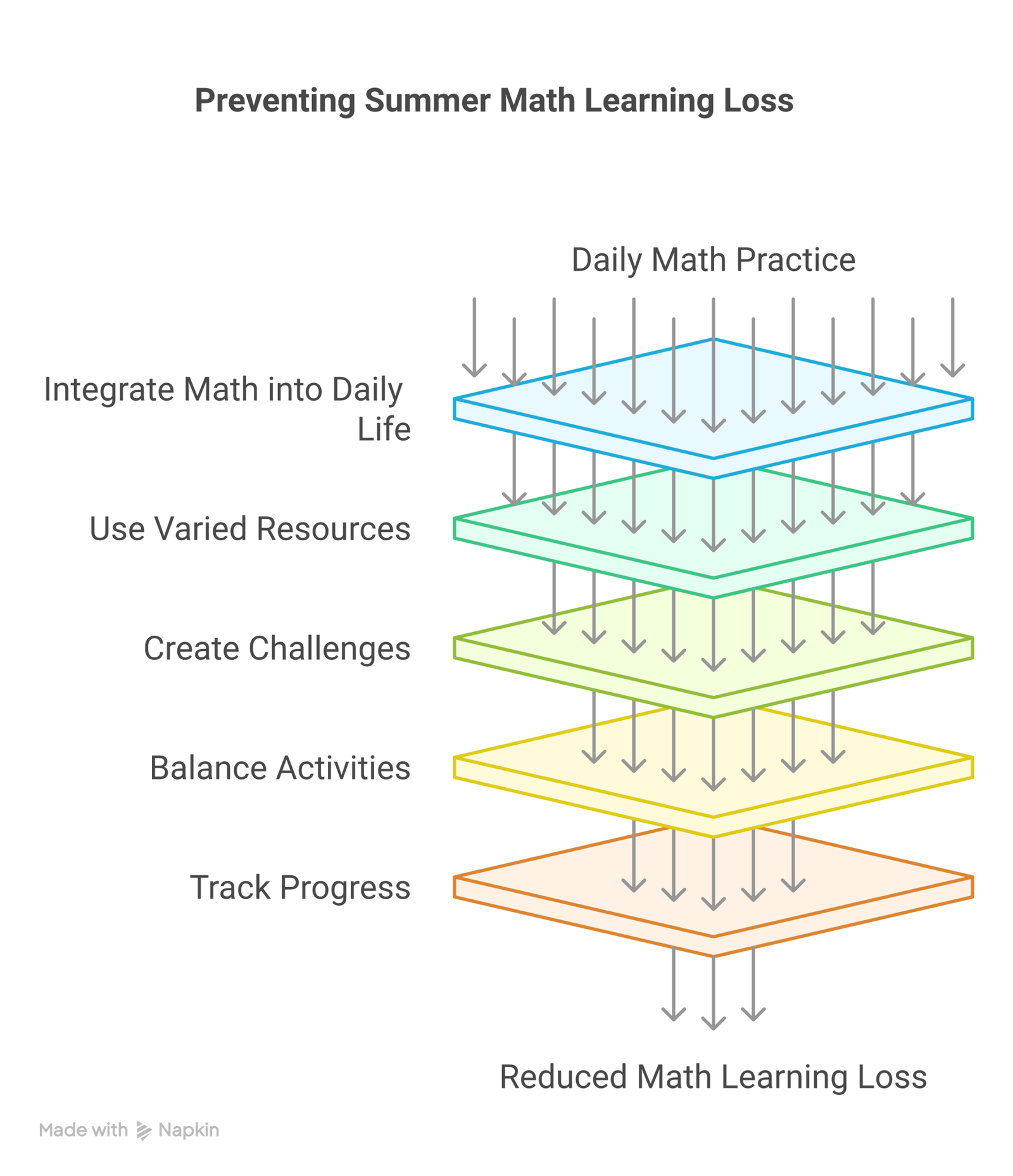
The goal isn’t to recreate school at home. That backfires quickly, especially in summer when kids want to be outside and having fun. The trick is finding ways to weave math into activities they already enjoy, supplemented by short, focused practice sessions.
1. Set a short daily routine
Pick a consistent time each day for 15-20 minutes of math practice. Morning works well because kids are fresh and it gets done before the day’s distractions take over. Use grade-appropriate worksheets that review concepts from the past school year. The Khan Academy offers free, structured practice by grade level. For worksheets specifically, MathSpark generates AI-powered math worksheets in about 10 seconds, tailored to your child’s grade level (1-9) and aligned with curriculum standards. It’s a fast way to get fresh practice material without searching through dozens of sites.
2. Make math part of everyday life
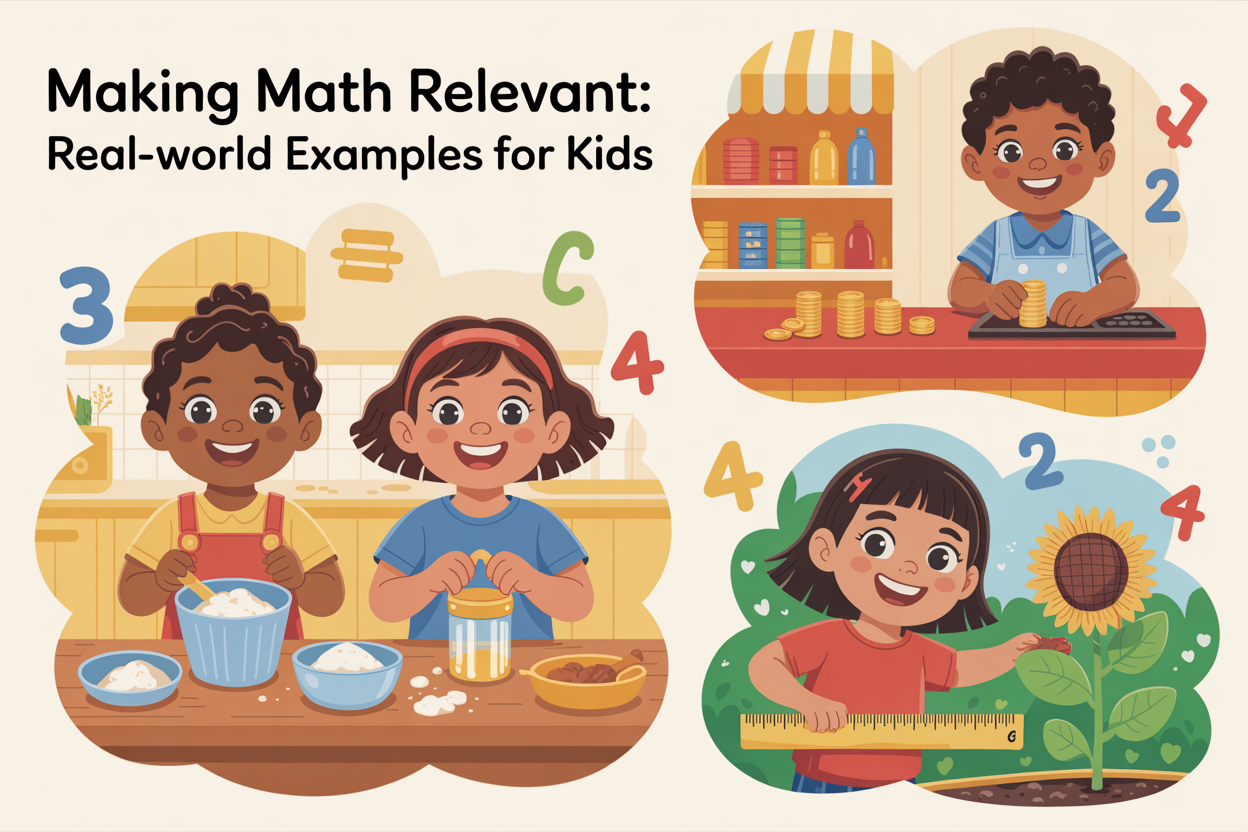
Cooking is one of the best stealth math activities. Doubling a recipe? That’s fractions. Measuring ingredients? Units and conversions. Figuring out cooking time? Elapsed time practice. Let your kids handle the measuring cups and do the calculations themselves.
Shopping works too. Give your child a budget at the store and let them add up prices, calculate discounts, or compare unit prices. A study from the American Psychological Association found that connecting math to real-world contexts significantly improves retention and reduces anxiety.
3. Use games, not just drills
Board games like Monopoly, Yahtzee, and even card games involve constant mental math. Dice games are particularly good for younger kids working on addition and multiplication. For digital options, apps like Prodigy Math turn practice into an adventure game that keeps kids engaged longer than a worksheet might.
4. Try a summer math challenge
Set up a goal chart where your child earns stickers or points for completing daily math activities. After hitting milestones (say, 20 days straight), they get a reward. The Education.com summer learning program offers structured challenges you can use as a template. The key is making it feel like an achievement rather than a chore.
💡 Pro tip
Mix up the format. If your child did worksheets on Monday, try a cooking activity on Tuesday and a board game on Wednesday. Variety keeps things interesting and exercises different math muscles. Even a 10-minute car ride game (“I’m thinking of a number…”) counts.
Age-specific approaches that keep kids engaged
Ages 5-7 (Grades K-2)
At this age, everything should feel like play. Count objects at the park. Sort seashells by size at the beach. Use sidewalk chalk to draw number lines and hop along them. Practice skip counting during walks. The NRICH project from the University of Cambridge has hundreds of free activities designed for this age group that require minimal prep.
Ages 8-10 (Grades 3-5)
This is the critical window where multiplication, division, and fractions need to stay sharp. Flashcard apps, timed challenges, and math puzzles work well. Let your child be the “family calculator” when you’re out. How much does this meal cost? What’s a 15% tip? If we drive 60 miles per hour, how long until we arrive? These real situations make abstract concepts concrete.
Ages 11-14 (Grades 6-9)
Older kids can handle more independence. Set up a weekly math journal where they solve one interesting problem per day. Art of Problem Solving offers engaging challenges that go beyond textbook math. You can also involve them in household budgeting, planning a trip itinerary with cost calculations, or even tracking sports statistics.
The role of worksheets and structured practice
Real-world math activities are great, but they shouldn’t replace structured practice entirely. Worksheets give kids focused repetition on specific skills, and that repetition is what builds fluency. The key is choosing the right level. Too easy and they’re bored. Too hard and they’re frustrated.
A good approach is to review the last unit or two from the previous school year, then gradually work through topics that will come up next year. MathSpark is particularly useful here because you can generate worksheets matched to your child’s grade and specific topic. Need 10 problems on fraction addition for a 4th grader? Done in seconds. Need mixed operations for a 6th grader? Same thing. It takes the guesswork out of finding the right practice material.
The Massachusetts Department of Education recommends a balanced approach: structured practice three days a week, real-world application activities two days, and weekends off. This prevents burnout while maintaining skill levels.
📝 Important note
Don’t turn summer math into a punishment or a battle. If your child resists, scale back to 10 minutes and make it a game. The goal is maintaining a connection to math, not creating negative associations that make September harder.
How to track progress without stressing anyone out
You don’t need formal assessments. A simple weekly check-in works fine. Pick five problems from different topics your child covered during the school year. If they solve them confidently, you’re on track. If they stumble, you know where to focus the next week’s practice.
Some parents find it helpful to keep a math log. Just a notebook where you jot down what your child practiced each day and any topics that need more attention. By the end of summer, you’ll have a clear picture of their strengths and weak spots to share with their new teacher in September.
Research published in the Journal of Political Economy shows that parental involvement is the single strongest predictor of whether a child maintains academic skills over summer break. You don’t need to be a math expert. You just need to be present and consistent.
Summer math programs worth considering
If you prefer a more organized approach, several programs are designed specifically to combat summer learning loss. Khan Academy has a free summer math program with daily assignments by grade level. XtraMath focuses specifically on math fact fluency and sends weekly progress reports to parents.
For kids who are more competitive, MATHCOUNTS offers summer problem sets that prepare students for math competitions. And local libraries often run free summer learning programs that include math components. Check with your library in May or June before programs fill up.
The bottom line: there’s no single “right” way to prevent summer math loss. What works is consistency. Fifteen minutes a day, every day, using whatever combination of activities keeps your child engaged. The effort you put in during June, July, and August pays off directly in September when your child walks into class ready to learn new material instead of spending weeks re-learning old material.
⚠️ Disclaimer
This article is for informational purposes and reflects general educational guidance as of March 2026. Every child learns differently, and specific learning concerns should be discussed with your child’s teacher or a qualified education specialist.
Frequently asked questions
How much math should my child do each day during summer?
Aim for 15-20 minutes of focused math practice daily. This is enough to maintain skills without causing burnout. For younger children (K-2), 10 minutes may be sufficient. The key is consistency rather than duration.
At what age does summer math loss start?
Research shows summer learning loss can begin as early as first grade, though it becomes more pronounced from third grade onward when math concepts build more heavily on prior knowledge. The effect is cumulative, so early prevention is worthwhile.
Can math apps replace worksheets for summer practice?
Apps and worksheets each have strengths. Apps provide instant feedback and gamification that keeps kids engaged. Worksheets build pencil-and-paper problem-solving skills that kids need in school. A mix of both is the most effective approach.
What if my child refuses to do math over the summer?
Start with activities that don’t feel like “school math.” Cooking, shopping, building projects, and board games all involve math without the worksheet stigma. Once your child warms up to math in these contexts, gradually introduce short structured practice sessions.
Is summer learning loss the same for all kids?
No. While math loss affects most students regardless of background, the degree varies. Children who have access to books, educational activities, and engaged parents tend to lose less. Kids in lower-income households often face larger gaps because of fewer enrichment opportunities during summer months.