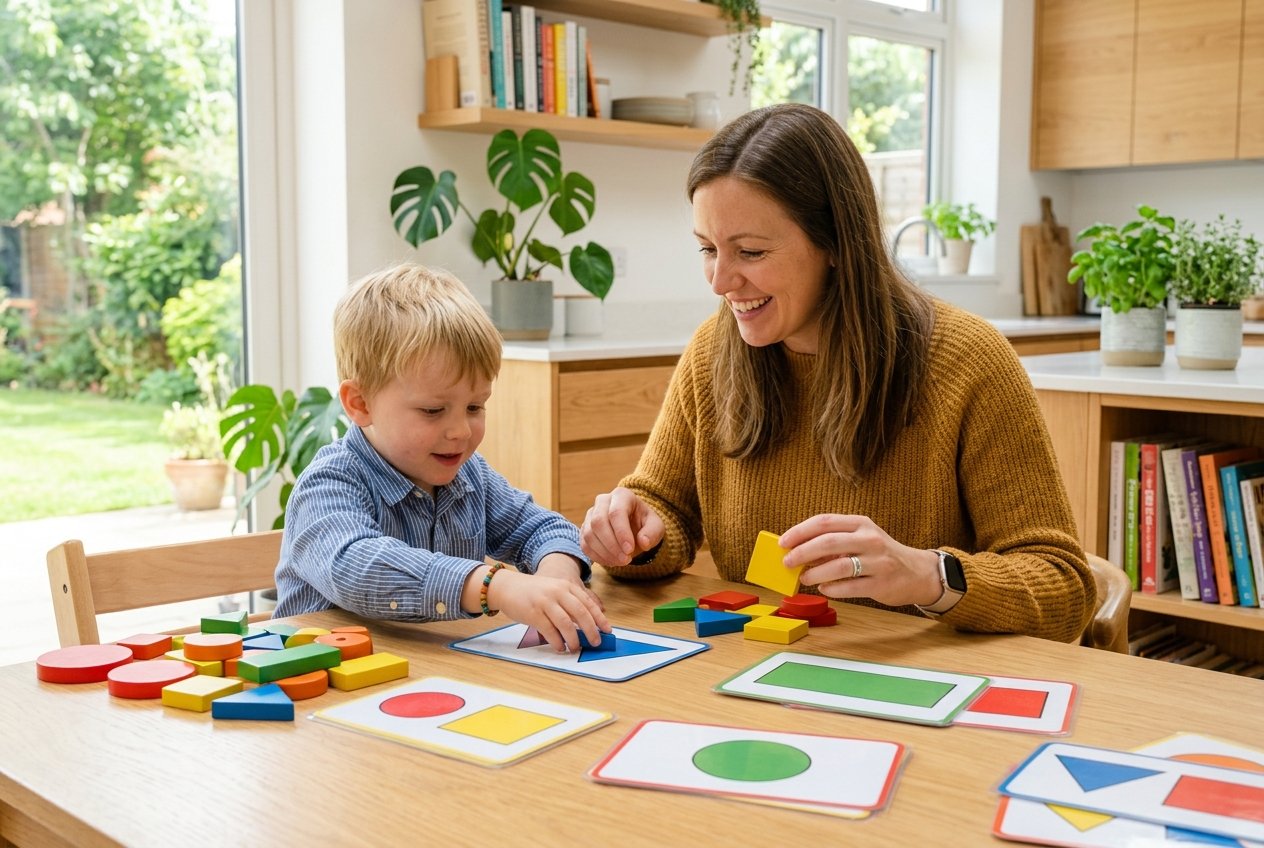
Summer Math Scavenger Hunts for Kids Ages 5-14
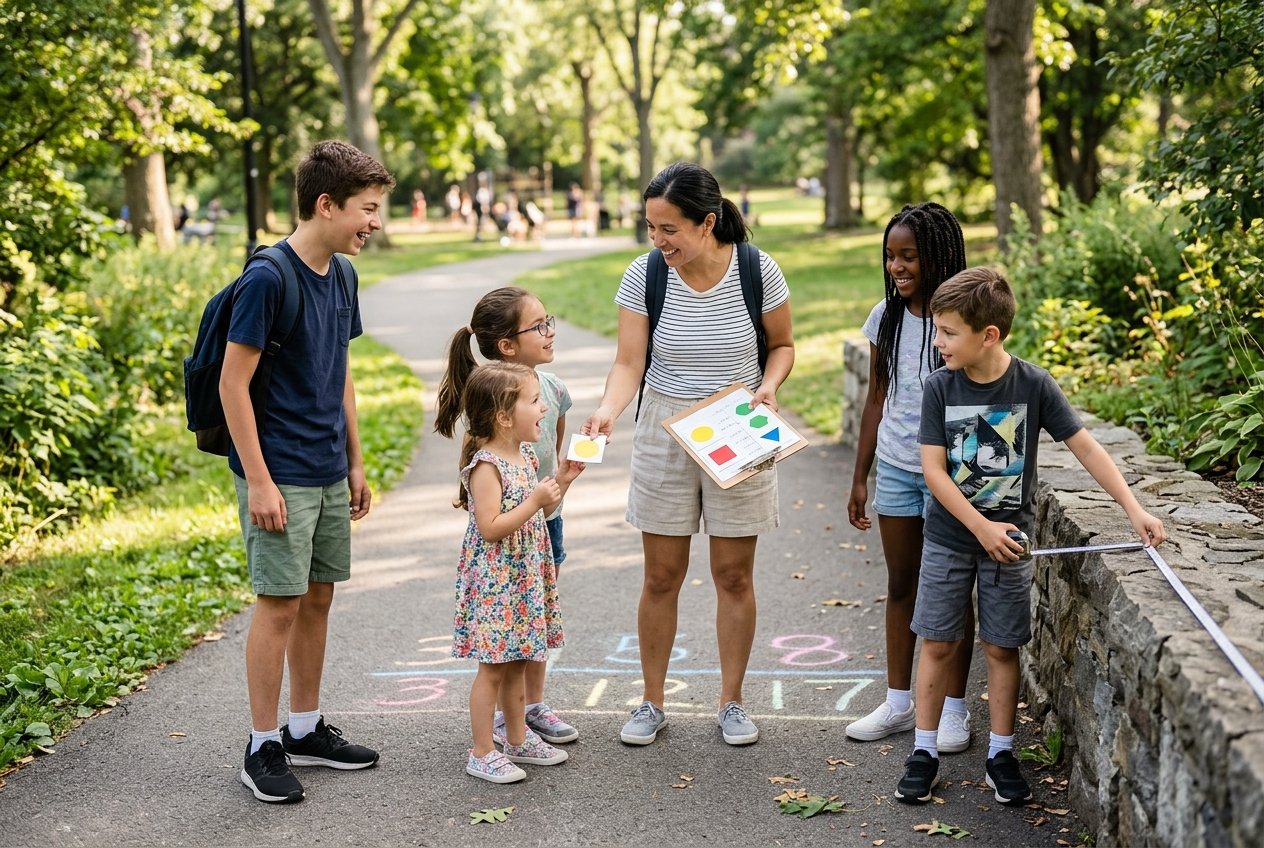
Summer math scavenger hunts are one of the easiest ways to keep children ages 5–14 thinking mathematically without turning vacation into a second school day. Instead of asking a tired child to sit with a worksheet at the kitchen table, you send them to find patterns on a beach towel, estimate the height of a tree, compare prices at the mini market, or photograph three examples of symmetry. That shift matters because math becomes something children notice, touch, explain, and laugh about. If you want a printable follow-up after the hunt, tools like MathSpark can turn the same skill into a quick worksheet in seconds, so the active game and the written practice reinforce each other.
The idea is simple: choose a math lens, give children a short hunt list, ask them to collect evidence, then discuss what they found. A five-year-old might count shells and sort them by size. A nine-year-old might measure shadows and compare lengths. A fourteen-year-old might estimate ratios, calculate percentages, or design a scoring system. The goal is not to make every moment educational. The goal is to keep math alive in normal family life, especially during summer when research reviews consistently find that math skills are vulnerable to seasonal regression. A hunt gives practice without the groan.
📺 Video Guide
Why Summer Math Scavenger Hunts Work
Good scavenger hunts line up surprisingly well with respected math-learning frameworks. The NCTM process standards emphasize problem solving, reasoning, communication, connections, and representation. A child hunting for right angles around the house is not just naming shapes; he is connecting geometry to a doorframe, representing his idea with a photo or sketch, and explaining why the corner qualifies. The Common Core Standards for Mathematical Practice make the same point in parent-friendly language: children should make sense of problems, model with mathematics, and choose tools strategically.
That is exactly what happens when a child decides whether a ruler, string, step count, or phone timer is the best tool for a challenge. It also explains why scavenger hunts feel less stressful than formal drills. They start with curiosity. Children move first, observe second, calculate third, and only then write something down. For reluctant learners, that order can be the difference between resistance and participation. For confident learners, it creates room for challenge because every item can be extended with a deeper question.
✓ Key Benefits
- ✓ Turns math into movement, observation, and conversation
- ✓ Works for mixed-age siblings without separate lesson plans
- ✓ Builds number sense, measurement, geometry, estimation, and reasoning
- ✓ Creates natural evidence for later worksheets or journal prompts
The Six-Step Scavenger Hunt Blueprint
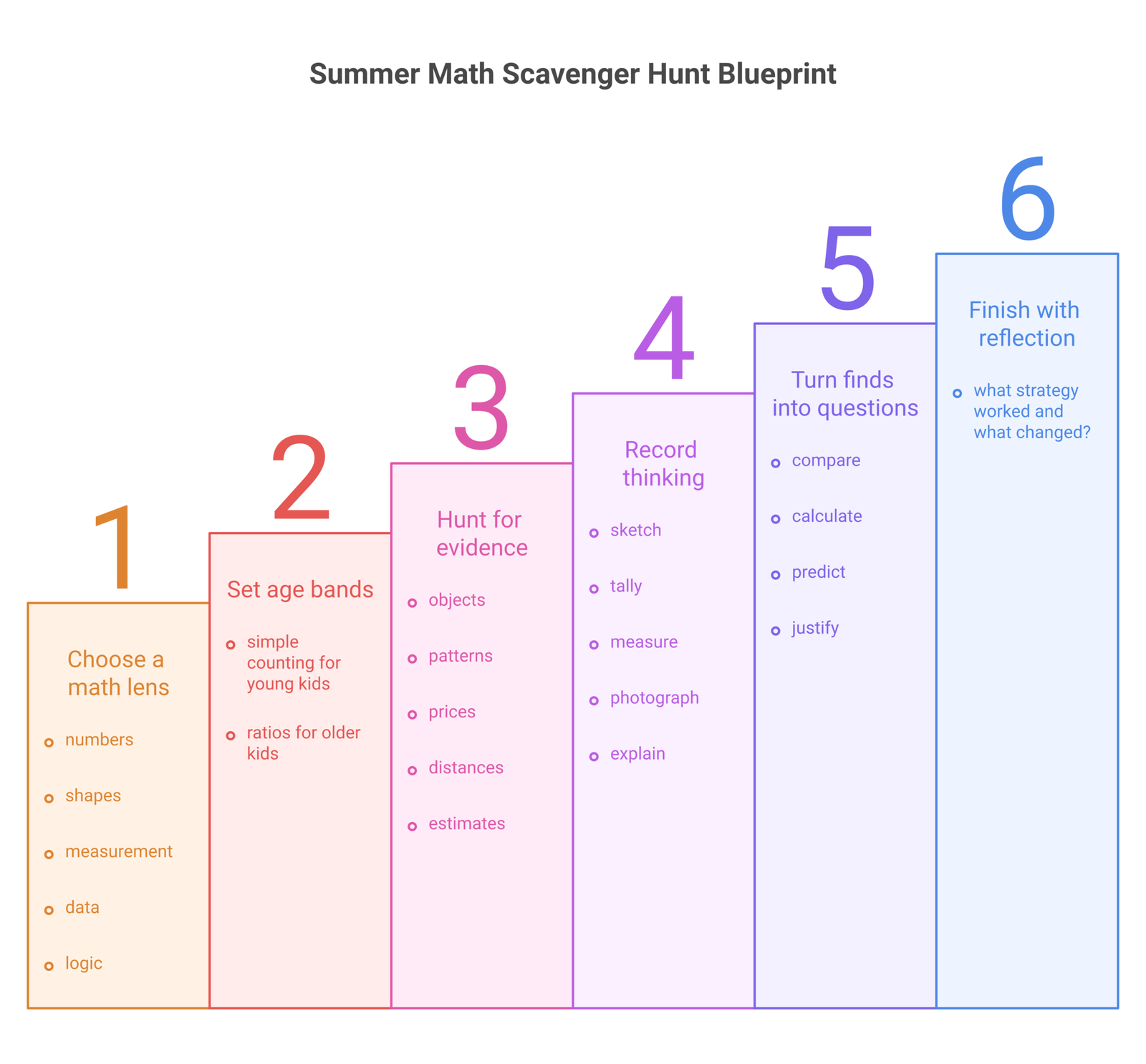
Step one is to choose a clear math lens. Do not write “find math” on a paper and hope for magic. Pick one focus: numbers, shapes, measurement, data, money, time, fractions, or logic. Step two is to set age bands. Ages 5–7 need concrete tasks like “find five circles” or “count ten steps.” Ages 8–10 can compare, estimate, tally, and measure. Ages 11–14 can calculate unit rates, percentages, probability, ratios, and simple algebraic rules.
Step three is to send children hunting for evidence. Evidence can be an object, a tally mark, a sketch, a photo, a measurement, or a short explanation. Step four is to turn each find into a question. “You found three rectangles” is fine, but “Which rectangle has the greatest area, and how do you know?” is better. Step five is to let children explain their thinking before correcting them. Step six is to finish with a small reflection: What strategy helped? What surprised you? What would you change next time?
This reflection piece is not fluff. The Education Endowment Foundation rates metacognition and self-regulation as a high-impact learning approach when children are taught to plan, monitor, and evaluate their work. In normal parent language, that means asking children to think about how they solved something, not just whether they got the answer.
💡 Keep it short
A strong hunt can take 15–25 minutes. If your family already uses a 15-minute summer routine, use the hunt as the active part and save written practice for another day.
Scavenger Hunt Ideas by Age
For ages 5–7, keep tasks visual and physical. Ask children to find three circles, two things longer than their hand, one object that is heavier than a spoon, five blue items, and a pattern that repeats. Let them point, touch, count aloud, and draw. At this age the best questions are concrete: How many? Which has more? Which is longer? What comes next?
For ages 8–10, add measurement and comparison. Ask children to estimate the length of a table, measure it, then calculate the difference between the estimate and the actual result. Ask them to find objects with perimeter, compare two containers, tally car colors on a walk, or create a bar chart from what they find. This connects beautifully with hands-on measurement activities.
For ages 11–14, make the hunt more strategic. Ask them to find a discount and calculate the final price, compare two package sizes by unit price, record five sports statistics and calculate averages, photograph examples of symmetry or angles, estimate the probability of drawing a certain color from a mixed bag, or design a scoring system for younger siblings. Older children need fewer items and better questions. Give them room to justify, challenge, and improve their answers.
📝 Mixed-age sibling trick
Use the same object but assign different questions. A beach ball can become counting for a six-year-old, circumference estimation for a ten-year-old, and surface-area reasoning for a thirteen-year-old.
Beach, Road Trip, Home, and Supermarket Versions
At the beach, ask children to collect shells in groups of five, compare footprints, estimate distances to a towel, build a sand shape with a specific perimeter, or create a repeating pattern with stones. In the car, hunt for numbers on license plates, add digits, compare speeds, estimate arrival time, or find geometric shapes in signs. At home, look for symmetry, arrays, fractions in food, clocks, calendars, and containers. At the supermarket, compare unit prices, estimate the total basket cost, calculate a discount, or identify the better value between two packages.
These versions matter because math sticks better when children see it in real life. The IES What Works Clearinghouse guide on mathematical problem solving recommends visual representations, multiple strategies, reflection, and precise math language. A supermarket hunt naturally invites all four: children see quantities, choose a strategy, explain their comparison, and use words like difference, total, estimate, per item, or percent.
If your child needs a calmer written bridge afterward, pair the hunt with printable addition worksheets for younger learners or a custom MathSpark sheet for older learners. The trick is to keep the written part connected to what they just noticed. “We counted shells, now let’s practice adding groups” feels coherent. Random drill after a fun activity feels like a trap. Children can smell that from three rooms away.
How to Turn Finds into Better Questions
The fastest way to improve a hunt is to upgrade the questions. Start with finding: “Find three objects shaped like rectangles.” Then ask comparison: “Which one has the largest area?” Then ask reasoning: “How could you prove it without measuring every side?” Then ask transfer: “Where else would this idea help?” This sequence moves children from noticing to thinking. It is also aligned with the elementary mathematics intervention guide from IES, which highlights clear language, representations, word problems, and systematic instruction for students who struggle with math.
Use sentence starters if your child freezes. Try: “I noticed…”, “I chose this because…”, “My estimate was…”, “I checked by…”, “Another way is…”. These small phrases make mathematical communication less intimidating. They also give parents a script, which is useful when everyone is hot, sandy, or halfway through a road trip.
Retrieval matters too. The Washington University retrieval practice guide explains that recalling information strengthens learning, and Retrieval Practice resources emphasize low-pressure recall over high-stakes testing. A scavenger hunt is retrieval practice in disguise: children recall shape names, operation facts, measurement ideas, and vocabulary while doing something playful. Add quick feedback and the learning gets stronger.
Sample Ready-to-Use Hunt List
- Find 4 examples of the same shape and explain what makes them match.
- Find something you can measure in centimeters and something better measured in meters.
- Find two prices or numbers and create an addition, subtraction, multiplication, or division question.
- Find a repeating pattern and predict the next three items.
- Find a real-life fraction, such as half a sandwich or one quarter of a towel.
- Estimate a distance, measure or pace it, then compare your estimate with the result.
- Create a tiny data set by tallying colors, objects, signs, shells, or sounds.
- Design one challenge for another family member and write the answer privately.
For more rich tasks, parents can borrow ideas from NRICH and Youcubed, both of which focus on reasoning, patterns, and mathematical discussion rather than speed alone. For skill review, Khan Academy is useful when a child needs a short explanation before trying a related hunt. For interactive exploration, Mathigon offers visual math experiences that pair well with geometry and pattern hunts.
How to Keep It Fun Instead of Turning It Into Homework
The biggest mistake is making the hunt too long. Ten good items beat thirty mediocre ones. Another mistake is correcting too fast. If a child calls an oval a circle, ask, “What do you notice about the sides?” rather than jumping in with a lecture. The third mistake is treating the hunt like a test. Keep points playful, let children challenge adults, and allow silly finds. A child who measures the dog’s tail is still measuring.
Use tools strategically. A ruler, tape measure, calculator, stopwatch, dice, coins, chalk, or camera can all support the activity. Let the child choose the tool and explain why. If you want digital options, Common Sense Media keeps curated lists of math games and apps, but the screen should support the hunt, not replace the thinking. Outside, kitchen, car, and supermarket math usually wins because it feels owned by the child.
To connect hunts with broader learning, link each game to a simple written output: one sketch, one equation, one sentence, one chart, or one custom worksheet. The summer math routine for kids approach works because it is light, consistent, and predictable. Children do better when practice feels like a rhythm, not a surprise inspection.
⚠️ Disclaimer
Educational guidance only. This article was prepared in June 2026 for parents and teachers. Adapt activities to your child’s age, safety needs, local curriculum, and confidence level.
Frequently Asked Questions
How long should a summer math scavenger hunt take?
Most families should aim for 15–25 minutes. Younger children often do best with 5–8 items, while older children can handle fewer items with deeper reasoning.
Can one hunt work for different ages?
Yes. Use the same object but change the question. A price tag can be counting for a young child, subtraction for an elementary child, and percentage reasoning for a middle school student.
Do scavenger hunts replace worksheets?
No. They build meaning and motivation. Worksheets still help with fluency when they are short, targeted, and connected to what the child explored.
What if my child hates math?
Start with movement, choice, and easy wins. Avoid timed pressure at first. Let your child create one challenge for you so the activity feels less one-sided.
How often should we do this in summer?
Once or twice per week is enough for most families, especially if you add short written practice or a quick worksheet on another day.